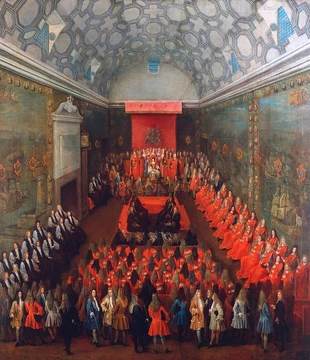
Leopold II, Holy Roman Emperor
Penultimate Holy Roman Emperor; abolished capital punishment in Tuscany.

Leopold II, born Peter Leopold Josef Anton Joachim Pius Gotthard in Vienna on 5 May 1747, served as the second-to-last Holy Roman Emperor. He also held the crowns of Hungary, Croatia, and Bohemia, and ruled as Archduke of Austria from 1790 until his death on 1 March 1792. Before that, he was Grand Duke of Tuscany (as Leopold I) from 1765 to 1790. His parents were Empress Maria Theresa and Emperor Francis I, making him brother to Queen Marie Antoinette of France, Queen Maria Carolina, Duchess Maria Amalia of Parma, and Emperor Joseph II. Like his brother Joseph, Leopold supported enlightened absolutism, though in a more moderate form. As a youth, Leopold was the third son and initially groomed for the clergy, receiving a theological education. In 1753, he was betrothed to Maria Beatrice d’Este, heir to the Duchy of Modena, but the marriage was never completed; she later wed his brother, Archduke Ferdinand. After his older brother Archduke Charles died young in 1761, the family decided Leopold would succeed his father as Grand Duke of Tuscany—a territory set aside as a secundogeniture for the second son. He married Maria Luisa, daughter of King Charles III of Spain, by proxy in Madrid on 16 February 1764, and in person on 5 August 1765. His father, Francis I, died on 18 August 1765, and Leopold became Grand Duke. For the first five years as Grand Duke, Leopold held little real power, with counsellors appointed by his mother running things. In 1770, he traveled to Vienna to end this arrangement and returned to Florence with full authority. Over the next twenty years, until his brother Joseph II died in 1790, he reformed Tuscany’s administration. He removed harsh restrictions on industry and personal freedom left by the Medici, introduced a fairer tax system with lower rates, and funded public works like draining the Valdichiana. With no army to maintain and having disbanded the small Medici navy, all revenue went to improving the state. Leopold was not popular with his subjects; he had a cold, reserved manner and simple, almost stingy habits, though he could show splendor when needed. This alienated those who had benefited from the old Medici abuses. Still, his steady, intelligent governance brought material prosperity. His ecclesiastical policies, which challenged deep-seated beliefs and put him at odds with the Pope, were less successful. He failed to secularize church property or fully bring clergy under state control. However, he permanently abolished the death penalty—the first such abolition in modern times. After effectively halting executions (the last was in 1769), he issued the Leopoldine Code on 30 November 1786, which banned capital punishment and ordered the destruction of execution tools. Torture was also outlawed. This act is commemorated annually on 30 November as the Feast of Tuscany, a custom started in 2000. Following Enlightenment ideas, he expanded La Specola museum with medical waxworks to teach Florentines about natural laws through observation. Leopold also helped draft a political constitution that foreshadowed the French constitution and shared features with the 1778 Virginia Bill of Rights. It emphasized citizens’ political rights and a balance between executive and legislative power. But it was never enacted because Leopold left for Vienna in 1790 to become emperor, and its radical nature faced opposition even from potential beneficiaries. He supported social reforms, making smallpox inoculation widely available and founding an early institution for juvenile delinquents. On 23 January 1774, he introduced Europe’s first law on the insane, allowing for the hospitalization of those deemed mentally ill. He later built the Bonifacio Hospital, appointing young physician Vincenzo Chiarugi to lead it. Chiarugi introduced humane regulations, including a ban on using chains for mental patients. Despite his short reign as emperor, Leopold is highly regarded. Historian Paul W.
- field
- Monarchy
- nationality
- Austrian
- known_for
- Abolition of death penalty and torture in Tuscany; moderate enlightened absoluti
Lore & Background
Leopold introduced the Leopoldine Code on 30 November 1786, which abolished the death penalty and ordered the destruction of all instruments for capital execution in Tuscany; torture was also banned. This made Tuscany the first nation in modern history to abolish the death penalty, an act commemorated since 2000 by the Feast of Tuscany every 30 November. He succeeded his childless eldest brother Joseph II in 1790 and lived for barely two years as emperor, during which he was hard pressed by peril from the growing revolutionary disorders in France that endangered his sister Marie Antoinette, and from the aggressive ambition of Catherine II of Russia and the unscrupulous policy of Prussia. He refused to be misled by Catherine's cunning and denied help to the émigrés who forced themselves on him.
Reader's Guide
Leopold II's significance lies in his brief but impactful reign as Holy Roman Emperor and his longer rule in Tuscany, where he implemented pioneering reforms. As Grand Duke, he removed ruinous restrictions on industry and personal freedom, introduced a rational system of taxation reducing rates, and executed profitable public works like draining the Valdichiana. He also introduced the 'legge sui pazzi' on 23 January 1774, the first law in Europe to hospitalize individuals deemed insane, and built the Bonifacio Hospital under Vincenzo Chiarugi, who banned chains and physical punishment. As emperor, he faced the growing French Revolution and sought to pacify his domains through concessions, though he also reversed some of his brother Joseph II's reforms, such as issuing a decree on 9 May 1790 that forced thousands of Bohemian serfs freed by Joseph back into servitude. His legacy is that of a shrewd, sensible monarch who balanced enlightened ideals with pragmatic governance, though his constitutional plans for Tuscany remained unrealized.
Did You Know?
- Leopold abolished the death penalty in Tuscany on 30 November 1786, making it the first nation in modern history to do so, and ordered the destruction of all instruments for capital execution.
- He introduced the 'legge sui pazzi' on 23 January 1774, the first law in Europe to allow hospitalizing individuals deemed insane, and later built the Bonifacio Hospital under Vincenzo Chiarugi, who banned chains and physical punishment.
- Leopold was initially selected for a clerical career and received an education focused on theology before becoming Grand Duke of Tuscany.
- He was married by proxy to Maria Luisa on 16 February 1764 in Madrid, more than a year before their in-person marriage on 5 August 1765.
- The historian Paul W. Schroeder called Leopold 'one of the most shrewd and sensible monarchs ever to wear a crown'.
Frequently Asked Questions
Why is Leopold II important in the context of enlightened absolutism?
He practiced what historians call moderate enlightened absolutism, using his sovereign power to implement progressive legal reforms rather than expanding autocratic control. His Tuscan reforms demonstrated that an absolute ruler could voluntarily limit state violence, influencing later liberal legal traditions across Europe.
More in Monarchs And Nobility 1-24
Spotted an error? Know more?
This is a living reference — every entry is fact-audited, and reader corrections feed straight into our audit queue. Suggest an edit · See this site's audit record