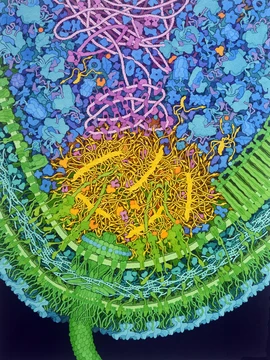
Signal transduction
Process transmitting signals through cells via molecular events.

Cells use signal transduction to turn a chemical or physical cue into a chain of molecular events inside the cell. The proteins that detect these cues are usually called receptors, though sometimes they are referred to as sensors. When a ligand binds to a receptor—or when the receptor senses a signal—it triggers a biochemical cascade, which is a series of steps known as a signaling pathway. These pathways often interact, forming networks that coordinate cellular responses through combinatorial signaling. At the molecular level, these responses can alter gene transcription or translation, change protein shape or location, or modify proteins after they are made. Such events are the core mechanisms behind cell growth, proliferation, metabolism, and many other functions. In multicellular organisms, these pathways regulate a wide variety of cell-to-cell communication.
The nature of the initial stimulus can vary widely. It might come from outside the cell, like the presence of epidermal growth factor (EGF), or from inside, such as DNA damage caused by telomere shortening during replication. Signals that reach the central nervous system are traditionally classified as senses and travel from neuron to neuron via synaptic transmission. Many other intercellular relay mechanisms exist in multicellular organisms, including those that guide embryonic development.
Most signaling pathways start when a signaling molecule, or ligand, binds to a receptor, causing a change in the receptor’s shape—a process called receptor activation. Most ligands are soluble molecules from the extracellular environment that bind to receptors on the cell surface. These include growth factors, cytokines, and neurotransmitters. Components of the extracellular matrix, like fibronectin and hyaluronan, also bind to surface receptors (integrins and CD44, respectively). Some molecules, such as steroid hormones, are lipid-soluble and cross the plasma membrane to reach receptors inside the cytoplasm or nucleus. When steroid hormone receptors are stimulated, they bind to the promoter regions of steroid-responsive genes.
Not all signaling molecules are classified by their molecular type. Odorants, for example, come from many different chemical classes, and neurotransmitters range from small molecules like dopamine to large neuropeptides like endorphins. Some molecules fit into more than one class—epinephrine acts as a neurotransmitter in the central nervous system and as a hormone when released by the adrenal medulla. Certain receptors, such as HER2, can become active without a ligand if they are overexpressed or mutated. This leads to constant pathway activation, which may or may not be counteracted by compensation. In HER2’s case, it acts as a partner for other epidermal growth factor receptors (EGFR), and its constitutive activation causes excessive cell growth and cancer.
In eumetazoans, most cells need to attach to a basement membrane to survive. This has led to complex mechanotransduction pathways that let cells sense how stiff their surroundings are. These signals are mainly orchestrated in focal adhesions, where the actin cytoskeleton bound to integrins detects changes and passes them downstream through YAP1. Calcium-dependent adhesion molecules like cadherins and selectins can also mediate mechanotransduction. Specialized mechanotransduction in the nervous system underlies hearing, touch, proprioception, and balance.
Controlling osmotic pressure—the difference in osmolarity between the cytosol and the extracellular medium—is critical for cellular and systemic homeostasis. Cells detect osmotic changes in three ways: through shifts in macromolecular crowding, ionic strength, or changes in the plasma membrane or cytoskeleton (the latter being a form of mechanotransduction). These changes are detected by proteins called osmosensors or osmoreceptors. In humans, the best-known osmosensors are transient receptor potential channels found in the primary cilium. In yeast, the HOG pathway is well studied.
Temperature sensing in cells is called thermoception and is mainly mediated by specific proteins.
Each component (or node) of a signaling pathway is classified by its role relative to the initial stimulus. Ligands are called first messengers, receptors are the signal transducers that activate primary effectors. These effectors are typically proteins and are often linked to second messengers, which can then activate secondary effectors, and so on. Depending on the efficiency of the nodes, a signal can be amplified—a concept called signal gain—so that one signaling molecule can trigger a response involving hundreds to millions of molecules. Like other signals, biological signal transduction involves delay, noise, feedback, feedforward, and interference, which can range from negligible to pathological. With the rise of computational biology, analyzing signaling pathways and networks has become essential for understanding cellular functions and diseases, including the signaling rewiring that underlies acquired drug resistance.
- field
- Cell biology and biochemistry
- known_for
- Transmission of chemical or physical signals through cells via molecular events
- key_concept
- Signaling pathways and networks
- components
- Receptors, ligands, first messengers, second messengers, effectors
Lore & Background
Signal transduction involves the transformation of a stimulus into a biochemical signal. Stimuli can range from extracellular cues, such as the presence of epidermal growth factor, to intracellular events like DNA damage from replicative telomere attrition. The majority of pathways involve the binding of signaling molecules, known as ligands, to receptors that trigger events inside the cell. Ligands include growth factors, cytokines, neurotransmitters, and steroid hormones, which may bind to cell surface or intracellular receptors. Some receptors, such as HER2, can be activated without a ligand when overexpressed or mutated, leading to constitutive pathway activation.
Reader's Guide
Signal transduction is fundamental to cellular function and organismal biology. It governs cell growth, proliferation, metabolism, and communication in multicellular organisms. The analysis of signaling pathways and networks has become essential for understanding cellular functions and disease, including signaling rewiring mechanisms underlying responses to acquired drug resistance. Each component of a signaling pathway is classified by its role relative to the initial stimulus: ligands are first messengers, receptors are signal transducers, and they activate primary effectors, often linked to second messengers. Signal amplification can occur, where one signaling molecule generates a response involving hundreds to millions of molecules. Transduction is characterized by delay, noise, feedback, feedforward, and interference, which can range from negligible to pathological.
Did You Know?
- Signal transduction can involve amplification, where one signaling molecule generates a response involving hundreds to millions of molecules.
- Some receptors, such as HER2, can be activated without a ligand when overexpressed or mutated, leading to constitutive pathway activation.
- Ligands are termed first messengers, while receptors are signal transducers that activate primary effectors.
- Signaling pathways interact to form networks, allowing coordinated cellular responses via combinatorial signaling events.
Frequently Asked Questions
What is Signal transduction?
Signal transduction is the cellular process in which a chemical or physical stimulus is relayed inward through a sequence of molecular events. It converts an external cue into a defined biochemical response inside the cell.
What are the main components of Signal transduction?
The core machinery includes receptors (or sensors) that detect the stimulus, ligands that bind to them, first and second messengers that propagate the signal, and effectors that carry out the final cellular action. Together these elements build the signaling cascade.
How does a signaling pathway differ from a signaling network?
A signaling pathway is a single chain of biochemical events set off when a ligand engages a receptor. When multiple pathways cross-talk and interact, they form a signaling network, enabling the cell to coordinate complex responses through combinatorial events.
Which fields of biology does Signal transduction belong to?
It sits at the intersection of cell biology and biochemistry. Understanding it is central to grasping how cells communicate with their environment and with one another.
Why is Signal transduction important?
It is the fundamental relay system that lets a cell interpret external cues—such as hormones, light, or mechanical force—and translate them into specific internal actions like growth or survival. Without this process, coordinated cellular behavior would be impossible.
More in Molecular Biology 1-18
Spotted an error? Know more?
This is a living reference — every entry is fact-audited, and reader corrections feed straight into our audit queue. Suggest an edit · See this site's audit record