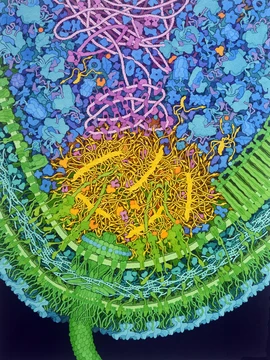
Post-translational modification
Covalent protein changes after synthesis, diversifying function beyond transcription.

Proteins are chemically altered after they are built and released from ribosomes through processes called post-translational modifications, or PTMs. These modifications are covalent changes that are often reversible, forming part of a larger system known as post-translational regulation, which governs the amount of active protein in a cell. An irreversible change in this context is proteolysis, where proteins are broken down. PTMs allow a protein to take on a wider range of functions than what is directly encoded by its gene. By 2023, over 650 distinct types of PTM had been identified. These modifications are not unique to eukaryotes; they also occur in prokaryotes.
PTMs can be carried out by enzymes or happen spontaneously. They are crucial for cell signaling—for instance, when prohormones are converted into active hormones. These modifications can target the side chains of amino acids or the ends of the protein chain (the C-terminus or N-terminus). They expand the chemical repertoire of the 22 standard amino acids by altering an existing functional group or adding a new one, such as a phosphate group. Phosphorylation is especially effective at controlling enzyme activity and is the most common PTM. Many proteins in both eukaryotes and prokaryotes also receive carbohydrate molecules through glycosylation, which helps with protein folding, stability, and regulation. The attachment of lipid molecules, called lipidation, often anchors a protein or part of it to the cell membrane.
Other PTMs involve cutting peptide bonds, such as when a propeptide is trimmed to its mature form or when the starting methionine residue is removed. The formation of disulfide bonds between cysteine residues is also considered a PTM. For example, the hormone insulin is cut twice after disulfide bonds form, and a middle section (a propeptide) is removed, leaving two polypeptide chains linked by disulfide bonds.
Some PTMs arise from oxidative stress. Carbonylation, for instance, marks a protein for degradation and can lead to the formation of protein clumps. Certain amino acid modifications can serve as biomarkers for oxidative damage. PTMs and metal ions work together in a reciprocal way to regulate protein function, influencing processes like signal transduction and gene expression. When these interactions go awry, they are linked to diseases such as cancer and neurodegenerative disorders.
The sites that commonly undergo PTM are those with a functional group that acts as a nucleophile: the hydroxyl groups of serine, threonine, and tyrosine; the amine groups of lysine, arginine, and histidine; the thiolate anion of cysteine; the carboxylates of aspartate and glutamate; and the N- and C-termini. Although the amide group of asparagine is a weak nucleophile, it can still serve as an attachment point for glycans. Rarer modifications occur on oxidized methionines and on some methylene groups in side chains.
PTMs can be detected experimentally using techniques like mass spectrometry, Eastern blotting, and Western blotting.
Modifications that add functional groups include the attachment of hydrophobic groups for membrane localization, such as myristoylation (adding a C14 saturated acid), palmitoylation (adding a C16 saturated acid), isoprenylation or prenylation (adding isoprenoid groups like farnesol or geranylgeraniol), and glypiation (forming a GPI anchor). Cofactors for enhanced enzymatic activity can also be added, including lipoylation, flavin moieties (FMN or FAD), heme C attachment via thioether bonds, phosphopantetheinylation, and retinylidene Schiff base formation. Translation factors undergo specific modifications like diphthamide formation, ethanolamine phosphoglycerol attachment, hypusine formation, and beta-lysine addition.
Smaller chemical groups added include acylation (O-, N-, or S-), acetylation (often at the N-terminus or on lysine), formylation, alkylation (such as methylation), amidation at the C-terminus, and monoaminylation (including dopaminylation, histaminylation, and serotonylation). Other additions involve amide bond formation, amino acid addition (like arginylation), polyglutamylation, and polyglycylation.
- field
- Biochemistry, molecular biology
- known_for
- Covalent modification of proteins after translation, expanding protein function beyond genetic code
- common_modification
- Phosphorylation
- detection_methods
- Mass spectrometry, Eastern blotting, Western blotting
Lore & Background
Post-translational modifications (PTMs) involve enzymes or occur spontaneously. Proteins are created by ribosomes, which translate mRNA into polypeptide chains, which may then change to form the mature protein product, released from the ribosome. PTMs are important components in cell signaling, as when prohormones are converted to hormones. They can occur on amino acid side chains or at the protein's C- or N-termini, expanding the chemical set of the 22 amino acids by changing an existing functional group or adding a new one such as phosphate.
Reader's Guide
Post-translational modifications are fundamental to cellular regulation, enabling rapid, reversible control of protein activity without altering gene expression. Phosphorylation is the most common change after translation and is highly effective for controlling enzyme activity. Glycosylation, the attachment of carbohydrate molecules, promotes protein folding and improves stability as well as serving regulatory functions. Lipidation often targets a protein to the cell membrane. PTMs also include cleaving peptide bonds, as in processing a propeptide to a mature form, and disulfide bond formation. Some PTMs, like carbonylation, are consequences of oxidative stress and can target proteins for degradation or form aggregates. PTMs and metal ions play a crucial reciprocal role in regulating protein function, influencing signal transduction and gene expression, with dysregulated interactions implicated in diseases like cancer and neurodegenerative disorders. Sites that often undergo PTM include the hydroxyl groups of serine, threonine, and tyrosine; the amine forms of lysine, arginine, and histidine; the thiolate anion of cysteine; the carboxylates of aspartate and glutamate; and the N- and C-termini. Detection is achieved via mass spectrometry, Eastern blotting, and Western blotting.
Did You Know?
- Phosphorylation is the most common change after translation.
- PTMs are also prokaryotic processes.
- Carbonylation is a PTM that can result in the formation of protein aggregates.
More in Molecular Biology 1-18
Spotted an error? Know more?
This is a living reference — every entry is fact-audited, and reader corrections feed straight into our audit queue. Suggest an edit · See this site's audit record