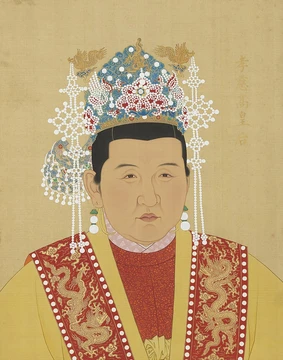
Empress Zhang (Hongzhi)
Only empress of an adult emperor with no concubines.
Last updated
Empress Xiaochengjing (1471–28 August 1541), of the Zhang clan, was a Chinese empress consort of the Ming dynasty. She was married to the Hongzhi Emperor and was the mother of the Zhengde Emperor. She is notable as the only empress to an adult emperor who had no concubines in Chinese history.
Empress
Empress Zhang was the daughter of Zhang Luan and was born in Xingji, now Cang county, Hebei province. She married the then-Crown Prince Youcheng in 1487, becoming crown princess, and was created empress when her husband succeeded the throne later that year.
She is described as a foolish and demanding woman, capable of no more than petty faults, including a constant desire for expensive objects, credulity toward Buddhist and Taoist clerics, and limitless favor for her family. Her brothers Zhang Heling and Zhang Yanling, with support from her and her mother Lady Jin, misused their high position. After the Hongzhi Emperor died in 1505, her son became the Zhengde Emperor, and she was created empress dowager, receiving the title Cishou in 1510.
Later Life
After the childless Zhengde Emperor died in 1521, his cousin Zhu Houcong ascended as the Jiajing Emperor. A crisis arose when Jiajing's mother, Lady Jiang, arrived at Tongzhou and heard she would be received as a princess rather than an empress, and that her son was pressured to call her his aunt. She threatened to return to Anlu with her son, who informed Empress Dowager Zhang he intended to abdicate. An edict under Empress Dowager Zhang's seal then gave Lady Jiang an imperial title.
Empress Dowager Zhang continued to regard Lady Jiang as an unimportant princess, receiving her with courtesies proper for an imperial princess, which infuriated the emperor and his mother. Thereafter, Jiajing used every means to humiliate and intimidate Empress Dowager Zhang and her family. In 1522, Jiajing married Lady Chen, chosen by Empress Dowager Zhang as his empress, but he did not warm to her. In spring 1524, Jiajing refused Empress Dowager Zhang a formal audience on her birthday, while honoring his own mother's birthday with elaborate ceremonies; officials who protested were arrested.
On April 15, 1525, a fire destroyed Empress Dowager Zhang's residential palace, forcing her to move to a smaller palace. The emperor initially approved rebuilding on a smaller scale but later suggested stopping work, ostensibly to ease the burden on subjects. Grand secretary Fei Hung noted she was not at ease, but the emperor was unmoved. In October, the minister of works suggested halting several building projects; the emperor agreed on condition that work on her palace be halted as well.
Patronage of art
The art of the Ming dynasty reflected the power acquired by Empress Zhang and other courtly women during her reign. A handscroll known as the Ordination Scroll, depicting her ordination as a Taoist priestess in 1493, is attributed to her. The original artist is unknown, and the scroll is at the San Diego Museum of Art. It includes a group of divine women called jade maidens, the Taoist priest who ordained her, and several deities.
Empress Zhang also influenced artworks by Wu Wei and possibly his colleagues, as well as paintings attributed to Zhang Lu. Another painting, Su Shi Returning to Court, a handscroll commonly attributed to Zhang Lu, seems to pertain to her; Jennifer Purtle argues she used it to compare herself to historical empresses. Empress Zhang understood art's influence in validating her power, which Purtle describes as dominated—subtle and indirect—and her influence cleared the way for other court women to gain power.
More in Ming Dynasty Empresses
Sources
Compiled from Wikipedia and the sources listed below. Text from Wikipedia is available under CC BY-SA 4.0; this entry is adapted from it.
- Wikipedia: Empress Zhang (Hongzhi) (CC BY-SA 4.0).
Spotted an error? Know more?
Reader corrections go straight into our review queue. Suggest an edit · How this site is sourced