Bornite
An iridescent copper ore named for mineralogist Ignaz von Born.

Bornite, often called peacock ore, is a sulfide mineral with the formula Cu5FeS4. It crystallizes in the orthorhombic system (pseudo-cubic) and serves as a significant source of copper. Fresh surfaces display a brown to copper-red hue, but these quickly tarnish into iridescent blues and purples, which is why it is nicknamed peacock copper or peacock ore.
As a key copper ore mineral, bornite is widespread in porphyry copper deposits, usually alongside the more common chalcopyrite. In the supergene enrichment zone of copper deposits, both chalcopyrite and bornite are typically replaced by chalcocite and covellite. Bornite also appears as disseminations in mafic igneous rocks, contact metamorphic skarn deposits, pegmatites, and sedimentary cupriferous shales. Its copper content is about 63 percent by mass, making it an important ore.
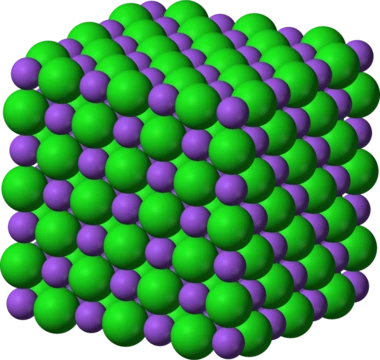
At temperatures above 228 °C (442 °F), bornite’s structure is isometric, with a unit cell roughly 5.50 Å on an edge. This structure features cubic close-packed sulfur atoms, with copper and iron atoms randomly occupying six of the eight tetrahedral sites in the cube’s octants. Upon cooling, the iron and copper atoms become ordered: 5.5 Å subcells where all eight tetrahedral sites are filled alternate with subcells where only four are filled, reducing the symmetry to orthorhombic.
The relative amounts of copper and iron can vary substantially, with solid solution extending toward chalcopyrite (CuFeS2) and digenite (Cu9S5). Exsolution of blebs and lamellae of chalcopyrite, digenite, and chalcocite is common.
Rare crystals are roughly cubic, dodecahedral, or octahedral, but bornite is usually massive. Penetration twinning occurs on the crystallographic direction {111}.
Bornite occurs globally in copper ores. Notable crystal localities include Butte, Montana, and Bristol, Connecticut, in the U.S.; the Carn Brea mine, Illogan, and elsewhere in Cornwall, England; the Frossnitz Alps in eastern Tirol, Austria; the Mangula mine in the Lomagundi district, Zimbabwe; the N'ouva mine at Talate, Morocco; the West Coast of Tasmania; and Dzhezkazgan, Kazakhstan. Traces are also found among hematite in the Pilbara region of Western Australia. Bornite has also been discovered on historical copper and bronze artifacts exposed to hot mineral spring environments, though such a patina is considered rare.
First described in 1725 from an occurrence in the Ore Mountains, Bohemia (now the Karlovy Vary Region of the Czech Republic), it was named in 1845 for Austrian mineralogist Ignaz von Born. Bornite has been recognized as a copper-bearing mineral since antiquity, though it was often confused with other copper sulfides due to similar appearance and association in ore deposits. Early civilizations mined bornite-bearing ores for copper to produce tools, weapons, ornaments, coins, and other objects, supporting the Bronze Age and later metalworking cultures. As mining and mineralogical science advanced during the 18th and 19th centuries, bornite was identified as a distinct mineral and grew in importance as a copper ore. During the Industrial Revolution, large hydrothermal copper deposits containing bornite were extensively mined to meet rising demand for copper in electrical wiring, steam engines, machinery, construction, and transportation. In the 20th century, improvements in geological exploration, ore processing, and metallurgical extraction allowed efficient recovery of copper from lower-grade bornite-bearing deposits, further boosting its economic value. Due to its high copper content and frequent association with other valuable sulfide minerals, bornite has remained one of the world's most significant secondary copper ores and has played an important role in the history of copper mining and metallurgy.
- chemical_formula
- Cu5FeS4
- crystal_system
- Orthorhombic (pseudo-cubic)
- copper_content
- About 63 percent by mass
- color
- Brown to copper-red, tarnishing to iridescent blue and purple
- named_after
- Austrian mineralogist Ignaz von Born
Lore & Background
Bornite, often called peacock ore due to its vivid iridescence, displays a brown to copper-red color on freshly broken surfaces. Upon exposure to air, these surfaces tarnish into striking shades of blue and purple, creating the colorful play of light that gives the mineral its common nickname. It crystallizes in the orthorhombic system, though its structure is pseudo-cubic; at high temperatures, the arrangement is isometric with a cubic close-packed sulfur framework, but cooling orders the copper and iron atoms, reducing symmetry. Rare crystals are approximately cubic, dodecahedral, or octahedral, but the mineral is usually found in massive form. Penetration twinning occurs along the {111} direction. Bornite is an important copper ore, containing about 63 percent copper by mass. It occurs globally in copper deposits, notably in porphyry copper systems alongside chalcopyrite, and both are often replaced by chalcocite and covellite in supergene enrichment zones. The mineral also appears as disseminations in mafic igneous rocks, contact metamorphic skarns, pegmatites, and sedimentary cupriferous shales. Notable crystal localities include Butte, Montana; Bristol, Connecticut; the Carn Brea mine in Cornwall, England; the Frossnitz Alps in Austria; the Mangula mine in Zimbabwe; and Dzhezkazgan, Kazakhstan. Traces occur in hematite of the Pilbara region, Western Australia. Bornite has been known since antiquity, often confused with other copper sulfides, and was first described in 1725 from the Ore Mountains, Bohemia, later named in 1845 for Austrian mineralogist Ignaz von Born. It has been mined for copper since the Bronze Age and became increasingly important during the Industrial Revolution for electrical and industrial uses.
Reader's Guide
Bornite has been recognized as a copper-bearing mineral since antiquity, though often confused with other copper sulfides. Early civilizations mined bornite-bearing ores for copper to produce tools, weapons, ornaments, and coins, supporting the Bronze Age and later metalworking cultures. During the Industrial Revolution, large hydrothermal deposits containing bornite were extensively mined to meet demand for copper in electrical wiring, steam engines, machinery, construction, and transportation. In the 20th century, improvements in exploration, ore processing, and metallurgical extraction made recovery from lower-grade deposits more efficient. Because of its high copper content and frequent association with other valuable sulfide minerals, bornite has remained one of the world's most significant secondary copper ores and has played an important role in the history of copper mining and metallurgy.
Did You Know?
- Bornite is also known as peacock ore due to its iridescent blue and purple tarnish.
- Rare crystals of bornite are approximately cubic, dodecahedral, or octahedral, but it is usually massive.
- Bornite has been found on historical copper and bronze artifacts exposed to hot mineral spring environments.
More in Minerals & Crystals 1-24
Spotted an error? Know more?
This is a living reference — every entry is fact-audited, and reader corrections feed straight into our audit queue. Suggest an edit · See this site's audit record