Mountain ration
Compact high-altitude ration for alpine troops in World War II.
The Mountain Ration, also called the M-Ration, was a compact U.S. military meal designed for troops in high-altitude areas of World War II's European theater. It was created to be easily prepared in cold, mountainous conditions.
Quick Facts
- Adopted
- November 1942
- Production period
- 1942 to 1943
- Serving size
- Four men for one day (three meals per man)
- Weight per ration
- less than 40 oz
- Developed by
- U.S. Army officers in experimental mountain warfare companies, Quartermaster Corps' Subsistence Research Laboratory
Facts from the source article.
Origin, development, and use
The Mountain ration was created from ideas developed between 1941 and 1942 by U.S. Army officers serving in experimental mountain warfare units. Many of these men were former ski instructors, forest rangers, and other experienced alpine travelers. Their suggestions were used by staff at the Quartermaster Corps' Subsistence Research Laboratory in Chicago to finalize and package the ration for mountain and alpine troops. Designed for high-altitude conditions, it was a compact, specialized ration that was easier to prepare at elevation, provided adequate roughage, and had enough bulk and quantity when heated to feed four men for one day. Each man’s daily portion contained 4,800 calories, and the entire four-man package weighed less than 40 ounces. The ration was officially adopted in November 1942 and produced from 1942 to 1943. It was issued to elite U.S. and British Commonwealth forces training for alpine or winter combat, most notably the 10th Mountain Division and the First Special Service Force. Each package served four men for one day, providing three meals per man. It was usually prepared at the platoon or squad level, though soldiers of the 10th Division were also taught to prepare it individually. The First Special Service Force tested the ration on November 28, 1942, during a training patrol to MacDonald Pass, Montana. The ration came in four varieties, packed in boxes containing enough for four men for three meals. Soldiers found this amount more than the average man could eat. The contents included powdered soup and milk, canned meat and butter, cereal, chocolate, biscuits, compressed fruits, sugar, tea, coffee, and powdered lemon.
Contents
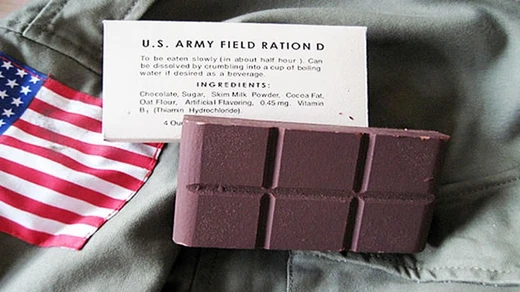
The mountain ration contained biscuits, Carter's spread (a butter substitute), cereal (three different variations), corned beef, dehydrated baked beans, dehydrated cheese, dehydrated potatoes, dehydrated soup, D ration bars, fruit bars, granulated sugar, chewing gum, hard candy, lemon-juice powder, pork luncheon meat, pork sausage meat, powdered milk, precooked rice, salt, instant coffee, tea, and toilet paper. The 10th Mountain Division's officers and NCOs, many with a pre-war background in high altitude and alpine cooking, were known to significantly augment the Mountain ration with a stocked supply of numerous additional ingredients and spices.
More in Military Food of the United States
Spotted an error? Know more?
Reader corrections go straight into our review queue. Suggest an edit · How this site is sourced