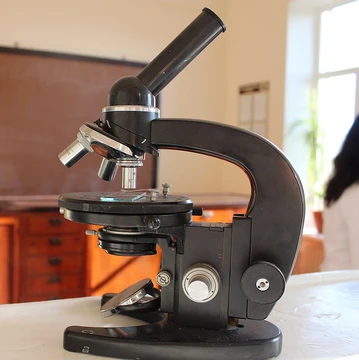
Campani compound microscope
A 17th-century compound microscope attributed to Giuseppe Campani.
The Campani compound microscope is a microscope on exhibit at the Museo Galileo in Italy. It was thought to have been built by Italian scientist Galileo Galilei but no longer bears that attribution. The instrument is now attributed to optical instrument maker Giuseppe Campani, who worked in the second half of the 17th century.
Quick Facts
- Maker
- Giuseppe Campani
- Date
- second half 17th century
- Location
- Museo Galileo, Italy
- Objective lens diameter
- 11 mm / 0.433 in
- Objective lens thickness
- 3.5 mm / 0.138 in
- Field lens diameter
- 30 mm / 1.18 in
- Field lens thickness
- 4.7 mm / 0.185 in
Facts from the source article.
Description
This compound microscope, housed at the Museo Galileo, is constructed from cardboard, leather, and wood, and fits into an iron stand with three curved legs. Its outer tube is wrapped in green vellum adorned with gold tooling. The instrument contains three double-convex lenses: an objective, a field lens, and an eyepiece. The objective lens is 11 mm across and 3.5 mm thick, made of clear glass with few flaws and a ground edge that shows some small chips. The field lens, 30 mm in diameter and 4.7 mm thick, sits in a cell that slides into the bottom of the inner tube; its glass has an amber-green tint, contains air bubbles, and has a chipped ground edge. The eyepiece, with an opening of 24 mm, also has some bubbles and is shielded by a wooden cap that screws onto its mount. This microscope is credited to Giuseppe Campani, an Italian optician and astronomer active in Rome during the second half of the 1600s, renowned for his skill in grinding lenses and making instruments. Compound microscopes first emerged in Europe around 1620, with one demonstrated by Cornelis Drebbel in London about 1621 and another shown in Rome in 1624. This particular instrument was once thought to have been made by Galileo, but that claim is no longer accepted. Galileo had used his 1609 telescope—which combined a concave eyepiece with a convex objective—either forward or backward to examine small objects like flies up close, though it was not a practical microscope. After seeing Drebbel’s compound microscope, which used two convex lenses, at the 1624 Rome exhibition, Galileo built his own improved version. In 1625, Giovanni Faber, a member of the Accademia dei Lincei, coined the term “microscope” (microscopio) for Galileo’s “small eyeglass” (occhialino).
More in Microscopes
Spotted an error? Know more?
Reader corrections go straight into our review queue. Suggest an edit · How this site is sourced