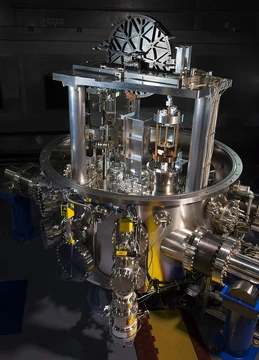
Caesium standard

The caesium standard is a primary frequency standard that works by using the absorption of photons during transitions between the two hyperfine ground states of caesium-133 atoms to regulate the output frequency. The first caesium clock was constructed by Louis Essen in 1955 at the National Physical Laboratory in the UK, and it was promoted globally by Gernot M. R. Winkler of the United States Naval Observatory. These atomic clocks are among the most precise time and frequency standards available, and they serve as the primary reference for defining the second within the International System of Units (SI). By definition, the radiation from the transition between the two hyperfine ground states of caesium-133, when free from external influences like Earth's magnetic field, has a frequency, ΔνCs, of exactly 9,192,631,770 Hz. This value was selected so that the caesium second matched, within the measurement limits of 1960 when it was adopted, the existing ephemeris second based on Earth's orbit around the Sun. Since no other time measurement had been as precise, the change had an effect smaller than the experimental uncertainty of all prior measurements.
Although the second is the only base unit explicitly defined by the caesium standard, most other SI units have definitions that reference either the second or units derived from it. As a result, every base unit except the mole, and every named derived unit except the coulomb, gray, sievert, radian, and steradian, have values implicitly at least partially defined by the properties of the caesium-133 hyperfine transition radiation. Among these, all but the mole, coulomb, and the dimensionless radian and steradian are implicitly defined by the general properties of electromagnetic radiation.
The official definition of the second was first given by the BIPM at the 13th General Conference on Weights and Measures in 1967: "The second is the duration of 9,192,631,770 periods of the radiation corresponding to the transition between the two hyperfine levels of the ground state of the caesium 133 atom." In 1997, the BIPM added the specification: "This definition refers to a caesium atom at rest at a temperature of 0 K." At its 26th conference in 2018, the BIPM restated the definition: "The second is defined by taking the fixed numerical value of the caesium frequency ∆νCs, the unperturbed ground-state hyperfine transition frequency of the caesium 133 atom, to be 9 192 631 770 when expressed in the unit Hz, which is equal to s−1."
The caesium atom has a ground state electron configuration of [Xe] 6s1 and an atomic term symbol of 2S1/2, meaning it has one unpaired electron and a total electron spin of 1/2. Its nucleus has a nuclear spin of 7/2. The simultaneous presence of electron and nuclear spins causes a hyperfine interaction that splits all energy levels into two sub-levels. One sub-level has parallel electron and nuclear spins, giving a total spin F = 4; the other has anti-parallel spins, giving F = 3. The lower-energy sub-level is F = 3, while F = 4 is slightly higher. When the atom is irradiated with electromagnetic radiation whose energy matches the difference between these sub-levels, the radiation is absorbed, exciting the atom from F = 3 to F = 4. After some time, the atom re-emits the radiation and returns to the F = 3 ground state. The radiation has a frequency of exactly 9.19263177 GHz, corresponding to a wavelength of about 3.26 cm, placing it in the microwave range.
A common confusion involves converting between angular frequency (ω) and frequency (f). Angular frequencies are often given as s−1 in scientific literature, but this implicitly means radians per second. The unit Hz should be interpreted as cycles per second. The conversion formula is ω = 2πf, meaning 1 Hz corresponds to an angular frequency of about 6.28 radians per second (or 6.28 s−1, with radians omitted by convention).
The caesium standard has parameters including velocity (c), energy/frequency (h), time period (ΔtCs), frequency (ΔνCs), wavelength (ΔλCs), photon energy (ΔECs), and photon mass equivalent (ΔMCs). The first units defined using the caesium standard were those related to time. In 1967, the second was defined as "the duration of 9,192,631,770 periods of the radiation corresponding to the transition between the two hyperfine levels of the ground state of the caesium 133 atom." This means: 1 second (s) equals 9,192,631,770 ΔtCs; 1 hertz (Hz) equals 1/s, or ΔνCs/9,192,631,770; and 1 becquerel (Bq) equals 1 nuclear decay per second, or 1/9,192,631,770 nuclear decays per ΔtCs. This also linked the definitions of derived units for force and energy, as well as the ampere (which at the time referenced the newton), to the caesium standard. Before 1967, the SI units of time and frequency were defined using the tropical year, and before 1960, other standards were used.
- first caesium clock built
- 1955
- built by
- Louis Essen
- location
- National Physical Laboratory, UK
- promoted by
- Gernot M. R. Winkler of the United States Naval Observatory
- SI base unit defined
- second
Verified Timeline
Lore & Background
The first caesium clock was built by Louis Essen in 1955 at the National Physical Laboratory in the UK and promoted worldwide by Gernot M. R. Winkler of the United States Naval Observatory. By definition, radiation produced by the transition between the two hyperfine ground states of caesium-133 (in the absence of external influences such as the Earth's magnetic field) has a frequency, ΔνCs, of exactly 9192631770 Hz. That value was chosen so that the caesium second equaled, to the limit of measuring ability in 1960 when it was adopted, the existing standard ephemeris second based on the Earth's orbit around the Sun. Because no other measurement involving time had been as precise, the effect of the change was less than the experimental uncertainty of all existing measurements.
Reader's Guide
The official definition of the second was first given by the BIPM at the 13th General Conference on Weights and Measures in 1967 as: 'The second is the duration of 9192631770 periods of the radiation corresponding to the transition between the two hyperfine levels of the ground state of the caesium 133 atom.' At its 1997 meeting the BIPM added to the previous definition the following specification: 'This definition refers to a caesium atom at rest at a temperature of 0 K.' The BIPM restated this definition in its 26th conference (2018), 'The second is defined by taking the fixed numerical value of the caesium frequency ∆νCs, the unperturbed ground-state hyperfine transition frequency of the caesium 133 atom, to be 9 192 631 770 when expressed in the unit Hz, which is equal to s−1.' While the second is the only base unit to be explicitly defined in terms of the caesium standard, the majority of SI units have definitions that mention either the second, or other units defined using the second. Consequently, every base unit except the mole and every named derived unit except the coulomb, gray, sievert, radian, and steradian have values that are implicitly at least partially defined by the properties of the caesium-133 hyperfine transition radiation.
Did You Know?
- The caesium standard's frequency, ΔνCs, is exactly 9,192,631,770 Hz, chosen so that the caesium second equaled the existing standard ephemeris second to the limit of measuring ability in 1960.
- The first caesium clock was built by Louis Essen in 1955 at the National Physical Laboratory in the UK.
- The official definition of the second was first given by the BIPM at the 13th General Conference on Weights and Measures in 1967.
- At its 1997 meeting, the BIPM added that the definition refers to a caesium atom at rest at a temperature of 0 K.
- The caesium-133 hyperfine transition radiation has a wavelength of about 3.26 cm, belonging to the microwave range.
The End of the Artifact Era
By May 2019, the entire architecture of international measurement had finally shed its last dependence on a physical object. The prototype kilogram, the final artefact anchoring the system, was retired so that every base unit could instead be derived from immutable physical constants. This philosophical reorientation placed disciplines such as time and frequency—identified by the International Bureau of Weights and Measures as one of nine core metrology areas—on firmer theoretical ground. Rather than pointing to a bar of metal stored in a vault, the definition of a second now rests on the natural behaviour of atoms, a principle no human hand can alter or degrade. The motivation was straightforward: a system built on constants is universally reproducible, immune to wear, and accessible to any laboratory equipped with the right instrumentation. The shift also broadened the BIPM's original mission, which had begun with length and mass standards, into electrical, photometric, and ionizing radiation domains, all now unified under a single constants-based framework.
The Institutional Backbone
No single nation can police the accuracy of every measurement made on its soil, so a layered architecture of institutions was built to do it collectively. The Metre Convention gave birth to the Bureau International des Poids et Mesures, originally tasked with forging international standards and tying them to national ones so that a kilogram in Paris and a kilogram in Tokyo meant the same thing. Over time the BIPM's remit expanded well beyond its founding scope, now encompassing electrical units, photometric standards, and ionizing radiation measurement. At the national level, every country maintains what is called a national measurement system: a web of laboratories, calibration facilities, and accreditation bodies that implement and sustain the metrology infrastructure. These national networks determine how measurements are actually performed domestically and whether the international community recognises them. The BIPM also keeps a peer-reviewed database of institutes worldwide, providing the fundamental reference points from which all traceability chains ultimately flow.
A Long Road to Agreement
The impulse to agree on a single length, a single weight, a single time is as old as civilisation itself. In 2900 BC, Egyptian scribes carved the royal cubit—defined as the Pharaoh's forearm plus the width of his hand—into black granite and distributed replicas to builders; the resulting pyramids show base lengths varying by no more than half a percent. In China, weights and measures carried a quasi-religious significance, appearing alongside ritual utensils in the Book of Rites. Roman and Greek architects each worked within their own distinct systems, but the collapse of those empires and the centuries of fragmentation that followed scattered much of that knowledge. England's Assize of Measures in 1196 and the wine-and-beer clause in the 1215 Magna Carta represent early attempts at statutory standardisation. The modern break came with the French Revolution, when political will to harmonise units across the country led to the metre being defined in March 1791 from a natural source, and a decimal metric system being formalised in 1795.
Three Pillars, Three Fields
The BIPM frames metrology as the science of measurement, covering both experimental and theoretical determinations at whatever level of uncertainty, in whatever field of science or technology. Its work rests on three overlapping pillars: defining internationally accepted units, realising those units in practical form, and maintaining chains of traceability that link any measurement in the field back to a reference standard. These pillars are exercised to different degrees across three sub-fields. Scientific or fundamental metrology sits at the top, pursuing the highest possible accuracy and developing new measurement methods. Applied, technical, or industrial metrology translates that precision into manufacturing and everyday processes. Legal metrology enforces statutory requirements on measuring instruments and methods. Together they ensure that a measurement made in a factory, a hospital, or a trading post is not merely a number but a value the international community can verify, trust, and rely upon for fair commerce and public safety.
More in Metrology 1-24
Spotted an error? Know more?
This is a living reference — every entry is fact-audited, and reader corrections feed straight into our audit queue. Suggest an edit · See this site's audit record