Hail
Solid precipitation in the form of balls or irregular lumps of ice, produced by thunderstorms.
Last updated
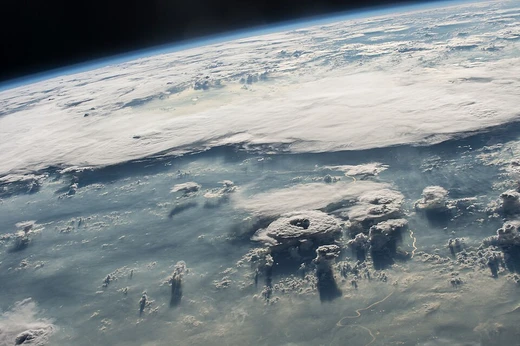
Hailstones usually measure between 5 mm and 15 cm in diameter, unlike ice pellets, graupel, or snow.[1] Hail is possible during most thunderstorms, as it is produced by cumulonimbus clouds.[2] Solid precipitation in the form of ice balls or irregular lumps, each termed a hailstone, is what hail is.[3]
Key facts and history
If it moves into an area where mostly water vapor is available, it acquires a layer of opaque white ice.[4] Hail can undergo "wet growth," where the outer layer is sticky, allowing a single hailstone to grow by collision with smaller hailstones.[5] Strong thunderstorm clouds characterized by intense updrafts, high liquid-water content, great vertical extent, large water droplets, and a substantial portion of the cloud layer below freezing are the environments where hail forms.[6] Upward wind speeds within the storm's updraft can reach 110 mph, propelling developing hailstones upward through the cloud.[7]
Variations in humidity and the concentration of supercooled water droplets in different cloud areas are encountered by a rising hailstone, and these variations alter its rate of growth.[4] "Dry growth" is another mode of hail formation; in this process, the latent heat released by freezing is insufficient to maintain a liquid outer layer, resulting in opaque ice that contains trapped air bubbles.[8] A hailstone will continue to ascend until its weight exceeds the force of the updraft, a process that can require at least 30 minutes.[9] Mid-latitude continental interiors are where hail occurs most frequently, because the freezing level is often below 11,000 ft in those regions.[10]
What the research sources say
The Encyclopedia of World Climatology notes that mountainous northern India is one of the more common regions for large hail, and that China also experiences significant hailstorms.[11][12] According to the Encyclopedia of World Climatology, during the Middle Ages people in Europe rang church bells and fired cannons to try to prevent hail and crop damage.[11][13] The Encyclopedia of World Climatology also reports that cloud seeding after World War II was used to attempt to eliminate the hail threat, particularly across the Soviet Union.[11][13] The Denver Post article notes that a meteorologist called the event "a very interesting phenomenon" that "produced copious amounts of hail in one small area".[14]
According to the same source, wheat, corn, soybeans, and tobacco are the crops most vulnerable to hail damage, and hail represents one of Canada's costliest hazards.[11][15] A Denver Post article dated June 5, 2015, reported that a single city block in Denver, Colorado, was buried under hail up to four feet deep.[14] That same article noted that the hailstones ranged in size from bumble bees to ping pong balls and that the hail fell for a duration of one and a half hours.[14]
References
- Wikipedia, "Hail" (CC BY-SA 4.0), which cites: "hail", nationalgeographic.org, 21 January 2011 (original not read by us) en.wikipedia.org
- Wikipedia, "Hail" (CC BY-SA 4.0), which cites: "Hail", Glossary of Meteorology, 2009 (original not read by us) en.wikipedia.org
- Wikipedia, "Hail" (CC BY-SA 4.0), which cites: "hail", nationalgeographic.org, 21 January 2011; "What's the difference between hail, sleet, and freezing rain?", The Straight Dope, 1999-08-06; "hailstone" (original not read by us) en.wikipedia.org
- Wikipedia, "Hail" (CC BY-SA 4.0), which cites: Nelson, "The Influence of Storm Flow Struce on Hail Growth", Journal of the Atmospheric Sciences, August 1983, p. 1965–1983 (original not read by us) en.wikipedia.org
- Wikipedia, "Hail" (CC BY-SA 4.0), which cites: Brimelow, "Modeling Maximum Hail Size in Alberta Thunderstorms", Weather and Forecasting, 2002, p. 1048–1062 (original not read by us) en.wikipedia.org
- Wikipedia, "Hail" (CC BY-SA 4.0), which cites: "Hail", Glossary of Meteorology, 2009; "Hail...", National Weather Service Forecast Office, 2009-01-27; "Forecasting Hail", theweatherprediction.com (original not read by us) en.wikipedia.org
- Wikipedia, "Hail" (CC BY-SA 4.0), which cites: "Hail", ncar.ucar.edu, 2008 (original not read by us) en.wikipedia.org
- Wikipedia, "Hail" (CC BY-SA 4.0), which cites: Rauber, "Severe & Hazardous Weather", Kendall/Hunt Publishing Company, 2012 (we also read that source) en.wikipedia.org
- Wikipedia, "Hail" (CC BY-SA 4.0), which cites: Marshall, "Hail Fact Sheet", University Corporation for Atmospheric Research, 2000-04-10 (original not read by us) en.wikipedia.org
- Wikipedia, "Hail" (CC BY-SA 4.0), which cites: Wolf, "Meso-Analyst Severe Weather Guide", University Corporation for Atmospheric Research, 2003-01-16 (original not read by us) en.wikipedia.org
- Open Library record, ISBN 9781402032646 ("Encyclopedia of world climatology"). CC0 (metadata); book content not read. openlibrary.org
- Wikipedia, "Hail" (CC BY-SA 4.0), which cites: Oliver, "Encyclopedia of World Climatology", Springer, 2005, p. 401; Liu, "The characteristics of cloud-to-ground lightning activity in hailstorms over northern China", Atmospheric Research, February 2009, p. 459–465 (we also read that source) en.wikipedia.org
- Wikipedia, "Hail" (CC BY-SA 4.0), which cites: "Hail", ncar.ucar.edu, 2008; Abshaev, "Radar Estimation of Physical Efficiency of Hail Suppression Projects", 22–24 October 2007, p. 228–231; Abshaev, "Estimation of antihail projects efficiency considering the tendency of hail climatology change", WWRP, 2012, p. 1–4; Federer, "Main Results of Grossversuch IV", Journal of Climate and Applied Meteorology, 1986-07-07, p. 917–957; "Hail", ncar.ucar.edu, 2008; Oliver, "Encyclopedia of World Climatology", Springer, 2005, p. 401 (we also read that source) en.wikipedia.org
- Wikipedia, "Hail" (CC BY-SA 4.0), which cites: Mitchell, "One Denver block buried under up to 4 feet of hail", The Denver Post, 5 June 2015 (we also read that source) en.wikipedia.org
- Wikipedia, "Hail" (CC BY-SA 4.0), which cites: Oliver, "Encyclopedia of World Climatology", Springer, 2005, p. 401; Coppola, "Introduction to international disaster management", Butterworth-Heinemann, 2007, p. 62 (we also read that source) en.wikipedia.org
Each numbered sentence above was checked against the source it cites before publication. Sentences citing Wikipedia adapt text from the English Wikipedia article Hail (contributors), used under CC BY-SA 4.0; this entry is available under the same licence. Other sources were used for facts only; no text or images are copied from them.
More in Meteorology
Sources
Compiled from Wikipedia and the sources listed below. Text from Wikipedia is available under CC BY-SA 4.0; this entry is adapted from it.
- Wikipedia: Hail (CC BY-SA 4.0).
- Word definitions: the , each quoted from its Wikipedia article.
Spotted an error? Know more?
Reader corrections go straight into our review queue. Suggest an edit · How this site is sourced