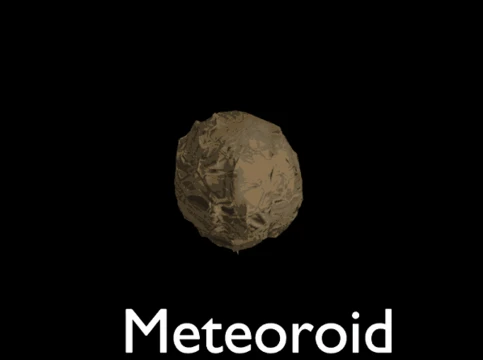
Earth-grazing meteoroid of 13 October 1990
Rare Earth-grazing meteoroid recorded from two distant camera positions.
On 13 October 1990, a 44-kilogram meteoroid, designated EN131090, briefly entered the atmosphere over Czechoslovakia and Poland before returning to space. This rare event was the second observed with scientific instruments and the first recorded from two separate locations, allowing its orbit to be calculated.
Quick Facts
- Date
- 13 October 1990
- Time
- 03:27:16±3 UT
- Duration
- 9.8 seconds
- Location
- Czechoslovakia, Poland
- First reporter
- Petr Pravec
- Pavel Klásek
- Lucie Bulíčková
- Filmed by
- European Fireball Network
Facts from the source article.
Did You Know?
- The 1972 Great Daylight Fireball was more than a thousand times as massive and got 40 km closer to Earth's surface.
- Observational data from this event and the 1972 fireball helped develop a method for computing grazing trajectories, later used for a 2006 event above Japan.
Observations
Three independent Czech observers—Petr Pravec, Pavel Klásek, and Lucie Bulíčková—reported visual observations. The event began at 03:27:16±3 UT, with the bright fireball moving from south to north and leaving a visible track for 10 seconds. Most data came from photographic cameras of the European Fireball Network at Červená hora and Svratouch, both in the present-day Czech Republic. The Červená hora image captured the fireball's trajectory over about 110°, crossing roughly 60% of the sky, and its rotating shutter interrupted the exposure 12.5 times per second to determine speed. The Svratouch image recorded only about 15° of the trajectory. Gotfred M. Kristensen detected the fireball in Havdrup, Denmark, using a pen recorder connected to a radio receiver for 78 seconds at 03:27:24±6 UT.
Encounter data
The meteoroid became visible north of Uherský Brod, Czechoslovakia, at a height of 103.7 km, approached to 98.67 km northeast of Wrocław, Poland, and disappeared at 100.4 km north of Poznań, Poland. It traveled 409 km in 9.8 seconds at a speed of 41.74 km/s, which did not change measurably. Jiří Borovička and Zdeněk Ceplecha estimated deceleration at perigee reached only 1.7 m/s², reducing velocity by 0.012 km/s (less than 0.03%). Computer simulations by D. W. Olson, R. L. Doescher, and K. M. Watson indicated deceleration below 0.5 m/s² except near perigee. The loss of kinetic specific energy was 0.5 MJ/kg, converted to heat. The change in the object's velocity vector due to Earth's gravity during its hours in Earth's vicinity was on the order of kilometers per second.
Physical characteristics
The meteoroid was a type I fireball, an ordinary chondrite. Its mass upon entry was about 44 kg, estimated from absolute magnitude and velocity. It lost about 350 g of mass during the encounter, beginning at a height of 100.6 km and lasting 35 seconds until 215.7 km. Its surface melted and solidified again after leaving, forming a typical meteoritic fusion crust. The object was not dangerous; even if headed lower, it would have exploded high above ground, with only small particles possibly reaching the surface.
Orbit
The swing by Earth significantly altered the orbit: aphelion and orbital period were reduced to almost half their original values. The object's inclination changed from 71° to 74°. The object returns to the encounter point approximately every 2.5 or 2.6 years, while Earth returns annually, but the period is not known precisely enough to predict the next encounter.
More in Meteoroids
Spotted an error? Know more?
Reader corrections go straight into our review queue. Suggest an edit · How this site is sourced