Frequently Asked Questions
The most-asked questions about messier objects.
What are Messier objects?
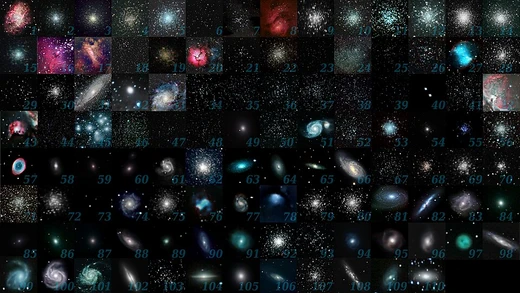
Messier objects are a catalog of 110 deep-sky targets—galaxies, nebulae, and star clusters—compiled in the 18th century. They range from faint smudges visible only through large telescopes to bright, easily spotted patches in the night sky.
Who was Charles Messier?
Charles Messier was an 18th-century French astronomer who systematically recorded faint 'comet-like' objects so he could distinguish them from actual comets during his searches. His 1774 catalog became the foundation for what we now call the Messier list.
How many objects are in the Messier catalog?
The original 1774 edition listed 103 entries, and Messier later added seven more, bringing the total to 110. All 110 remain in standard use today, numbered M1 through M110.
What kinds of objects does the catalog include?
The list spans three main categories: emission and reflection nebulae, open and globular star clusters, and external galaxies. A few entries are also planetary nebulae or supernova remnants.
Where should a beginner start observing Messier objects?
Bright, large, and well-placed targets like M31 (Andromeda Galaxy), M42 (Orion Nebula), and M45 (Pleiades) are excellent first picks because they are visible even in light-polluted skies. A simple pair of binoculars or a small telescope is all you need for these.
What is the Messier Marathon?
It is a popular annual challenge in which observers try to spot all 110 catalog entries in a single night, typically around the spring equinox when the full list is above the horizon. Most successful attempts happen in mid-to-high northern latitudes between March and May.
Why did Messier originally make his list?
He was a dedicated comet hunter and kept wasting time re-examining faint fixed objects that looked like comets but never moved. By cataloging them, he could quickly rule them out and focus on genuine new comets.
Can you see Messier objects with the naked eye?
A handful—roughly a dozen or so—are visible without any optical aid under dark skies, including M31, M42, M45, and several globular clusters. The vast majority require at least binoculars or a small telescope to become visible.
How does the Messier catalog compare to the NGC catalog?
The New General Catalogue (NGC) is far larger, listing over 7,800 objects, whereas Messier's list is a curated subset of 110. Every Messier object has a corresponding NGC designation, but the reverse is not true.
What makes M1 (the Crab Nebula) special?
It is the remnant of a supernova observed by Chinese and Arab astronomers in 1054 CE, making it one of the best-studied stellar-explosion sites in the sky. It also hosts a rapidly spinning pulsar at its center, discovered in 1968.