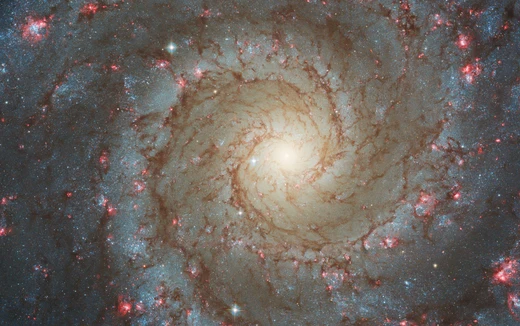
Black Eye Galaxy
A spiral galaxy with a dark dust band and counter-rotating disks.
The Black Eye Galaxy (Messier 64, NGC 4826) is a relatively isolated spiral galaxy 17 million light-years away in Coma Berenices. It was discovered by Edward Pigott in March 1779, and independently by Johann Elert Bode the following month, as well as by Charles Messier the next year. A dark band of absorbing dust partially in front of its bright nucleus gave rise to its nicknames. The galaxy is inclined 60° to the line-of-sight and has a morphological classification of (R)SA(rs)ab, though Ann et al. (2015) gave it a class of SABa. It is a type 2 Seyfert galaxy with an HII/LINER nucleus and contains approximately 100 billion stars. Its interstellar medium consists of two counter-rotating disks of approximately equal mass.
Quick Facts
- Constellation
- Coma Berenices
- Group cluster
- CVn I (M94 Group)
- Stars
- ~100 billion
- Names
- Sleeping Beauty Galaxy
- Evil Eye Galaxy
- M64
- NGC 4826
- PGC 44182
- UGC 8062
Facts from the source article.
More in Messier Objects: Spiral Galaxies
Spotted an error? Know more?
Reader corrections go straight into our review queue. Suggest an edit · How this site is sourced