Frequently Asked Questions
The most-asked questions about messier objects, part 3.
What is Messier Objects, Part 3 in a nutshell?
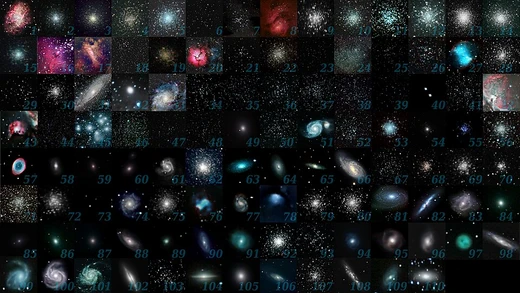
It is the third volume of an unofficial fan encyclopedia that walks through the final stretch of Charles Messier's 110-entry catalog, roughly M74 through M110. The section focuses on late-18th-century galaxy discoveries, a handful of globular clusters, and the companion objects Messier noted near the Andromeda region.
Who are the central 'characters' a reader should care about?
The recurring figures are Charles Messier himself, the 18th-century French astronomer who logged the objects, and the galaxies and clusters he catalogued—especially the Sombrero Galaxy (M104) and the Pinwheel (M101), which fans treat as the volume's protagonists.
Where should a complete newcomer begin reading Part 3?
Start with the introductory entry on M74, the smallest and most approachable spiral in the section, because it establishes the visual vocabulary (spiral arms, dust lanes, core brightness) that every later entry builds on.
What is the single most-searched fact about this volume?
Fans most often look up why M110, a small elliptical galaxy, is catalogued as a separate Messier object even though it is essentially a companion to the much larger Andromeda Galaxy (M31), which appears earlier in the catalog.
What is the 'origin story' behind the objects in Part 3?
Messier compiled these entries between 1773 and 1781 while hunting for comets, noting down every faint smudge of light he encountered so future astronomers would not mistake them for returning comets.
What is the most commonly cited misconception about this section?
Many readers assume every Messier object is a galaxy, but Part 3 actually includes at least one globular star cluster and a planetary nebula, so the catalog is a mixed bag of deep-sky types rather than a pure galaxy list.
What do fans consider the 'climax' or highlight moment of the volume?
The M104 entry is widely treated as the peak, because the Sombrero Galaxy's dramatic edge-on dust lane and bright bulge make it the most visually striking single object Messier ever logged.
How does Part 3 connect to Parts 1 and 2?
Parts 1 and 2 cover the earlier entries (roughly M1 through M73), including supernova remnants, open clusters, and the first spiral galaxies, so Part 3 serves as the natural continuation and closing arc of the full 110-object survey.
Is this encyclopedia an official or peer-reviewed source?
No; it is explicitly an unofficial fan project written by amateur astronomers and stargazers, so while the astronomical data aims for accuracy, the tone, ordering, and commentary reflect enthusiast perspective rather than institutional authority.
What practical tip do the most-read entries give for actually seeing these objects?
The volume repeatedly advises readers that most Part 3 targets are fainter than the early Messier objects, so a dark-sky site, a telescope of at least eight inches, and averted-vision technique are recommended to bring out spiral structure and low-surface-brightness halos.