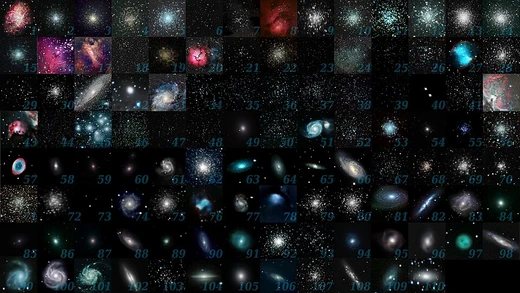
Frequently Asked Questions
The most-asked questions about messier objects, part 2.
What does Part 2 of the Messier objects encyclopedia cover?
Part 2 spans Messier objects M51 through M110, encompassing 60 deep-sky targets including galaxies, nebulae, open clusters, and globular clusters. It picks up right where Part 1 (M1–M50) leaves off, so readers can work through the full 110-object catalog in two volumes.
Who is the central figure behind the Messier catalog?
Charles Messier, an 18th-century French astronomer, compiled the list while hunting for comets and noting non-cometary sky objects to avoid confusing them. Many of the entries were actually first spotted by his colleague Pierre Méchain or other contemporaries, but Messier credited and published them under his catalog.
Where should a beginner start when observing Part 2 objects?
M51, the Whirlpool Galaxy, is a popular first target because it is bright, relatively large, and visible in modest binoculars or a small telescope. M81 (Bode's Galaxy) and M82 (the Cigar Galaxy) are also forgiving starting points that reward even casual observers.
How many objects are included in Part 2?
There are 60 Messier objects in this volume, running from M51 to M110. That makes Part 2 slightly larger than Part 1, which contains the first 50 entries.
Which Part 2 objects are considered the most iconic or visually striking?
The Whirlpool Galaxy (M51), the Pinwheel Galaxy (M101), and the Sombrero Galaxy (M104) are frequently cited as the showstoppers of this section. M104 in particular is famous for its dramatic dust lane and bright central bulge, even in small instruments.
What types of deep-sky objects appear in Part 2?
The section includes spiral and elliptical galaxies, emission and reflection nebulae, open star clusters, and globular clusters. Galaxies make up the largest share, reflecting Messier's growing interest in distant island universes toward the end of his catalog.
What is generally considered the hardest Part 2 object to find with a small telescope?
Faint, low-surface-brightness galaxies like M74 and M90 often give observers the most trouble, especially under light-polluted skies. M110, the companion to the Andromeda Galaxy, is also subtle and easy to overlook without knowing exactly where to look.
When were most Part 2 objects first recorded?
The majority were cataloged between 1773 and 1781, during Messier's most productive observing years. A handful, such as M101, were actually discovered earlier by John Herschell or other astronomers and later added to the list.
What kind of equipment do I need to see Part 2 objects?
A pair of 10×50 binoculars will reveal the brighter galaxies and clusters, while a 6- to 8-inch telescope opens up fainter spirals and the structure of nebulae. Dark-adapted eyes and a star chart or go-to mount make a big difference for the fainter entries.
Are there any notable 'pair' or 'triple' groupings within Part 2?
M81 and M82 form one of the most celebrated galaxy pairs in the sky, visible together in a single field of view. M51 and its small companion NGC 5195 also make a visually compelling double, and M93 sits near several other clusters in a rich patch of sky.