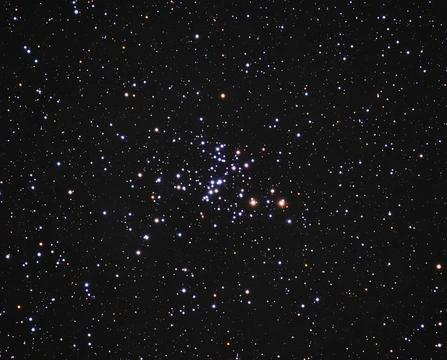
Eagle Nebula
A young open cluster with the iconic Pillars of Creation.
The Eagle Nebula is a young open cluster of stars in the constellation of Serpens, also catalogued as Messier 16, M16, or NGC 6611. Discovered by Jean-Philippe de Cheseaux in 1745–46, it is sometimes called the Star Queen Nebula. The nebula is famous for the dark silhouette near its center, known as the Pillars of Creation, imaged by the Hubble Space Telescope.
Quick Facts
- Constellation
- Serpens
- Names
- Messier 16
- NGC 6611
- Sharpless 49
- RCW 165
- Cr 375
- Gum 83
- Star Queen Nebula
Facts from the source article.
Characteristics
The Eagle Nebula, also known as IC 4703, is an H II region where stars are actively forming, located around 5700 light-years away. Its associated cluster holds roughly 8100 stars, most found in a gap in the molecular cloud northwest of the Pillars. The brightest star, HD 168076, is a binary system with an O3.5V and O7.5V star, boasting about 80 times the Sun's mass and up to a million times its luminosity. The cluster is estimated to be 1 to 2 million years old. A gas spire in the northeastern part stretches about 9.5 light-years, or 90 trillion kilometers.
"Pillars of Creation" region
Images from the Hubble Space Telescope in 1995, produced by Jeff Hester and Paul Scowen, greatly improved scientific understanding of the nebula's interior. One image became famous as the Pillars of Creation, depicting a large star-forming region. Small dark pockets within the pillars are believed to be protostars, known as Bok globules. These columns, resembling stalagmites, are composed of interstellar hydrogen gas and dust that act as incubators for new stars. Inside and on the surface of the columns, astronomers have found knots of denser gas called EGGs (Evaporating Gaseous Globules), where stars are forming. X-ray images from the Chandra Observatory showed that X-ray sources from young stars do not coincide with the pillars but dot the nebula randomly; protostars in the EGGs are not yet hot enough to emit X-rays. Evidence from the Spitzer Space Telescope originally suggested the pillars might be threatened by a past supernova, with hot gas observed in 2007 indicating they were likely being disturbed by a supernova that exploded 8,000 to 9,000 years ago. The main blast of light would have reached Earth 1,000 to 2,000 years ago, and a slower shock wave might have blown away the pillars. However, Hubble imaged the pillars again in 2014 in visible and infrared light, providing a detailed account of evaporation rates. No supernova was evidenced within them, and it is estimated they will still exist for at least 100,000 more years.
More in Messier Objects: Open Clusters
Spotted an error? Know more?
Reader corrections go straight into our review queue. Suggest an edit · How this site is sourced