Frequently Asked Questions
The most-asked questions about mermaids.
What is a mermaid?
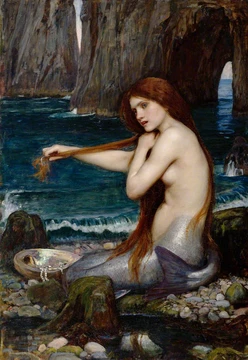
A mermaid is a mythological humanoid creature with the upper body of a human woman and the lower body of a fish. The concept appears independently across maritime cultures worldwide, from Norse and Slavic folklore to East Asian and Polynesian legends.
Where do mermaid myths originate?
Mermaid legends trace back to ancient Sumerian and Babylonian texts, where the sea goddess Tiamat and the fish-goddess Atargatis serve as early precursors. They were later carried into Greek, Norse, Slavic, African, and Asian oral traditions, each adding local color to the basic half-human, half-fish archetype.
What is the difference between a mermaid and a 'merfolk'?
'Merfolk' is an umbrella term covering all fish-tailed humanoid sea creatures, including male counterparts (mermen) and child forms (merlings). 'Mermaid' specifically refers to the female variant and is the form most commonly depicted in art and literature.
Are mermaids always portrayed as beautiful and kind?
No—across most folklore traditions, mermaids are ambiguous or outright dangerous figures who lure sailors to shipwreck with their singing or seductive presence. The benevolent, tragic-heroine image popularized by Hans Christian Andersen's 1837 tale is a relatively modern reinterpretation.
What is the most well-known mermaid story?
Andersen's 'The Little Mermaid' (1837) is the single most widely known narrative, in which a young mermaid trades her voice for legs and risks eternal death for love. It was later adapted into Disney's 1989 animated film, which shifted the tone toward a romantic comedy and cemented the character in global pop culture.
How do mermaids differ from sirens?
In classical Greek mythology, sirens are bird-bodied creatures who sing sailors to their deaths on rocky shores, whereas mermaids are fish-tailed and typically inhabit open water. In modern usage the terms are often conflated, but the original mythological distinction is body shape and habitat.
What abilities or powers are mermaids said to have?
Folklore attributes to mermaids an enchanting voice, the capacity to heal or curse with a kiss, and the ability to manipulate weather or summon storms. Some traditions also grant them knowledge of the sea's hidden treasures and the power to grant or deny a human's wishes.
Where do mermaids live in mythology?
They are generally said to dwell in deep ocean trenches, coral kingdoms, or beneath sea caves, often under the rule of a sea king or a goddess figure. Coastal and river-dwelling variants also appear in Slavic and East Asian tales, where they inhabit shallower waters near shore.
What happens when a mermaid meets a human in these stories?
The most common narrative arc involves a mermaid falling in love with a human, making a Faustian bargain (often with a sea-witch) to walk on land, and facing a tragic or bittersweet ending. Other stories frame the encounter as a warning: the human is lured, cursed, or drowned as punishment for trespassing.
How do mermaids appear in modern media?
Beyond Disney's animated and live-action films, mermaids feature prominently in video games, anime, and fantasy novels as allies, antagonists, or neutral inhabitants of underwater civilizations. They have also become a staple of body-positive and identity-affirming fan communities, where the 'mermaid' aesthetic is embraced as a form of self-expression.