Wacław Sierpiński
Mathematician mentioned in the Mathemalchemy installation.

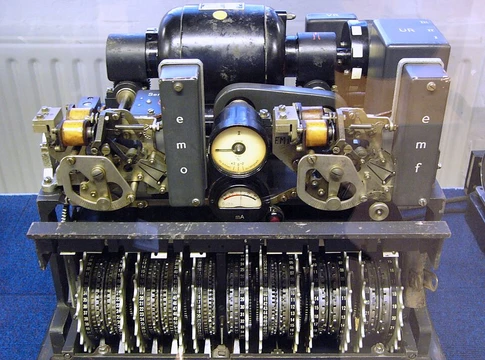
Wacław Franciszek Sierpiński (1882–1969) was a Polish mathematician renowned for his extensive contributions to set theory, number theory, the theory of functions, and topology. He published over 700 papers and 50 books. Born in Warsaw to a doctor and his wife, his mathematical talent emerged early. He studied at the University of Warsaw, where he won a gold medal for an essay on Voronoy's number theory work, though he delayed its publication until 1907 to avoid Russian. After teaching briefly, he earned his doctorate at Jagiellonian University in 1906, studying under Stanisław Zaremba. He joined the University of Lwów in 1908, becoming head of its mathematics faculty in 1910. His interest in set theory was sparked in 1907 by a theorem about specifying points in the plane with a single coordinate; after learning the answer was "Cantor," he devoted himself to the field and gave the first lecture course on set theory in 1909. During World War I, he worked in Moscow with Nikolai Luzin, beginning their study of analytic sets, and in 1916 he produced the first example of an absolutely normal number. After the war, he moved to the University of Warsaw, where he became a professor in 1919. He helped break Soviet ciphers during the Polish–Soviet War. In 1920, he co-founded the journal *Fundamenta Mathematicae*. His work on the axiom of choice and continuum hypothesis included proving that Zermelo–Fraenkel set theory with the generalized continuum hypothesis implies the axiom of choice. Three well-known fractals—the Sierpiński triangle, carpet, and curve—bear his name, as do Sierpiński numbers and the associated problem. He retired in 1960 but continued seminars and editorial work until 1967.
- field
- Mathematics
- known_for
- Contributions to set theory, number theory, theory of functions, topology; Sierp
Lore & Background
The Mathemalchemy installation includes Wacław Sierpiński among the mathematicians explicitly mentioned or alluded to. The installation's creators aimed to illustrate as much of mathematics as possible, touching on fractals—a field where Sierpiński's work on the Sierpiński triangle, carpet, and curve is iconic. The exhibit features hundreds of detailed mathematical artifacts, some smaller than 0.5 inches, and includes puns and Easter eggs for visitors to decode. Mathemalchemy was built by a cross-disciplinary team of 24 people during 2020 and 2021, employing materials like ceramics, knitting, 3D printing, and origami to create a room-sized installation that celebrates the intersection of art and mathematics.
Reader's Guide
Wacław Sierpiński is one of many mathematicians celebrated in the Mathemalchemy installation, which touches on number theory, fractals, tessellations, and more. The installation's creators, including Duke University mathematician Ingrid Daubechies and fiber artist Dominique Ehrmann, designed the exhibit to be accessible to viewers of all levels, with self-guided tours and detailed explanations available on the official website. The installation occupies a footprint approximately 20 by 10.5 feet and extends up to 9.5 feet in height, containing more than 1,000 parts. Mathematically sophisticated visitors may enjoy decoding the many mathematical allusions, including those to Sierpiński's work, while the exhibit also features a downloadable comic book exploring its themes.
Did You Know?
- Wacław Sierpiński is explicitly mentioned or alluded to in the Mathemalchemy installation.
- The Mathemalchemy installation touches on fractals, including those named after Sierpiński.
- The installation was built by a team of 24 people during 2020 and 2021.
- Mathemalchemy includes more than 1,000 parts and occupies a footprint of about 20 by 10.5 feet.
Frequently Asked Questions
Who is Wacław Sierpiński?
Wacław Sierpiński was a Polish mathematician born in 1882 who became one of the most prolific and influential figures in twentieth-century mathematics. He is best remembered for his work across set theory, topology, number theory, and the theory of functions, as well as for the fractal structures that carry his name.
What is the Sierpiński triangle?
The Sierpiński triangle is a self-similar fractal produced by repeatedly removing the central equilateral triangle from a larger one, leaving an infinite pattern of ever-smaller triangles. It is one of the most visually iconic fractals and is named after Sierpiński, who described the construction in the early twentieth century.
What are Sierpiński numbers?
Sierpiński numbers are integers k for which k·2ⁿ + 1 is never prime for any positive integer n, a concept Sierpiński introduced in 1960. Finding the smallest such k remains a celebrated open problem in number theory and intersects with the primality-testing techniques used in cryptography.
How prolific was Sierpiński as a writer?
Over his career Sierpiński produced more than 700 research papers and roughly 50 books, covering everything from deep set-theoretic results to light recreational mathematics. That extraordinary volume of output made him one of the most published mathematicians of the twentieth century.
Why does Sierpiński matter to cryptography fans?
His number-theoretic ideas, especially the Sierpiński-number problem, revolve around primality questions that sit at the heart of modern cryptographic protocols. More broadly, the set-theoretic and topological foundations he helped build underpin much of the abstract mathematics that cryptographers rely on.
More in Mathematics And Cryptography 1-24
Related in Mathematics And Cryptography
Links follow this subject's own source article.
Spotted an error? Know more?
This is a living reference — every entry is fact-audited, and reader corrections feed straight into our audit queue. Suggest an edit · See this site's audit record