A Night at the Opera (film)
The Marx Brothers' first MGM film, a comedy classic.
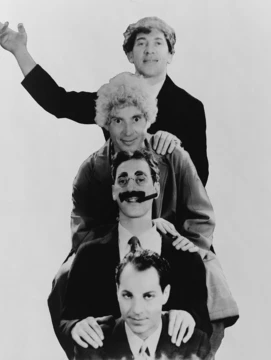
A Night at the Opera is a 1935 American comedy film starring the Marx Brothers (Groucho, Harpo and Chico), with Kitty Carlisle, Allan Jones, Margaret Dumont, Sig Ruman, and Walter Woolf King. It was the first of five films the Marx Brothers made under contract for Metro-Goldwyn-Mayer after leaving Paramount Pictures, and the first after Zeppo left the act. Selected for preservation in the National Film Registry in 1993, it also appears on AFI's 100 Years...100 Movies list at number 85 and on AFI's 100 Years...100 Laughs list at number 12.
Quick Facts
- Director
- Sam Wood
- Producer
- Irving Thalberg
- Story
- James Kevin McGuinness
- Screenplay
- George S. Kaufman
- Morrie Ryskind
- Add'l dialogue:
- Al Boasberg
- Starring
- Groucho Marx
- Chico Marx
- Harpo Marx
- Music
- Herbert Stothart
- Cinematography
- Merritt B. Gerstad
- Editing
- William LeVanway
Facts from the source article.
Did You Know?
- The film was banned in Budapest.
- The film grossed $1,164,000 from the US and Canada and $651,000 elsewhere.
Plot
In Milan, wealthy widow Mrs. Claypool is stood up by her business manager Otis B. Driftwood, who is dining with another woman. Driftwood joins her and introduces her to Herman Gottlieb, director of the New York Opera Company. Driftwood arranges for Mrs. Claypool to invest $200,000 in the opera company, enabling Gottlieb to engage tenor Rodolfo Lassparri. Backstage, chorister Ricardo Baroni hires his friend Fiorello as his manager. Ricardo loves soprano Rosa Castaldi, who is also courted by Lassparri. Driftwood finds Lassparri attacking his dresser Tomasso; Tomasso knocks Lassparri unconscious. Fiorello introduces himself as manager of the greatest tenor, and Driftwood mistakenly signs Ricardo to a contract. Driftwood, Mrs. Claypool, Rosa, Lassparri, and Gottlieb sail for New York. Ricardo, Fiorello, and Tomasso stow away in Driftwood's trunk. Discovered, they refuse to leave until they eat, crowding Driftwood's tiny stateroom. Lassparri spots them among immigrants; they are caught and jailed. Driftwood helps them escape, and they sneak into the country posing as three bearded aviators. During a hero's welcome in New York, they are exposed and flee to Driftwood's hotel room, pursued by police sergeant Henderson.
Selected sequences
The stateroom scene was written primarily by Al Boasberg, who typed the finished scene, shredded the pages, and tacked them to his ceiling; Irving Thalberg and the brothers spent hours reassembling it. Driftwood plans a rendezvous with Mrs. Claypool in his third-class cabin, about the size of a janitor's closet. He discovers Fiorello, Tomasso, and Ricardo have stowed away in his trunk, discarding his clothes. Fiorello insists on eating, and Driftwood orders dinner. Fiorello and Tomasso each order about a dozen hard-boiled eggs, and Driftwood orders everything else, including coffee to sober up stewed prunes. This sets up the scene where 15 people crowd into the tiny cabin: Driftwood, Fiorello, Tomasso, Ricardo, two cleaning ladies, a manicurist, a ship's engineer and his assistant, a young woman using the phone to call her Aunt Minnie, a maid, and four waiters with trays of hard-boiled eggs. All tumble out when Mrs. Claypool opens the door. The film also includes the contract scene between Driftwood and Fiorello, and adaptations of opera scenes from Pagliacci and Il trovatore, featuring the Miserere duet sung by Kitty Carlisle and Allan Jones. MGM added production numbers such as the song 'Alone' and 'Cosi Cosa'.
Production
Groucho was appalled by an early draft by Bert Kalmar and Harry Ruby and insisted on getting George S. Kaufman and Morrie Ryskind to write the screenplay. Producer Irving Thalberg suggested a change of direction: in their Paramount films, the brothers attacked almost anyone, but Thalberg felt this made them unsympathetic, especially to female filmgoers. In the MGM films, the brothers were recast as more helpful characters, saving their comic attacks for villains. The routines were honed in live stage performances before filming. According to Oscar Levant, the first preview in Long Beach was a disaster with hardly a laugh, as was the second. Thalberg and Kaufman spent days in the editing room adjusting timing, cutting about nine minutes, and the result was a hit. The film originally was to begin with each brother roaring instead of Leo the Lion, with Harpo honking his horn, but MGM head Louis B. Mayer felt the parody would cheapen the trademark; the opening appeared years later in a re-release trailer.
In popular culture
The stateroom scene inspired Jacques Brel's song 'Le Gaz' on his album Jacques Brel 67. The Bob Newhart Show episode 'Bum Voyage' features an homage with Bob and a dozen cast members crammed into a stateroom. Cyndi Lauper used a similar overcrowded stateroom gag in her music video for 'Girls Just Want to Have Fun'. Sting recreated the gag in his video for 'All This Time'. A Seinfeld episode, 'The Pothole', features the four main characters crammed into a janitor's closet. Mystery writer Jeffrey Cohen's novel A Night at the Operation (2009) pays tribute. Chico's line 'There ain't no sanity clause' was used as a title for a 1980 single by The Damned. Detective Comics #826 pays homage, with Robin distracting the Joker by saying 'There ain't no Sanity Claus. The British rock group Queen named their 1975 studio album after the film. The film's script is credited as the basis for the 1992 film Brain Donors.
Frequently Asked Questions
Who directed A Night at the Opera (film)?
A Night at the Opera was directed by Sam Wood.
When was A Night at the Opera (film) released?
A Night at the Opera was released on 15 November 1935.
Who composed the music for A Night at the Opera (film)?
The music for A Night at the Opera was composed by Herbert Stothart.
Who wrote A Night at the Opera (film)?
A Night at the Opera was written by George S. Kaufman, Morrie Ryskind, Add'l dialogue: and Al Boasberg.
More in Marx Brothers
Spotted an error? Know more?
Reader corrections go straight into our review queue. Suggest an edit · How this site is sourced