Timothy Canham
Software engineer and operations lead for the Mars helicopter Ingenuity.
Timothy Canham is an American software engineer at the Jet Propulsion Laboratory (JPL). He serves as the operations lead and former software lead for the Mars helicopter Ingenuity. He resides in Santa Clarita, California.
Quick Facts
- Fields
- Computer engineering, space science
- Workplaces
- NASA Jet Propulsion Laboratory
- Education
- Marcus Whitman High School, Clarkson University (bachelor's degree, electrical and computer engineering)
Facts from the source article.
Career
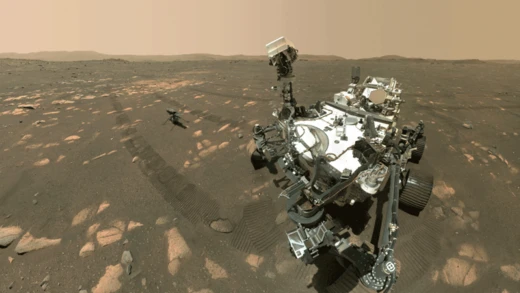
After finishing at Clarkson University, Timothy Canham landed a position at the Jet Propulsion Laboratory, where he has remained ever since, taking just a single year off during the 1990s. His earlier work included writing software that helped the Curiosity rover touch down safely. He also helped design the Fprime flight software framework, a system used on many JPL missions, including Ingenuity. Canham first got involved with the Ingenuity helicopter project in mid-2015, leading a small team of around 20 people to build a prototype and work out the fundamentals. In 2017, the helicopter was chosen to hitch a ride to Mars aboard the Perseverance rover. During a 2021 interview, Canham noted that the craft would run on a Linux operating system with open-source code, a Snapdragon 801 processor, and guidance loops operating at 500 hertz. Perseverance touched down on Mars in February 2021, and two months later, Ingenuity made history with the first powered, controlled flight on another world, a 39.1-second hop. Beyond spacecraft work, Canham has taken part in university outreach to help students. The Ingenuity team received the 2021 Jack Swigert Award for Space Exploration, and in 2022, they were given the Collier Trophy for opening the skies of Mars and other worlds to future exploration.
Scientific publications
Canham co-authored several papers. These include "Project Golden Gate: towards real-time Java in space missions" (2004), "Workstation-Based Avionics Simulator to Support Mars Science Laboratory Flight Software Development" (2012), and "Modeling for Partitioned and Multi-core Flight Software Systems: (Instrument Software Framework)" (2014). He contributed to "Mars Helicopter Technology Demonstrator" (2018) and "F Prime: An Open-Source Framework for Small-Scale Flight Software Systems" (2018). He also authored "Mars Helicopter: Leveraging Commercial Hardware and Open Source Software" (2019).
More in Mars 2020
Spotted an error? Know more?
Reader corrections go straight into our review queue. Suggest an edit · How this site is sourced