Frequently Asked Questions
The most-asked questions about marine sponges.
What exactly are marine sponges?
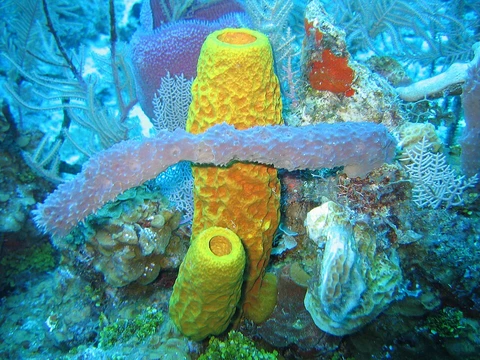
Marine sponges are filter-feeding animals in the phylum Porifera, meaning they lack true tissues, organs, and a nervous system. They have been pumping nutrients out of seawater for over 600 million years, making them one of the oldest surviving animal lineages on the planet.
Who are the 'main characters' fans talk about most?
The giant barrel sponge (Xestospongia muta) is a perennial fan favorite for its enormous size and iconic shape, while hexactinellid glass sponges like Euplectella are celebrated for their intricate silica scaffolding. The Venus flower basket is probably the single most photographed species in the community.
Where should a newcomer start learning about sponges?
A solid entry point is understanding the basic body plan: water enters through tiny pores called ostia, passes through a central chamber, and exits via an opening called the osculum. From there, exploring the three main classes—Calcarea, Demospongiae, and Hexactinellida—gives you a clear map of the entire group.
What's the most surprising fact about sponges?
Despite looking like simple blobs, many sponges can regenerate a whole new individual from a tiny fragment, and some can collapse into a loose cell mass when stressed before rebuilding themselves. They also have no brain, heart, or conventional immune system, yet they still mount chemical defenses against predators and pathogens.
Where do marine sponges live?
They occur in virtually every ocean setting, from sunlit tropical reefs down to the deepest hadal trenches. Some species thrive in near-freezing polar waters while others colonize volcanic hydrothermal vents, a range of habitat tolerance that's striking for an animal without a circulatory system.
How do sponges reproduce?
Most species can reproduce both sexually, releasing sperm into the water column, and asexually through budding or fragmentation. A single sponge can generate millions of sperm cells, and in some species the resulting 'sperm clouds' drift to fertilize neighboring individuals of the same kind.
What's the symbiosis 'arc' that fans love?
Many sponges harbor dense communities of bacteria, archaea, and small invertebrates within their tissues, with microbial partners sometimes accounting for the majority of the sponge's dry mass. These partnerships frequently produce the bioactive compounds that make sponges so interesting to pharmacology research.
Why are sponges considered ecologically important?
They function as living water filters, processing enormous volumes of seawater and recycling dissolved organic matter back into the food web. Sponge reefs in particular provide three-dimensional structural habitat for hundreds of other species, playing a role somewhat analogous to coral reefs.
What's a common misconception about sponges?
A lot of people assume sponges are plants or fungi because they sit motionless and look structurally simple, but they are unmistakably animals that actively pump water through their bodies and respond to environmental cues. They also don't 'breathe' the way fish do; gas exchange occurs passively across their cell surfaces.
What's the most notable 'discovery moment' in sponge history?
The 2016 identification of a glass sponge living at roughly 8,300 meters in the Izu-Ogasawara Trench shattered previous depth records for the group. More broadly, the ongoing stream of sponge-derived compounds showing anti-cancer and anti-inflammatory activity keeps the research narrative feeling very much alive.