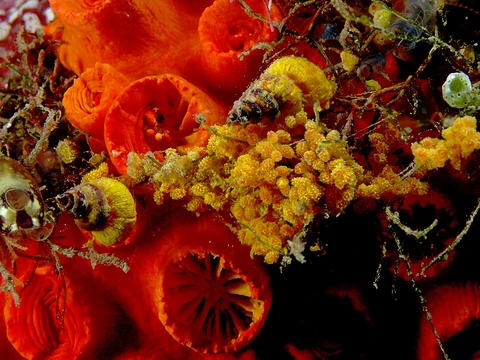
Clanculus johnstoni
A small, carmine top snail endemic to Australian waters.
Last updated

Ch. Hedley · via Wikipedia: Clanculus johnstoni · Public domain
The shell is small, solid, and globose-conic, reaching 6 mm in height and 6 mm in diameter.[1]
Scientific classification
- KingdomAnimalia
- PhylumMollusca
- ClassGastropoda
- SubclassVetigastropoda
- OrderTrochida
- FamilyTrochidae
- GenusClanculus
- SpeciesClanculus johnstoni
Named by Hedley, 1917
Close relatives
Other species of Clanculus with a Codexery entry.
- Clanculus albanyensis Clanculus albanyensis
- Clanculus albugo Clanculus albugo
- Clanculus aloysii Clanculus aloysii
- Clanculus atypicus Clanculus atypicus
- Clanculus berthelotii Clanculus berthelotii
- Clanculus bronni Clanculus bronni
- Clanculus brunneus Clanculus brunneus
- Clanculus clanguloides Clanculus clanguloides
Sources: Wikipedia taxobox: Clanculus johnstoni (CC BY-SA 4.0) · order, family and genus agree with WoRMS AphiaID 594197 (CC BY 4.0)
Where the clanculus johnstoni has been recorded
Each dot is a place where the species has been observed and reported (82 records, half-degree grid) — not a modelled range. 3 inland records left out (institution coordinates).
Map: drawn by Codexery. Data: GBIF occurrence search (records CC0 / CC BY) · Natural Earth basemap (public domain) · place coordinates: Wikipedia (CC BY-SA 4.0)
Quick Facts
- Shell height
- 6 mm (0.24 in)
- Number of whorls
- 5
- Spirals on penultimate whorl
- 4, plus a fifth half-buried in the suture
- Distribution
- Endemic to Australia; intertidal depths off the Northern Territory and Queensland
Facts from the source article.
Biology and range
Five whorls make up the shell.[1] An olive brown color variant exists, where only a trace of carmine remains on the summit.[1] The aperture is oblique and ascends at its final part.[1] Roughly a dozen entering ridges lie inside the outer lip, with the lowest ridge being larger than the others.[1]
What the specialist sources record
The original description by Hedley (1917) in the Proceedings of the Royal Society of Queensland states the shell has a translucent callus uniting the lips.[1] GBIF holds 83 occurrence records for this taxon as of 7 October 2026.[2] The World Register of Marine Species lists Clanculus johnstoni as an accepted species in the order Trochida.[3]
References
- Wikipedia, "Clanculus johnstoni" (CC BY-SA 4.0), which cites: Hedley, C. 1917. Description of a new shell from Caloundra. Proceedings of the Royal Society of Queensland 29: 55-56 (original not read by us) en.wikipedia.org
- GBIF Backbone Taxonomy and occurrence index, Clanculus johnstoni (taxon key 4615512). CC BY 4.0 (backbone); counts are facts. gbif.org
- World Register of Marine Species, Clanculus johnstoni (AphiaID 594197). CC BY 4.0. marinespecies.org
Each numbered sentence above was checked against the source it cites before publication. Sentences citing Wikipedia adapt text from the English Wikipedia article Clanculus johnstoni (contributors), used under CC BY-SA 4.0; this entry is available under the same licence. Other sources were used for facts only; no text or images are copied from them.
More in Marine Snails
Sources
Compiled from Wikipedia and the sources listed below. Text from Wikipedia is available under CC BY-SA 4.0; this entry is adapted from it.
- Wikipedia: Clanculus johnstoni (CC BY-SA 4.0).
- Classification: the source article's taxobox; order, family and genus checked against WoRMS, the World Register of Marine Species (CC BY 4.0).
- Occurrence records: GBIF (CC0 / CC BY). Basemap: Natural Earth (public domain).
Spotted an error? Know more?
Reader corrections go straight into our review queue. Suggest an edit · How this site is sourced