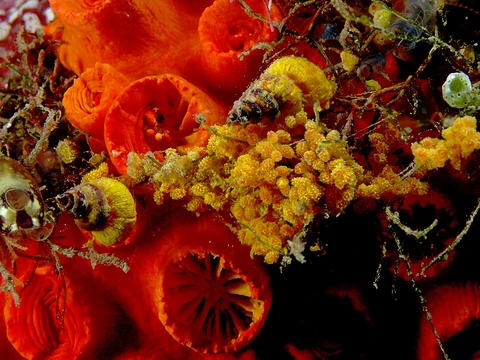
Clanculus consobrinus
A perforate, depressed top snail with pinkish-brown shell.
Last updated

Tate, 1893 · CC0
Its shell size ranges from 8 mm to 13 mm.[1] The shell is perforate, depressed, and pinkish-brown with sparse black dots.[1] A marine gastropod mollusk belonging to the family Trochidae is the species Clanculus consobrinus.[2][3]
Scientific classification
- KingdomAnimalia
- PhylumMollusca
- ClassGastropoda
- SubclassVetigastropoda
- OrderTrochida
- FamilyTrochidae
- GenusClanculus
- SpeciesClanculus consobrinus
Named by Tate, 1893
Close relatives
Other species of Clanculus with a Codexery entry.
- Clanculus albanyensis Clanculus albanyensis
- Clanculus albugo Clanculus albugo
- Clanculus aloysii Clanculus aloysii
- Clanculus atypicus Clanculus atypicus
- Clanculus berthelotii Clanculus berthelotii
- Clanculus bronni Clanculus bronni
- Clanculus brunneus Clanculus brunneus
- Clanculus clanguloides Clanculus clanguloides
Sources: Wikipedia taxobox: Clanculus consobrinus (CC BY-SA 4.0) · order, family and genus agree with WoRMS AphiaID 594191 (CC BY 4.0)
Where the clanculus consobrinus has been recorded
Each dot is a place where the species has been observed and reported (140 records, half-degree grid) — not a modelled range. 18 inland records left out (institution coordinates). 1 isolated far-off record not drawn.
Map: drawn by Codexery. Data: GBIF occurrence search (records CC0 / CC BY) · Natural Earth basemap (public domain)
Quick Facts
- Number of whorls
- 5
- Distribution
- South Australia and Western Australia
Facts from the source article.
Biology and range
GBIF holds 200 occurrence records for this taxon.[4] Five whorls make up the low-conic spire, which has an acute apex.[1] A subcanaliculate suture is present.[1] The shell's base exhibits a somewhat convex shape.[1]
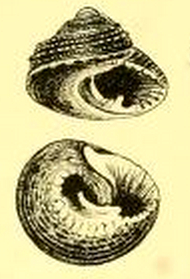
The columella is oblique, and its front edge is plain except for a basal tooth.[1] Four equal granulose lirae and obliquely transverse raised threads ornament the penultimate whorl.[1] Seven concentric lirae are found on the base; the inner ones are subgranose and the outer ones are plain.[1]
What the specialist sources record
The World Register of Marine Species lists Clanculus consobrinus as an accepted species in the family Trochidae, order Trochida, class Gastropoda.[3] GBIF also accepts this species, placing it in the kingdom Animalia, phylum Mollusca, class Gastropoda, order Trochida, family Trochidae.[4]
References
- Wikipedia, "Clanculus consobrinus" (CC BY-SA 4.0), which cites: Transactions of the Royal Society of South Australia v.17 (1892-1893) (original not read by us) en.wikipedia.org
- Wikipedia, "Clanculus consobrinus" (CC BY-SA 4.0), which cites: Rosenberg, G. (2012). Clanculus consobrinus Tate, 1893. Accessed through: World Register of Marine Species at http://www.marinespecies.org/aphia.php?p=taxdetail (original not read by us) en.wikipedia.org
- World Register of Marine Species, Clanculus consobrinus (AphiaID 594191). CC BY 4.0. marinespecies.org
- GBIF Backbone Taxonomy and occurrence index, Clanculus consobrinus (taxon key 4615515). CC BY 4.0 (backbone); counts are facts. gbif.org
Each numbered sentence above was checked against the source it cites before publication. Sentences citing Wikipedia adapt text from the English Wikipedia article Clanculus consobrinus (contributors), used under CC BY-SA 4.0; this entry is available under the same licence. Other sources were used for facts only; no text or images are copied from them.
More in Marine Snails
Sources
Compiled from Wikipedia and the sources listed below. Text from Wikipedia is available under CC BY-SA 4.0; this entry is adapted from it.
- Wikipedia: Clanculus consobrinus (CC BY-SA 4.0).
- Classification: the source article's taxobox; order, family and genus checked against WoRMS, the World Register of Marine Species (CC BY 4.0).
- Occurrence records: GBIF (CC0 / CC BY). Basemap: Natural Earth (public domain).
- Word definitions: the Codexery glossary, each quoted from its Wikipedia article.
Spotted an error? Know more?
Reader corrections go straight into our review queue. Suggest an edit · How this site is sourced