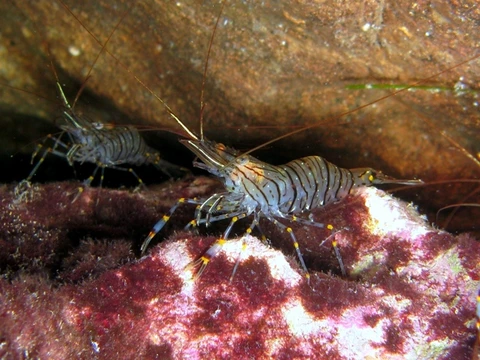
Parhippolyte uveae
A cave shrimp with variable color and behavior across its range.
Last updated
This species is the type species of the genus Parhippolyte.[1] English carcinologist Lancelot Alexander Borradaile authored the species description based on south Pacific specimens gathered by Arthur Willey during 1895–1897.[1]
Scientific classification
- KingdomAnimalia
- PhylumArthropoda
- CladePancrustacea
- ClassMalacostraca
- OrderDecapoda
- SuborderPleocyemata
- InfraorderCaridea
- FamilyBarbouriidae
- GenusParhippolyte
- SpeciesParhippolyte uvae
Named by Borradaile, 1900
Sources: Wikipedia taxobox: Parhippolyte uveae (CC BY-SA 4.0)
Where the parhippolyte uveae has been recorded
Map: drawn by Codexery. Data: Natural Earth basemap (public domain) · place coordinates: Wikipedia (CC BY-SA 4.0)
Quick Facts
- Described by
- Lancelot Alexander Borradaile
- Collected by
- Arthur Willey
- Collection period
- 1895–1897
- Type species of
- Parhippolyte
- Family
- Barbouriidae
- Color forms
- red and white banded (Hawaii) or bright red (other parts of range)
Facts from the source article.
Key facts and history
The species was first described in a 1900 publication by Cambridge University Press.[1] It occurs in anchialine pools and marine caves, including lava pipes in Hawaii and more open areas on other islands.[2] Specimens have been collected from Aldabra, Indonesia, the Philippines, Loyalty Islands, Fiji, Ellice Islands, and Hawaii.[3] In Hawaii, Parhippolyte uveae displays a red and white banded pattern, whereas populations elsewhere exhibit a uniformly bright red coloration.[4]
This shrimp possesses notably elongated, thin legs and antennae.[4] The Mascarene Islands of Réunion and Mauritius are among the locations where this species has been documented.[3] Aquarium hobbyists can obtain Parhippolyte uveae, which is considered straightforward to maintain and breed.[5] Vatulele islanders observe a taboo against harming these prawns, although guides have been permitted to display them to tourists.[6]
What the cited sources add
The IRENAV account by Joseph Poupin lists additional collection locations including Eniwetak Atoll, Vanua Vatu, Vanua Levu Islands, and Funafuti Atoll.[7] Poupin notes that the presence of true P. uveae at Réunion in anchialine ponds must still be confirmed.[7] Poupin also states that presence in French Polynesia must still be confirmed.[7] The IRENAV source comments that there is confusion in the literature between Parhippolyte uveae and Parhippolyte misticia.[7]
Poupin describes P. uveae as mostly an anchialine species in shallow waters, qualified as a "sun lover" by Wear & Holthuis.[7]
References
- Wikipedia, "Parhippolyte uveae" (CC BY-SA 4.0), which cites: L.A. Borradaile, "Zoological results based on material from New Britain, New Guinea, Loyalty Islands and elsewhere, collected during the years 1895, 1896, and 1897", Cambridge University Press, 1900, p. 395–428 (original not read by us) en.wikipedia.org
- Wikipedia, "Parhippolyte uveae" (CC BY-SA 4.0), which cites: "Parhippolyte uveae Borradaile, 1899 (Crustacea: Decapoda: Hippolytidae) from Kakaban Island, Indonesia", Zoologische Mededelingen, 1996, p. 227–233; "An Underwater Guide to Hawai'i", University of Hawaii Press, 1897, p. 76 (we also read that source) en.wikipedia.org
- Wikipedia, "Parhippolyte uveae" (CC BY-SA 4.0), which cites: "Parhippolyte uveae Borradaile, 1899 (Crustacea: Decapoda: Hippolytidae) from Kakaban Island, Indonesia", Zoologische Mededelingen, 1996, p. 227–233; Joseph Poupin, "Parhippolyte uveae Borradaile, 1900", French Navy School, Institut de Recherche de l'Ecole Navale (IRENAV) (we also read that source) en.wikipedia.org
- Wikipedia, "Parhippolyte uveae" (CC BY-SA 4.0), which cites: "An Underwater Guide to Hawai'i", University of Hawaii Press, 1897, p. 76 (we also read that source) en.wikipedia.org
- Wikipedia, "Parhippolyte uveae" (CC BY-SA 4.0), which cites: "Appendix 6 A proposal to create an aquacultural facility Wakatobi Marine National Park, SE Sulawesi, Indonesia", Piotr Kalinowski, Oaklea Ltd; Thomas M. Iliffe, "Parhippolyte sterreri (Hart & Manning, 1981)", Anchialine caves and Cave Fauna of the World (original not read by us) en.wikipedia.org
- Wikipedia, "Parhippolyte uveae" (CC BY-SA 4.0), which cites: "Proceedings of the Asia-Pacific Forum on Karst Ecosystems and World Heritage", UNESCO, 2001 (original not read by us) en.wikipedia.org
- Joseph Poupin, "Parhippolyte uveae Borradaile, 1900", French Navy School, Institut de Recherche de l'Ecole Navale (IRENAV). facts only, no text reused. crustiesfroverseas.free.fr
Each numbered sentence above was checked against the source it cites before publication. Sentences citing Wikipedia adapt text from the English Wikipedia article Parhippolyte uveae (contributors), used under CC BY-SA 4.0; this entry is available under the same licence. Other sources were used for facts only; no text or images are copied from them.
More in Marine Shrimp
Sources
Compiled from Wikipedia and the sources listed below. Text from Wikipedia is available under CC BY-SA 4.0; this entry is adapted from it.
- Wikipedia: Parhippolyte uveae (CC BY-SA 4.0).
- Word definitions: the Codexery glossary, each quoted from its Wikipedia article.
Spotted an error? Know more?
Reader corrections go straight into our review queue. Suggest an edit · How this site is sourced