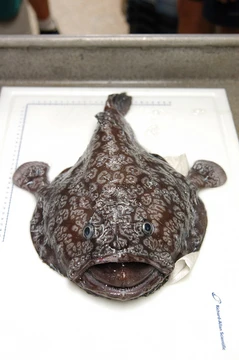
Icelus (fish)
Scaled sculpins of the northern Pacific and Atlantic oceans.
Last updated

Kitty Mecklenburg · via Wikipedia: Scaled sculpin · Public domain
Icelus is a genus of marine ray-finned fishes commonly known as scaled sculpins, belonging to the family Psychrolutidae. Most species are found in the northern Pacific Ocean, with a few also occurring in the North Atlantic Ocean. The genus is notable for its distinctive scalation and the taxonomic debate surrounding its classification.
Scientific classification
- KingdomAnimalia
- PhylumChordata
- ClassActinopterygii
- DivisionTeleostei
- OrderPerciformes
- SuborderCottoidei
- FamilyPsychrolutidae
- GenusIcelus
Named by Krøyer, 1845
Sources: Wikipedia taxobox: Scaled sculpin (CC BY-SA 4.0)
Quick Facts
- Type species
- Icelus hamatus
Facts from the source article.
Lore & Background
The genus Icelus was proposed in 1845 by Danish zoologist Henrik Nikolai Krøyer as a monospecific genus for the species Icelus hamatus, described from Belsund in Spitsbergen. That species was later determined to be a synonym of Cottus bicornis, which had been described by Johan Reinhardt in 1840 from East Greenland. The name Icelus comes from Greek mythology, referring to one of the sons of Hypnus, the god of sleep, alluding to the sluggish movements of many northern sculpin species.
Scaled sculpins are characterized by a single row of large, spiny plate-like scales beneath the dorsal fins, spinous tube-like scales on the lateral line, scales on the axil of the pectoral fins and on the upper part of the eye, and a spine or bump on the nuchal bone. The genus has been classified variously: the 5th edition of Fishes of the World places it within the subfamily Cottinae of the family Cottidae, while other authors classify it within the subfamily Icelinae of the family Psychrolutidae. Previously, Icelus was considered the only genus in the family Icelidae, proposed in 1923 by David Starr Jordan.
An indeterminate fossil specimen of Icelus is known from the Middle Miocene of Sakhalin, Russia. The 19 recognized species range in size from the smallest, I. sekii (maximum standard length 5.3 cm), to the largest, I. cataphractus (maximum total length 30 cm).
Reader's Guide
The genus Icelus holds significance in ichthyology due to its contested taxonomic history and its role as a representative of cold-water sculpin diversity. The shifting classification—from being the sole genus in the family Icelidae to its current placement within either Cottidae or Psychrolutidae—reflects ongoing debates about sculpin relationships. The genus is primarily Pacific, with 16 of its 18 species found in the North Pacific Ocean, while two species (I. bicornis and I. spatula) extend into the Atlantic and Arctic oceans. The fossil record from the Middle Miocene of Sakhalin indicates a long evolutionary history in the North Pacific region.
The scaled sculpins' distinctive morphology, including their unique scale patterns and nuchal spine, distinguishes them from other sculpin groups. The genus name, derived from Greek mythology, connects these fishes to the perceived lethargic behavior of northern sculpins. With 19 recognized species, Icelus continues to be studied for its biogeography and systematics, with new species still being described as recently as 2022.
More in Marine Fish Genera
Sources
Compiled from Wikipedia and the sources listed below. Text from Wikipedia is available under CC BY-SA 4.0; this entry is adapted from it.
- Wikipedia: Scaled sculpin (CC BY-SA 4.0).
- Word definitions: the Codexery glossary, each quoted from its Wikipedia article.
Spotted an error? Know more?
Reader corrections go straight into our review queue. Suggest an edit · How this site is sourced