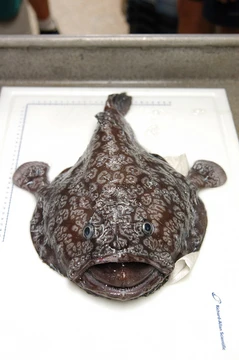
Hapalogenys
Marine fish genus with soft, barbeled chins and laterally compressed bodies.
Last updated

Daiju Azuma · via Wikipedia: Hapalogenys · CC BY-SA 2.5
Hapalogenys, commonly known as barbeled grunters or velvetchins, is a genus of marine ray-finned fish found in coastal areas and river mouths at depths between 30 and 230 m. Its range extends from southern Japan to the Bay of Bengal and northwestern Australia.
Scientific classification
- KingdomAnimalia
- PhylumChordata
- ClassActinopterygii
- DivisionTeleostei
- OrderAcanthuriformes
- FamilyLobotidae
- GenusHapalogenys
Named by Richardson, 1844
Sources: Wikipedia taxobox: Hapalogenys (CC BY-SA 4.0)
Quick Facts
- Type species
- Hapalogenys nitens
Facts from the source article.
Lore & Background
The genus name Hapalogenys is a compound of the Greek hapalos, meaning 'soft', and genys, meaning 'chin'. Sir John Richardson, who erected the genus, explained that this referred to the 'velvety softness of the chin and lower lip, which is made more conspicuous by contrast with the rigidly rough scales that cover the rest of the head'. The type species is Hapalogenys nitens, described by Richardson in 1844 and designated as the type by Pieter Bleeker in 1876. H. nitens was later found to be a junior synonym of Pogonias nigripinnis, and the species is now formally known as Hapalogenys nigripinnis.
Species in this genus have laterally compressed bodies, with 10 pores on and behind the chin, including a pair of tiny pores near the symphysis. The lower jaw and chin bear dense clusters of short barbels. Their small teeth are arranged in bands on the jaws, vomer, and palatines. They have 7 branchiostegal rays supporting the gill membranes.
The dorsal fin contains 11 spines and 13–15 soft rays, while the anal fin has 3 spines and 8–9 soft rays. The caudal fin is rounded. The largest species, Hapalogenys nigripinnis, attains a maximum standard length of 40 cm.
Taxonomic placement of the genus is disputed. The 5th edition of Fishes of the World places Hapalogenys in the monotypic family Hapalogenyidae within the order Perciformes, noting that the family is in a clade of seven families and is probably close to the Acanthuroidei, Monodactylidae, and Priacanthidae. Other authorities place the genus in the family Lobotidae (along with Lobotes and Datnioides) within the order Acanthuriformes.
Reader's Guide
Hapalogenys holds significance as a genus of marine fishes with distinctive morphological features, particularly the velvety soft chin and barbels that give it its common names. The genus was established by Sir John Richardson, a prominent 19th-century naturalist, and its type species designation by Pieter Bleeker reflects the historical development of ichthyological taxonomy. The later synonymy of Hapalogenys nitens with Hapalogenys nigripinnis illustrates the ongoing refinement of species concepts. The genus currently comprises eight recognized species, several of which were described relatively recently, indicating that taxonomic understanding of the group continues to evolve.
The disputed family-level classification—whether Hapalogenys belongs in its own monotypic family Hapalogenyidae within Perciformes or in Lobotidae within Acanthuriformes—highlights unresolved phylogenetic questions that affect broader perciform and acanthuriform systematics. Ecologically, the genus occupies coastal and river-mouth habitats at moderate depths, and some species are consumed in East Asia, giving them economic importance. The largest species reaches 40 cm in standard length, making them moderate-sized fish within their communities. The presence of barbels and specialized chin pores suggests a benthic or near-benthic feeding strategy, though specific dietary details are not recorded in the available literature.
More in Marine Fish Genera
Sources
Compiled from Wikipedia and the sources listed below. Text from Wikipedia is available under CC BY-SA 4.0; this entry is adapted from it.
- Wikipedia: Hapalogenys (CC BY-SA 4.0).
- Word definitions: the Codexery glossary, each quoted from its Wikipedia article.
Spotted an error? Know more?
Reader corrections go straight into our review queue. Suggest an edit · How this site is sourced