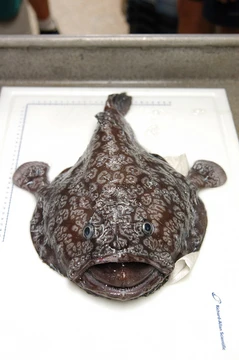
Halieutopsis
A genus of deep-sea batfishes found in the Indian and Pacific Oceans.
Last updated

Robert French / Museums Victoria. · via Wikipedia: Halieutopsis · CC BY 3.0
Halieutopsis is a genus of marine ray-finned fish in the family Ogcocephalidae, commonly known as deep sea batfishes. Members of this genus live in the Indian and Pacific Oceans.
Taxonomy
The genus was first proposed in 1899 by American zoologist Samuel Garman as a monospecific group, with the type species collected off the Galapagos Islands. It belongs to the Indo-Pacific clade within the family Ogcocephalidae, which is itself the sole family in the suborder Ogcocephaloidei, part of the anglerfish order Lophiiformes.
Etymology
The name Halieutopsis combines halieut (from the Greek halieutaea, meaning "angler" or "fisherman") with the suffix opsis ("looking like"), referring to the genus’s resemblance to the related genus Halieutaea.
Species
Seventeen species are currently recognized: Halieutopsis andriashevi, H. bathyoreos, H. echinoderma, H. galatea, H. ingerorum, H. kawaii, H. margaretae, H. murrayi, H. nasuta, H. nudiventer, H. oblonga, H. okamurai, H. simula, H. stellifera, H. taiwanea, H. tumifrons, and H. vermicularis. Many authorities consider H. vermicularis a synonym of H. nasuta.
Characteristics
These batfishes are distinguished from other ogcocephalines by lacking gill filaments on the third and fourth gill arches, and typically having teeth on the fifth ceratobranchial arranged in two small, well-separated patches. The illicium is simple, spine-like, and lacks a cavity at its base. The esca has two large lateral lobes and a dorsal middle lobe, often with cirrhi or skin flaps. The pectoral fin bases are broadly connected to the body.
The lateral line is broken; the tail portion runs along the lower body and reaches just before or past the anus, with one to six neuromasts on each side of the anus. Individuals are relatively small, usually less than 100 mm in standard length. The largest species, H. nasuta, reaches a maximum total length of 140 mm.
Halieutopsis species are found in the Indian Ocean and the western and eastern Pacific Oceans, in temperate to tropical regions on continental shelves and slopes, and in deeper Indo-Pacific waters, at depths ranging from about 100 to 4020 meters.
Scientific classification
- KingdomAnimalia
- PhylumChordata
- ClassActinopterygii
- DivisionTeleostei
- OrderLophiiformes
- FamilyOgcocephalidae
- GenusHalieutopsis
Named by Garman, 1899
Sources: Wikipedia taxobox: Halieutopsis (CC BY-SA 4.0)
Lore & Background
Halieutopsis was first proposed as a monospecific genus in 1899 by the American zoologist Samuel Garman, with its type locality given as off the Galapagos Islands. The genus is classified within the 'Indo-Pacific clade' of the family Ogcocephalidae, which itself is placed in the monotypic suborder Ogcocephaloidei within the order Lophiiformes, the anglerfishes. The name Halieutopsis suffixes opsis, meaning 'looking like', to halieut, derived from halieutaea, Greek for an 'angler' or 'fisherman', referencing the genus' resemblance to the genus Halieutaea.
Halieutopsis are distinguished from other Ogcocephaline genera by having no gill filaments on the third and fourth gill arches, with teeth typically found on the fifth ceratobranchial where they are divided into two well separated, small patches. The illicium is relatively simple and resembles a spine, lacking a cavity at its base. The esca has two large lateral lobes and a dorsal, middle lobe which typically has cirrhi or skin flaps.
The base of the pectoral fin is widely connected to the body. The lateral line is broken, with the part towards the tail running along the lower body and reaching to just in front of or past the anus, with between one and six neuromasts on each side of the anus. These batfishes are relatively small, typically having a standard length of less than 100 mm, with the largest species being H. nasuta at a maximum published total length of 140 mm.
Halieutopsis batfishes are found in the Indian Ocean and the western and eastern Pacific Oceans in temperate to tropical regions on continental shelves, slopes, and in deeper waters of the Indo-Pacific at depths between approximately 100 and 4020 m.
More in Marine Fish Genera
Test yourself
Three questions drawn from this entry’s sources. Pick an answer to check it.
Answers checked against the source article
Sources
Compiled from Wikipedia and the sources listed below. Text from Wikipedia is available under CC BY-SA 4.0; this entry is adapted from it.
- Wikipedia: Halieutopsis (CC BY-SA 4.0).
- Word definitions: the Codexery glossary, each quoted from its Wikipedia article.
Spotted an error? Know more?
Reader corrections go straight into our review queue. Suggest an edit · How this site is sourced