Frequently Asked Questions
The most-asked questions about marine angelfish.
What exactly are marine angelfish?
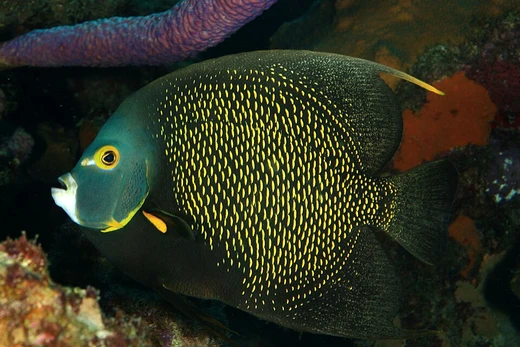
Marine angelfish are a diverse group of reef-associated fish in the family Pomacanthidae, found primarily across the Indo-Pacific and parts of the Atlantic. They are recognized by their laterally compressed, disc-like bodies, vivid coloration, and the angular dorsal-and-anal fin structure that gives them an 'angel-like' silhouette.
How are they related to freshwater angelfish?
Despite sharing the common name, marine and freshwater angelfish are not closely related; they belong to entirely different families and evolved their similar body shapes through convergent evolution. The name 'angelfish' is purely a descriptive label for their disc profile and fin shapes, not an indicator of kinship.
How many species exist in the group?
Taxonomists recognize roughly 80 to 90 species spread across about seven genera, with Centropyge (commonly called 'pea' or 'dwarf' angelfish) alone accounting for over fifty. Some genera, like the monotypic Pygoplites, contain only a single described species.
What do they eat in the wild?
Most marine angelfish are opportunistic omnivores, grazing on sponges, tunicates, filamentous algae, and small invertebrates tucked into reef crevices. A handful of species are more specialized, relying heavily on sponge tissue for the bulk of their nutrition.
What's the size range across the group?
Adult sizes vary dramatically, from the tiny Pygoplites diacanthus at roughly four inches to Holacanthus species that can exceed twelve inches. This wide range means the group spans both nano-reef and large-display-tank suitability.
Which species is most sought after by hobbyists?
The Orchid Angelfish (Pygoplites diacanthus) is often considered the crown jewel of the group because of its striking purple-and-yellow coloration and scarcity in the wild. Among more accessible options, the Bi-spot (Centropyge bicuspis) and Lemon Pea (Centropyge flavissima) remain perennial favorites for smaller reef tanks.
Are marine angelfish peaceful tankmates?
Most species are moderately territorial, particularly toward conspecifics and visually similar fish, though they generally coexist fine with non-aggressive reef dwellers. Males in particular can become noticeably combative as they mature and stake out a territory.
Where in the ocean can you find them?
The bulk of the group is native to coral reefs across the Indo-Pacific, stretching from the Red Sea east to Fiji and south to northern Australia. A smaller number of species, notably those in the genus Holacanthus, inhabit reefs in the Western Atlantic and Caribbean.
What's a common misconception about keeping them?
A frequent error is assuming that because a species is small as a juvenile it will stay small and easy to house; many 'dwarf' angelfish still demand substantial tank volume and stable parameters as adults. Another is underestimating dietary needs, since several species require sponge-based supplements in captivity to maintain health and color.
What makes the group notable in reef-keeping culture?
Marine angelfish are often regarded as the showpiece of a reef aquarium because of their bold coloration and active swimming, making them a natural centerpiece for experienced hobbyists. Their popularity has also fueled significant interest in selective breeding programs and sparked ongoing conservation discussions around wild-caught populations.