Eof
Swineherd whose vision led to the founding of Evesham Abbey.
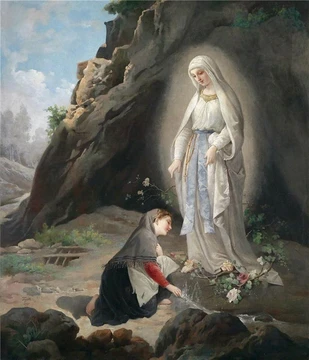
Around 701, a swineherd named Eof, also known as Eoves, reported seeing a vision of the Virgin Mary near what is now Evesham, England. He told Bishop Egwin of Worcester, who then established Evesham Abbey at that location. The town's name derives from Eof's ham, meaning Eof's homestead.
Quick Facts
- Date of vision
- about 701
- Location
- Evesham, England
- Visionary
- Eof (also Eoves)
- Recipient of vision report
- Egwin, Bishop of Worcester
- Resulting foundation
- Evesham Abbey
Facts from the source article.
Legend
According to the standard Lives and the work on Saint Egwin and his Abbey of Evesham, a swineherd named Eof was looking for a lost pig when he came across three supernaturally beautiful women singing in the woods. He told Bishop Egwin about it right away. Egwin went to the same spot and also saw the three women. One of them was holding a book and a gold cross, and Egwin identified her as the Virgin Mary. This story is how the location for Evesham Abbey was chosen. A letter supposedly written by Ecgwin includes the Latin phrase primum cuidam pastori gregum, and the Acta Sanctorum uses similar wording, pastores gregum. The Latin can mean either a shepherd or a herdsman. William Dugdale, in his Monasticon Anglicanum, calls Eoves a herdsman of the bishop. George May, the leading historian of Evesham, lists both herdsman and swineherd. The idea that Eof was a swineherd goes back at least to William of Malmesbury in the twelfth century. The front of the conventual seal of Evesham Abbey clearly shows stylised pigs, not sheep, so the monks there believed Eof kept pigs. A bronze statue in the town centre, paid for by public subscription and made by British sculptor John McKenna, commemorates the legend. It was unveiled in a public ceremony on Sunday, 15 June 2008.
More in Marian Visionaries
Spotted an error? Know more?
Reader corrections go straight into our review queue. Suggest an edit · How this site is sourced