Frequently Asked Questions
The most-asked questions about mantis shrimp.
What exactly is a mantis shrimp?
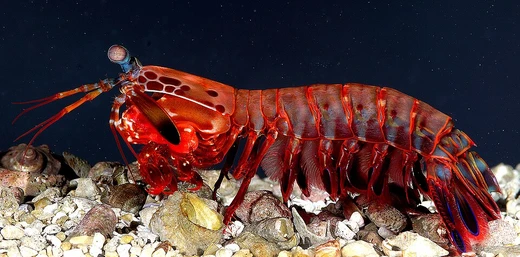
It's a small, armored crustacean in the order Stomatopoda that lives in tropical and subtropical reef waters. Despite the name, it is neither a true shrimp nor related to insects; it's closer to crabs and lobsters. They're famous for lightning-fast strikes and extraordinarily complex eyes.
What are the two main feeding types people talk about?
'Smashers' (peacock stomatopods) swing their raptorial appendages like a fist to crush shells, while 'spearers' (spear stomatopods) jab with a harpoon-tipped limb to impale soft-bodied prey. Almost every species falls into one of these two morphologies.
Where do mantis shrimp live and how are they found?
They burrow in sand, mud, or rocky crevices across the Indo-Pacific, the Atlantic, and the Caribbean. Most species are solitary and territorial, defending their tunnel from other invertebrates and small fish.
What's the single most mind-blowing fact about them?
Smasher species accelerate their punch so rapidly that the water in front of the limb flashes-boils, producing a cavitation bubble that adds extra impact force. The combined hit can exceed 80 mph and generate a brief flash of light (sonoluminescence) as the bubble collapses.
How does their vision compare to a human's?
Mantis shrimp possess up to 16 types of photoreceptor cells, far more than our three cone types, and can also detect polarized light. This gives them a color and polarization range that no other known animal matches, though their brain processes that information in ways still being studied.
Can a mantis shrimp hurt a human?
In practice, they're too small and fast to pose a real threat, though a direct hit from a large smasher can sting or bruise. The more common danger is to aquarium glass: their strikes have been recorded shattering thick tank panels.
What's a good starting point if I've never looked into them?
Begin by learning the smasher-versus-spearer distinction, since it shapes nearly every other behavior. From there, dive into their visual system and then watch slow-motion footage of a strike to see the cavitation effect in action.
How big do they actually get?
Most species range from roughly 5 to 15 cm in body length, with the largest, Austrosquilla osculans, reaching about 23 cm. Even the biggest are still palm-sized, which makes their power-to-size ratio all the more striking.
Why are they called 'mantis shrimp' if they're neither?
Early naturalists in the 1800s latched onto the name because their forward-folding raptorial limbs looked like a praying mantis's forelegs, and 'shrimp' was a loose catch-all for small crustaceans. The term stuck in common usage long after taxonomy sorted them into their own order.
What's a standout moment in mantis-shrimp research?
The 2001 demonstration that a smasher's punch generates a cavitation bubble was a watershed, because it showed an animal producing a physical effect previously associated only with sonar and deep-sea phenomena. Equally iconic is the ongoing puzzle of how their 16-channel visual system is processed, a question that has kept neurobiologists busy for decades.