Burasa
Last updated
Burasa (pronounced ['bu:rasaʔ]), also known as burasak or buras, is a rice dumpling from the Bugis people, made by cooking rice in coconut milk and wrapping it in a banana leaf pouch. It resembles lontong but has a richer taste due to the coconut milk. This dish is a specialty of the Bugis and Makassar communities in South Sulawesi, and it is also common among the Bugis diaspora in the Malaysian states of Johor, Selangor, Sabah, and Sarawak. It often serves as a staple in place of steamed rice or ketupat, and pairs well with a rich chicken dish braised with galangal (known as ayam masak lengkuas in Malay or likku/lekku in Buginese).
To prepare burasa, rice is first steamed until half-cooked, then cooked further in coconut milk seasoned with daun salam (Indonesian bay leaf) and salt until all the liquid is absorbed. The partially cooked rice is then wrapped in banana leaves into cylindrical or pillow shapes, tied with string—often made from banana leaf fibers—with two cylinders typically bound together. These packages are steamed again until fully cooked.
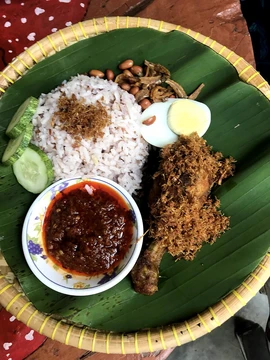
In Indonesia, burasa can be eaten as a snack with serundeng (spiced shredded coconut), hard-boiled egg, or sambal kacang (spicy peanut sauce). Bugis and Makassar people often eat it as a substitute for steamed rice or ketupat, commonly alongside coto Makassar, konro, pallubasa, or lekku. It is also frequently taken as travel provisions or rations during sailing trips.
More in Malaysian cuisine
Sources
Compiled from Wikipedia and the sources listed below. Text from Wikipedia is available under CC BY-SA 4.0; this entry is adapted from it.
- Wikipedia: Burasa (CC BY-SA 4.0).
Spotted an error? Know more?
Reader corrections go straight into our review queue. Suggest an edit · How this site is sourced