Mount Hikurangi (Gisborne District)
North Island's highest non-volcanic peak, sacred to Ngāti Porou.
Last updated
Where it is
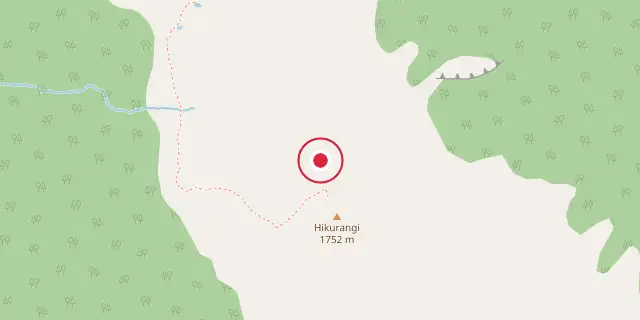
Coordinates: 37°55′01″S 178°03′36″E (-37.9170, 178.0600) · Open in OpenStreetMap
Coordinates and connected clubs: the infobox of Wikipedia: Mount Hikurangi (Gisborne District) (CC BY-SA 4.0). Map: drawn by Codexery from OpenStreetMap tiles.
Mount Hikurangi (Te Ara ki Hikurangi) is a 1752 m peak in the eastern corner of New Zealand's North Island, about 80 km north of Gisborne. It is the North Island's highest non-volcanic peak, located on a spur of the Raukūmara Range in the Waiapu Valley. In Māori mythology, it was the first part of the North Island to emerge when Māui pulled it as a giant fish from the ocean.
History
Ngāti Porou believe they descend from Māui, connecting them to the mountain since it arose from the sea. In the 1870s, the Crown acquired the mountain and made it a state forest park. Ownership was returned to Ngāti Porou in November 1990, and they now manage the mountain and facilitate public access. Several gold rushes occurred in early European settlement.
In 1874, about 100 Māori prospected on and around the mountain, but Sir James Hector found no gold. In 1875, “Scotty” Siddons claimed to have met a Māori with a few ounces of gold, but he and a mate found only mundic on the north-west side. In 1886, Reupane te Ana discovered what he thought was a large gold deposit; after many people rushed to collect it, the metal turned out to be mundic, and Reupane became known as “Tommy Poorfellow.”
The first sunrise of the new day
Mount Hikurangi is traditionally seen as the first place on Earth to receive the new day's sunlight, though this is open to debate. It holds true only during the Southern Hemisphere summer, since Fiji and Tonga are further east. Because of the Earth's axial tilt, the mountain catches the sun earlier than those islands in summer, but not before the Chatham Islands or Antarctica. Around midsummer, some South Island peaks like those on Banks Peninsula and Mount Cargill in Dunedin receive dawn light at almost the same moment.
Still, the mountain gained global attention during the new Millennium celebrations. The Department of Conservation notes it is accepted as the first mainland point to greet the morning sun. Ngāti Porou marked the first dawn of the year 2000 on the summit with karakia led by Tamati and Amster Reedy. Nine large whakairo telling Māui's story and his family were also placed on the mountain for the event, carved under Derek Lardelli's guidance by students from Toihoukura.
Flora and fauna
The summit of Mount Hikurangi is the northernmost place where New Zealand's alpine vegetation can be seen, including large buttercups and prickly wild Spaniards. The mountain contains the only known habitat of the Hikurangi tutu, a small sub-alpine shrub found on the grassy scree slope behind the Mount Hikurangi Tramping Hut. It was the location of the last known mainland sighting of the North Island saddleback in 1910, before its reintroduction to the North Island in 2002.
In Māori times, kaka fattened on tawari berries on the mountain. In the 1960s, members of the Gisborne Tramping Club heard what may have been the call of a kākāpō, a parrot last documented in the North Island in 1895.
The nearby Raukūmara Forest Park's forests include podocarp-broadleaved species such as rimu, rātā, tawa, hinau, rewarewa, kāmahi, kahikatea, miro, beech and tōtara. Native birds and animals include pīwakawaka, tūī, whio, kākā, falcons, kererū, brown kiwi, Hochstetter's frogs, snails, lizards, skinks, Motuweta riparia, and short- and long-tailed bats. Introduced animals include deer, goats, possums, pigs, cattle and mustelidae.
Significance to Māori
Mount Hikurangi, known as Te Ara ki Hikurangi, holds deep spiritual, cultural, and physical importance for Ngāti Porou, standing as the iwi’s most significant symbol. In Māori tradition, it was the first part of the North Island to rise when Māui, a Ngāti Porou ancestor, hauled it up as a giant fish from the sea. His canoe, Nukutaimemeha, was left stranded on the mountain and now rests petrified near the top. Another ancestral figure, Paikea, is also tied to the mountain.
The story goes that Paikea’s half-brother Ruatapu tried to kill around 70 older relatives at sea in Hawaiki as revenge for being belittled. Only Paikea survived by appealing to sea gods and ancestors, then traveled to New Zealand on a whale. Ruatapu sent a great flood, Te Tai a Ruatapu, to wipe out survivors, and Mount Hikurangi became a refuge from that deluge. The mountain appears often in Ngāti Porou’s karakia, waiata, haka, and pēpeha.
One identity proverb says: Ko Hikurangi te maunga, Ko Waiapu te awa, Ko Ngāti Porou te iwi. The haka Rūaumoko includes the line: He atua! He tangata! He atua!
He tangata! Ho! Another haka, Whakarongo ake ki te hīrea waha o Māui, contains: Whakaeteete mai ko Hikurangi. A saying about abundant food is: He kākā tāwari ki Hikurangi, he moki ki te moana.
When snow covers the mountain, the saying goes: Ka rukuruku a Te Rangi-tāwaea i ōna pūeru. Te Kani-a-Takirau once said: Ehara a Hikurangi i te maunga haere, meaning Hikurangi is not a travelling mountain, using this to explain why he would not leave the area when offered the Māori Kingship, declaring he was already a king through his ancestors.
Did You Know?
- The mountain is about 130 km north of Gisborne by road.
- The traditional greeting of South Island iwi Ngāi Tahu to North Island visitors is 'Haere mai, e te Rāwhiti!' (Welcome, O Sunrise!).
More in Māori Mythology
Sources
Compiled from Wikipedia and the sources listed below. Text from Wikipedia is available under CC BY-SA 4.0; this entry is adapted from it.
- Wikipedia: Mount Hikurangi (Gisborne District) (CC BY-SA 4.0).
Spotted an error? Know more?
Reader corrections go straight into our review queue. Suggest an edit · How this site is sourced