Great Zimbabwe
Last updated

via Wikipedia: Great Zimbabwe · see source
Where it is
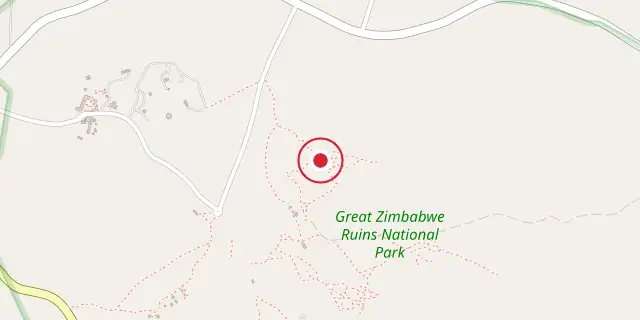
Coordinates: 20°16′01″S 30°55′59″E (-20.2670, 30.9330) · Open in OpenStreetMap
Coordinates and connected clubs: the infobox of Wikipedia: Great Zimbabwe (CC BY-SA 4.0). Map: drawn by Codexery from OpenStreetMap tiles.
Located in the southeastern highlands of present-day Zimbabwe not far from Masvingo, Great Zimbabwe represents the biggest stone construction built in Southern Africa before colonial times.[1] Human occupation began around 1000 AD, and during the 13th century it became the seat of government for the Kingdom of Great Zimbabwe.[1] The stone city covers 7.22 km² and was erected by forebears of the Shona people.[1]
What happened
The Great Enclosure, with dry stone walls 11 m high, was built during the 13th and 14th centuries.[2] By the late 15th century, offshoots from the royal family formed new dynasties, possibly due to losing succession disputes.[3] The 11th century marked the start of major building activity, which lasted into the 15th century.[1] Around 1300, Great Zimbabwe overtook Mapungubwe as a hub for commerce.[4]
Controlling the trade routes that connected the goldfields to the Swahili coast generated much of its prosperity.[5] People probably kept living at the site into the 1600s, after which it was finally deserted.[2]
What the cited sources add
Ndoro states that the great conical tower, 30 feet high and 18 feet in diameter at the base, appears to have served a merely symbolic function.[6] Ndoro explains that the absence of blue-and-white Chinese porcelain, which became widespread during the mid-15th century, suggests Great Zimbabwe's economic importance was less by that time.[6] The Live Science account reports that the earliest written records for the city date to the 16th century, a time after it was largely abandoned.[7] The Live Science account notes that a team of scientists wrote that the excavated area at Great Zimbabwe is less than 2 percent.[7]
Bing's study of Chinese-style ceramics states that the corpus from Great Zimbabwe includes around 20 bowl and plate sherds of Longquan green-glazed stoneware, dated from the beginning of the 14th to the end of the 15th century.[8] Bing's study also notes that no mosque remains have been identified at the Great Zimbabwe site.[8]
References
- Wikipedia, "Great Zimbabwe" (CC BY-SA 4.0), which cites: Pikirayi, "The Conundrum of Great Zimbabwe", Journal of Urban Archaeology, January 2023, p. 95–114; Chirikure, "New Perspectives on the Political Economy of Great Zimbabwe", Journal of Archaeological Research, 2020-06-01, p. 139–186; Pikirayi, "Great Zimbabwe, 1100–1600 AD, Rise, Development, and Demise of", Springer International Publishing, 2020, p. 4696–4709; "Great Zimbabwe: African City of Stone", Live Science, 10 March 2017 (we also read that source) en.wikipedia.org
- Wikipedia, "Great Zimbabwe" (CC BY-SA 4.0), which cites: Pikirayi, "Great Zimbabwe, 1100–1600 AD, Rise, Development, and Demise of", Springer International Publishing, 2020, p. 4696–4709 (original not read by us) en.wikipedia.org
- Wikipedia, "Great Zimbabwe" (CC BY-SA 4.0), which cites: Newitt, "Southern Zambezia States and Indian Ocean Trade, 1450–1900", 2018-05-24; Pikirayi, "Great Zimbabwe, 1100–1600 AD, Rise, Development, and Demise of", Springer International Publishing, 2020, p. 4696–4709; Huffman, "Ritual Space in the Zimbabwe Culture", Journal of Archaeological, Ethnographic and Experimental Studies, 2014-04-01, p. 4–39; Waarden, "Butua and the End of an Era: The Effect of the Collapse of the Kalanga State on Ordinary Citizens: an Analysis of Behaviour Under Stress", Archaeopress, 2012 (original not read by us) en.wikipedia.org
- Wikipedia, "Great Zimbabwe" (CC BY-SA 4.0), which cites: Ndoro, "Great Zimbabwe", Scientific American, 2005-01-01; Chirikure, "Mapungubwe Reconsidered: A Living Legacy: Exploring Beyond the Rise and Decline of the Mapungubwe State", Real African Publishers Pty Ltd., 2015-10-01 (original not read by us) en.wikipedia.org
- Wikipedia, "Great Zimbabwe" (CC BY-SA 4.0), which cites: Mlambo, "A history of Zimbabwe", New York, NY : Cambridge University Press, 2014; Hawarden, "Early Maritime Cultures in East Africa and the Western Indian Ocean", Archaeopress, 2018; Delius, "Turning South African History Upside Down: Ivory and Gold Production, the Indian Ocean Trading System and the Shaping of Southern African Society, 600–1900 AD", Journal of Southern African Studies, 2024, p. 499–; Bing, "Chinese-style ceramics in East Africa from the 9th to 16th century:...", journals.openedition.org; Gilbert Pwiti, "Trade and econom en.wikipedia.org
- Ndoro, "Great Zimbabwe", Scientific American, 2005-01-01. scientificamerican.com
- "Great Zimbabwe: African City of Stone", Live Science, 10 March 2017. livescience.com
- Bing, "Chinese-style ceramics in East Africa from the 9th to 16th century:...", journals.openedition.org. journals.openedition.org
Each numbered sentence above was checked against the source it cites before publication. Sentences citing Wikipedia adapt text from the English Wikipedia article Great Zimbabwe (contributors), used under CC BY-SA 4.0; this entry is available under the same licence. Other sources were used for facts only.
More in Lost Civilizations
Sources
Compiled from Wikipedia and the sources listed below. Text from Wikipedia is available under CC BY-SA 4.0; this entry is adapted from it.
- Wikipedia: Great Zimbabwe (CC BY-SA 4.0).
Spotted an error? Know more?
Reader corrections go straight into our review queue. Suggest an edit · How this site is sourced