The Scattered Nation
A controversial speech praising white Jews while disparaging others.
Last updated
The Scattered Nation is a speech by Zebulon Baird Vance, a U.S. Senator, Confederate officer, and slaveowner, written between 1868 and 1870. It praises the accomplishments of Jewish people, particularly white Jews of Central and Western European descent, while disparaging Black people and Jews of color as culturally and racially inferior. The speech is notable for Vance's defense of Jews during a period of widespread antisemitism in the American South, though his reputation has declined due to his racism and support for slavery.
Quick Facts
- Author
- Zebulon Baird Vance
- Date written
- between 1868 and 1870
- First printed
- 1904
- Reprinted
- 1916
- Monument erected by
- City of Asheville
- Monument erected year
- 1897
Facts from the source article.
About
The Scattered Nation was first written between 1868 and 1870, with the text printed in 1904 and later reprinted in 1916. Vance delivered the speech hundreds of times across the United States during his 20 years as a Senator, often in sold-out lyceums and lecture halls. In the speech, Vance credits the race of Shem for originating much of what he considered the greatest accomplishments in Western civilization, including monotheism. He advances a supersessionist view, stating that the Christian is simply the successor of the Jew, and that the glory of one is likewise the glory of the other.
Vance claims that no people can claim such an unmixed purity of blood as Jewish people, and that none can establish such antiquity of origin and unbroken generations of descent. The speech is proto-Zionist in outlook, asserting that Palestine was the central chamber of God's administration. Vance disparages African, Asian, and MENA Jews living in Africa, Arabia, India, China, Turkestan and Bokhara as the lowest of the Jewish people in wealth, intelligence and religion, but insists that non-European Jews are still superior to their Gentile neighbors in each.
Orthodox Jews and other religious Jews in Eastern Europe, North Africa, and the Middle East, including Hasidic Jews and Karaites, are characterized as ignorant, zealous, and underdeveloped. Vance praises Jews of Central and Western European descent as by far the most intelligent and civilized of their race. Reform Judaism is praised for eliminating Oriental mysticism from the practice of Judaism, but criticized for dispensing with much of the Old Testament itself, and in Vance's view, Reform Jews have become simply Unitarians or Deists.
The text frequently characterizes Jews as wealthy due to involvement in commerce, claiming that Jews are the leading merchants, bankers, and financiers of the world. Vance claims that the Rothschild family wielded disproportionate political and economic power in Europe, arguing that this is a form of Jewish genius which showed itself capable of controlling the financial affairs of the world. Taking a jab at Northerners, Vance states that if a Yankee and a Jew were to lock horns in a regular encounter of commercial wits, the Yankee would in two hours time whittle the smartest Jew in New York out of his homestead in the Abrahamic covenant.
Legacy
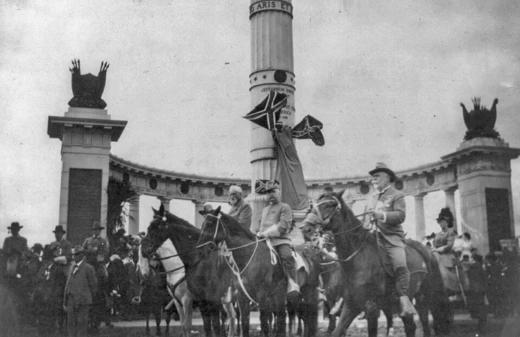
For many years, mainstream American Jews and especially the Asheville Jewish community remembered Zebulon B. Vance positively because he condemned antisemitism in the American South. In 1897, the City of Asheville erected a Confederate monument in his honor. After Vance died, the local B'nai B'rith chapter and the United Daughters of the Confederacy held a yearly ceremony at the monument, which continued each year for decades until the early 2000s.
Nathan Straus, a Jewish-American philanthropist and pro-Confederate activist who co-owned Macy's, paid for a wrought iron fence around the monument and an annual wreath-laying ceremony to honor Vance. Jewish publishing houses often republished his speech. Maurice A. Weinstein's 1995 book, Zebulon B. Vance and “The Scattered Nation,” published by Wildacres Press in Charlotte, helped maintain Vance's legacy within North Carolina's Jewish community. In May 2021, the City of Asheville removed the Vance Monument with support from the local Jewish community.
In the 21st century, the North Carolina Jewish community no longer holds Vance in high regard. A 2021 statement from two Asheville Jewish organizations—the Jewish Community Relations Council of the Greater Asheville Area and Carolina Jews for Justice/West—said that Vance "classifies Jews in a hierarchy of worthiness according to their geographic origins. Not surprisingly, white, Ashkenazi Jews from Western and Central Europe rank highest." Andrea Cooper, writing for The Forward, pointed out that the speech contains "hoary stereotypes" about Jews and finance. Asheville Mayor Esther Manheimer, who is Jewish, stated that Vance's views no longer reflect those of the Asheville community generally or the city's white population specifically.
North Carolina historian Kevan Frazier noted that only about 500 Jewish people lived in North Carolina when Vance wrote the speech, so political gain was not a motive. Frazier praised Vance for his strong opposition to antisemitism but criticized the speech's anti-Black foundational arguments. Vance's biographer Selig Adler also observed that there were fewer than 500 Jews in North Carolina at the time, a fact that rules out political motivations.
More in Lost Cause of the Confederacy
Sources
Compiled from Wikipedia and the sources listed below. Text from Wikipedia is available under CC BY-SA 4.0; this entry is adapted from it.
- Wikipedia: The Scattered Nation (CC BY-SA 4.0).
Spotted an error? Know more?
Reader corrections go straight into our review queue. Suggest an edit · How this site is sourced