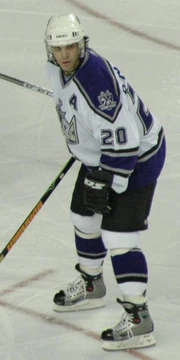
Ilya Kovalchuk
Russian winger, first overall pick, and Olympic gold medalist.
Last updated
Ilya Valeryevich Kovalchuk is a Russian former professional ice hockey winger. Over his career, he suited up for the Atlanta Thrashers, New Jersey Devils, Los Angeles Kings, Montreal Canadiens, and Washington Capitals in the NHL, plus Ak Bars Kazan, Khimik Moscow Oblast, SKA Saint Petersburg, Avangard Omsk, and Spartak Moscow in the Russian Superleague and KHL. He was the first Russian ever taken first overall in the NHL draft, going to Atlanta in 2001.
Spartak Moscow
Kovalchuk came up through Spartak Moscow’s youth system and played two seasons with their senior team in the Vysshaya Liga before heading to North America. After eight years with the Thrashers, he was traded to New Jersey in 2010.
There, he signed a 15-year, $100 million contract after the NHL blocked a 17-year, $102 million deal. In 2013, he left the NHL to return to Russia, joining SKA Saint Petersburg for five seasons. He came back to the NHL in 2018, then returned to the KHL for the 2020–21 season, took two years off, and eventually finished his playing days back with Spartak.
In the NHL, Kovalchuk ranks tied for fourth all time in regular-season overtime goals (15) and 18th in goals-per-game average (.511). He is the seventh-highest scoring Russian in league history. He was named to two NHL All-Star teams and, in 2004, shared the Maurice "Rocket" Richard Trophy as the league’s top goal-scorer with Jarome Iginla and Rick Nash.
International play
Internationally, Kovalchuk played for Russia’s junior teams at the World U18 Championship and World Junior Championship, and for the senior team at the World Championship, World Cup, and Winter Olympics. He won World Championship gold in 2008 and 2009. At his fifth Olympics in 2018, he was named tournament MVP while helping the Olympic Athletes from Russia win the gold medal.
Early life
Kovalchuk was born in Kalinin (now Tver), about 180 kilometres northwest of Moscow, the second child and first son of Valeri and Lyubov. He was named after Ilya Muromets, a legendary figure from Kievan Rus’. His father played basketball in Tver, then coached and headed the sport’s school at the Spartak Olympic reserve in the city from 1980 to 1998.
His mother ran the #2 polyclinic at the #7 Tver city hospital. Valeri wrote a book about Kovalchuk’s development, “From Tver to Atlanta,” published in 2004; he died of heart disease in 2005. Kovalchuk’s sister, Arina, is seven years older.
Lore & Background
Kovalchuk developed in the youth system of Spartak Moscow, joining their senior team in the Vysshaya Liga in 1999. After two seasons, he was drafted first overall by the Atlanta Thrashers in 2001. He wore number 17 as a tribute to Soviet star Valeri Kharlamov. In his rookie season, he scored 29 goals and 51 points despite missing 17 games with a season-ending shoulder injury, finishing second in Calder Memorial Trophy voting to teammate Dany Heatley.
He scored 41 goals in 2003–04, tying for the Maurice 'Rocket' Richard Trophy with Jarome Iginla and Rick Nash. After the 2004–05 NHL lockout, he returned to Russia, playing for Ak Bars Kazan and Khimik Moscow Oblast before signing a five-year, $32 million contract with the Thrashers. He scored 52 goals in 2005–06, becoming the first Thrashers player to reach 50 goals in a season. He was named team captain in January 2009.
In February 2010, he was traded to the New Jersey Devils after contract negotiations failed. With the Devils, he signed a 15-year, $100 million contract after a 17-year, $102 million deal was blocked by the NHL. In 2013, he left the NHL to return to Russia, joining SKA Saint Petersburg for five seasons before returning to the NHL in 2018. He returned to the KHL for the 2020–21 season, took two years off, and ultimately returned to Spartak Moscow.
Roots in Tver and the Spartak Pipeline
Ilya Valeryevich Kovalchuk was born on April 15, 1983, in Kalinin—now Tver, roughly 180 kilometres northwest of Moscow. As the first son of Valeri and Lyubov, he was notably large at birth and named for Ilya Muromets, the legendary warrior of Kievan Rus'. His father had played basketball in Tver before becoming a coach, leading the sport's school at the Spartak Olympic reserve from 1980 to 1998.
His mother headed the second polyclinic at Tver's seventh city hospital. Their older sister Arina was seven years his senior. At age seven, young Ilya was invited to the Spartak Moscow youth academy, and every weekend he and his father took the train to attend training.
That early bond with the Spartak system defined his formative years, eventually leading to his appearance at the 1997 Quebec International Pee-Wee Hockey Tournament. On the ice, he wore number 17 in tribute to Soviet superstar Valeri Kharlamov. His father later chronicled his son's journey in a 2004 book, "From Tver to Atlanta," a fitting arc from a small provincial city to the NHL's biggest stage.
First Overall and the Thrashers Era
When the Atlanta Thrashers selected Kovalchuk with the top pick in the 2001 NHL entry draft, he became the first Russian player ever to be chosen first overall in league history. His rookie campaign was interrupted by a season-ending shoulder injury that cost him 17 games, yet he still tallied 29 goals and 51 points, finishing second to teammate Dany Heatley in Calder Trophy voting. By 2003–04, his scoring prowess was undeniable: 41 goals and 87 points earned him a three-way tie for the Maurice "Rocket" Richard Trophy alongside Jarome Iginla and Rick Nash. The 2005–06 season marked a personal peak—52 goals and a career-high 98 points made him the first Thrashers player to cross the 50-goal mark.
Despite a dip in production in 2006–07, the franchise reached the Stanley Cup playoffs for the first time in its history. Kovalchuk's career statistics cement his place in NHL lore: he is tied for fourth all-time in regular-season overtime goals with 15, ranks 18th in goals-per-game average at .511, and stands as the seventh-highest scoring Russian in league history. Two All-Star selections underscored his elite standing.
Russia's Golden-Era Scorer on the World Stage
Kovalchuk's international résumé spans both junior and senior levels for Russia. He represented the national junior squad at the World U18 Championship and the World Junior Championship before progressing to the senior team, where he competed in the World Championship, World Cup, and Winter Olympics. His crowning achievements came at the 2008 and 2009 World Championships, where Russia claimed gold with Kovalchuk on the roster. The pinnacle of his international career arrived at the 2018 Winter Olympics, his fifth appearance at the Games.
Competing under the banner of Olympic Athletes from Russia, he was named the tournament's most valuable player while helping the team capture the gold medal. That MVP honour at the Olympics, combined with two World Championship titles, placed him among the most decorated Russian forwards of his generation on the world stage. His longevity in international competition—spanning from junior tournaments through five Olympic cycles—reflected both his sustained excellence and Russia's continued reliance on his scoring ability in high-pressure tournaments.
A Peripatetic Career Across Two Leagues
Kovalchuk's career path was anything but linear. The 2004–05 NHL lockout sent him back to Russia, where he split time between Ak Bars Kazan and Khimik Moscow Oblast in the Russian Superleague. A subsequent contract standoff with Atlanta kept him in Russia once more; he played 11 games for Khimik, posting 8 goals and 13 points, before signing a five-year, $32 million deal to rejoin the Thrashers. In 2010, a trade to the New Jersey Devils brought a landmark 15-year, $100 million contract after the league blocked a proposed 17-year, $102 million deal.
By 2013, he chose to leave the NHL entirely, spending five seasons with SKA Saint Petersburg in the KHL. His 2018 return to North America saw him suit up for the Montreal Canadiens, Los Angeles Kings, and Washington Capitals. A final KHL stint with Avangard Omsk in 2020–21 was followed by two years away from the game. Ultimately, the circle closed: Kovalchuk returned to Spartak Moscow, the very club whose youth system had first shaped him as a seven-year-old trainee.
Reader's Guide
Kovalchuk's significance lies in his status as the first Russian selected first overall in the NHL draft and his consistent goal-scoring prowess, evidenced by his .511 goals-per-game average and his tie for fourth all time in regular-season overtime goals. He won the Maurice 'Rocket' Richard Trophy in 2004 as co-leader in goals. His career was marked by a high-profile contract with the New Jersey Devils—a 15-year, $100 million deal after a larger 17-year, $102 million contract was blocked by the NHL—and his subsequent departure from the NHL in 2013 to return to Russia. He played for SKA Saint Petersburg for five seasons before returning to the NHL in 2018.
Internationally, he won gold medals at the 2008 and 2009 World Championships and was named most valuable player at his fifth Olympics in 2018, helping Olympic Athletes from Russia win the gold medal. He is the seventh-highest scoring Russian in NHL history. His legacy includes being the all-time leader for the Atlanta Thrashers in games played, goals, assists, and points at the time of his trade.
Career statistics and honours
Regular season and playoffs
| Regular season | Playoffs | |||||||||||
|---|---|---|---|---|---|---|---|---|---|---|---|---|
| Season | Team | League | GP | G | A | Pts | PIM | GP | G | A | Pts | PIM |
| 1999–00 | Spartak Moscow | RUS-2 | 49 | 12 | 5 | 17 | 75 | — | — | — | — | — |
| 1999–00 | Spartak–2 Moscow | RUS-3 | 2 | 2 | 1 | 3 | 14 | — | — | — | — | — |
| 2000–01 | Spartak Moscow | RUS-2 | 40 | 28 | 18 | 46 | 78 | 12 | 14 | 4 | 18 | 38 |
| 2001–02 | Atlanta Thrashers | NHL | 65 | 29 | 22 | 51 | 28 | — | — | — | — | — |
| 2002–03 | Atlanta Thrashers | NHL | 81 | 38 | 29 | 67 | 57 | — | — | — | — | — |
| 2003–04 | Atlanta Thrashers | NHL | 81 | 41 | 46 | 87 | 63 | — | — | — | — | — |
| 2004–05 | Ak Bars Kazan | RSL | 53 | 19 | 23 | 42 | 72 | 4 | 0 | 1 | 1 | 0 |
| 2005–06 | Khimik Moscow Oblast | RSL | 11 | 8 | 5 | 13 | 24 | — | — | — | — | — |
| 2005–06 | Atlanta Thrashers | NHL | 78 | 52 | 46 | 98 | 68 | — | — | — | — | — |
| 2006–07 | Atlanta Thrashers | NHL | 82 | 42 | 34 | 76 | 66 | 4 | 1 | 1 | 2 | 19 |
| 2007–08 | Atlanta Thrashers | NHL | 79 | 52 | 35 | 87 | 52 | — | — | — | — | — |
| 2008–09 | Atlanta Thrashers | NHL | 79 | 43 | 48 | 91 | 50 | — | — | — | — | — |
| 2009–10 | Atlanta Thrashers | NHL | 49 | 31 | 27 | 58 | 45 | — | — | — | — | — |
| 2009–10 | New Jersey Devils | NHL | 27 | 10 | 17 | 27 | 8 | 5 | 2 | 4 | 6 | 6 |
| 2010–11 | New Jersey Devils | NHL | 81 | 31 | 29 | 60 | 28 | — | — | — | — | — |
| 2011–12 | New Jersey Devils | NHL | 77 | 37 | 46 | 83 | 33 | 23 | 8 | 11 | 19 | 6 |
| 2012–13 | SKA Saint Petersburg | KHL | 36 | 18 | 24 | 42 | 12 | — | — | — | — | — |
| 2012–13 | New Jersey Devils | NHL | 37 | 11 | 20 | 31 | 18 | — | — | — | — | — |
| 2013–14 | SKA Saint Petersburg | KHL | 45 | 16 | 24 | 40 | 38 | 10 | 3 | 2 | 5 | 31 |
| 2014–15 | SKA Saint Petersburg | KHL | 54 | 25 | 30 | 55 | 69 | 22 | 8 | 11 | 19 | 12 |
| 2015–16 | SKA Saint Petersburg | KHL | 50 | 16 | 33 | 49 | 24 | 4 | 0 | 0 | 0 | 2 |
| 2016–17 | SKA Saint Petersburg | KHL | 60 | 32 | 46 | 78 | 47 | 18 | 6 | 3 | 9 | 35 |
| 2017–18 | SKA Saint Petersburg | KHL | 53 | 31 | 32 | 63 | 26 | 15 | 6 | 4 | 10 | 12 |
| 2018–19 | Los Angeles Kings | NHL | 64 | 16 | 18 | 34 | 10 | — | — | — | — | — |
| 2019–20 | Los Angeles Kings | NHL | 17 | 3 | 6 | 9 | 12 | — | — | — | — | — |
| 2019–20 | Montreal Canadiens | NHL | 22 | 6 | 7 | 13 | 2 | — | — | — | — | — |
| 2019–20 | Washington Capitals | NHL | 7 | 1 | 3 | 4 | 4 | 8 | 0 | 1 | 1 | 2 |
| 2020–21 | Avangard Omsk | KHL | 16 | 5 | 12 | 17 | 16 | 24 | 4 | 5 | 9 | 31 |
| 2023–24 | Spartak Moscow | KHL | 20 | 4 | 4 | 8 | 2 | 5 | 0 | 0 | 0 | 2 |
| NHL totals | 926 | 443 | 433 | 876 | 544 | 40 | 11 | 17 | 28 | 33 | ||
| RSL totals | 64 | 27 | 28 | 55 | 96 | 4 | 0 | 1 | 1 | 0 | ||
| KHL totals | 334 | 147 | 205 | 352 | 234 | 98 | 27 | 25 | 52 | 125 | ||
International
| Year | Team | Event | GP | G | A | Pts | PIM |
|---|---|---|---|---|---|---|---|
| 2000 | Russia | U17 | 6 | 10 | 4 | 14 | 2 |
| 2000 | Russia | WJC18 | 6 | 2 | 3 | 5 | 6 |
| 2001 | Russia | WJC | 7 | 4 | 2 | 6 | 37 |
| 2001 | Russia | WJC18 | 6 | 11 | 4 | 15 | 26 |
| 2002 | Russia | OLY | 6 | 1 | 2 | 3 | 14 |
| 2003 | Russia | WC | 7 | 4 | 0 | 4 | 6 |
| 2004 | Russia | WC | 6 | 3 | 1 | 4 | 6 |
| 2004 | Russia | WCH | 4 | 1 | 0 | 1 | 4 |
| 2005 | Russia | WC | 9 | 3 | 3 | 6 | 4 |
| 2006 | Russia | OLY | 8 | 4 | 1 | 5 | 31 |
| 2007 | Russia | WC | 9 | 2 | 5 | 7 | 10 |
| 2008 | Russia | WC | 8 | 2 | 6 | 8 | 52 |
| 2009 | Russia | WC | 9 | 5 | 9 | 14 | 4 |
| 2010 | Russia | OLY | 4 | 1 | 2 | 3 | 0 |
| 2010 | Russia | WC | 9 | 2 | 10 | 12 | 2 |
| 2011 | Russia | WC | 9 | 3 | 5 | 8 | 6 |
| 2013 | Russia | WC | 8 | 8 | 5 | 13 | 29 |
| 2014 | Russia | OLY | 5 | 3 | 0 | 3 | 2 |
| 2015 | Russia | WC | 10 | 2 | 3 | 5 | 2 |
| 2018 | OAR | OLY | 6 | 5 | 2 | 7 | 4 |
| 2019 | Russia | WC | 10 | 2 | 3 | 5 | 4 |
| Junior totals | 25 | 27 | 13 | 40 | 71 | ||
| Senior totals | 127 | 51 | 57 | 108 | 180 | ||
All-Star Games
| Year | Location | G | A | P | |
|---|---|---|---|---|---|
| 2004 | St. Paul | 1 | 0 | 1 | |
| 2008 | Atlanta | 0 | 1 | 1 | |
| 2009 | Montreal | 0 | 0 | 0 | |
| 2013 | Chelyabinsk | 3 | 0 | 3 | |
| 2014 | Bratislava | 1 | 2 | 3 | |
| 2015 | Sochi | 4 | 2 | 6 | |
| NHL All-Star totals | 1 | 1 | 2 | ||
| KHL All-Star totals | 8 | 4 | 12 | ||
Tables copied from the source article, totals included as the source gives them: Wikipedia: Ilya Kovalchuk (CC BY-SA 4.0). Wide tables scroll sideways.
Frequently Asked Questions
When did Ilya Kovalchuk play for the Los Angeles Kings?
Kovalchuk joined the Kings as a free-agent signing for the 2017-18 NHL season. It was one of the final stops in a long career that also included stints with Atlanta, New Jersey, Montreal, and Washington.
Why did Ilya Kovalchuk join the Kings?
After his time in Montreal and Washington, Kovalchuk signed with Los Angeles to add depth and a proven scoring threat to their forward lines. The Kings were looking for a veteran with a proven track record to complement their core group.
More in Los Angeles Kings Players
Test yourself
Three questions drawn from this entry’s sources. Pick an answer to check it.
Answers checked against the source article
Sources
Compiled from Wikipedia and the sources listed below. Text from Wikipedia is available under CC BY-SA 4.0; this entry is adapted from it.
- Wikipedia: Ilya Kovalchuk (CC BY-SA 4.0).
- Statistics, medals and awards: the tables of the source article.
- Word definitions: the Codexery glossary, each quoted from its Wikipedia article.
Spotted an error? Know more?
Reader corrections go straight into our review queue. Suggest an edit · How this site is sourced