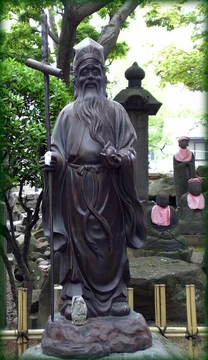
Sri Chand
Founder of the Udasi sect and son of Guru Nanak.
He is also known as Baba Sri Chandra, Bhagwan Sri Chandra, Guru Chandradev, Guru Chandracharya, and Sri Candracarya.[1][2] His traditional lifespan is given as 8 September 1494 to 13 January 1629, though current scholarship suggests calendar conversion errors.[3] The Udasi sect of ascetic Sadhus was founded by Sri Chand, who was the eldest son of Guru Nanak, the first Guru and founder of Sikhism.[1][4]
Quick Facts
- Religion
- Udasi
- Father
- Guru Nanak
- Birth name
- Sri Chand Bedi
- Born
- 8 September 1494
- Died
- 13 January 1629 (134 years old)
- Place of death
- Kiratpur, Lahore Subah, Mughal Empire
- Mother
- Mata Sulakhni
- Relatives
- Lakhmi Das (brother)
Facts from the source article.
Key facts and history
Sri Chand was born to Mata Sulakhani on 8 September 1494 in Sultanpur Lodhi, with lore describing his birth as marked by ash-covered body and matted hair.[4] At age seven, his father Guru Nanak began his first travel tour, and Sri Chand later studied Vedic literature under Pandit Hardayal.[5][6] He left for Srinagar at age eleven to study Sanskrit and yoga, and defeated scholar Somanatha Tripathi in a religious debate.[7] After Guru Nanak returned home in 1522, Sri Chand had become a celibate ascetic.[8]
Sri Chand was given joint-custody of his father's estate but left it to his brother to pursue a spiritual career.[9] After his father's death in 1539, Sri Chand built a samadh at Kartarpur and later shifted his father's ashes to Pakkhoke Randhawa, where Dera Baba Nanak developed.[10][11] He founded the Udasi sect to propagate his interpretation of his father's philosophy, establishing its base at Barath near Pathankot.[12] Sri Chand wrote a ten-verse work titled Arta Sri Guru Nanak Dev in praise of his father.[13]
According to a sakhi, he visited Guru Arjan and contributed to the seventeenth canto of the Sukhmani Sahib by reciting his father's verse.[14] He died in Kiratpur on 13 January 1629, with Udasi beliefs claiming he disappeared into the forests of Chamba.[15]
What the cited sources add
Surjit Singh Gandhi's account states that Sri Chand was unable to reconcile his father's teaching of mental asceticism with his own preference for physical separation from the world.[16][9] Gandhi also notes that Sri Chand borrowed elements like langar and sangat from his father's practices, but promoted celibacy and asceticism as the ideal lifestyle.[16][9] According to Gandhi, Sri Chand considered the hymns of later Sikh gurus to be divine, but his advocacy of asceticism and celibacy versus the Sikh gurus' ideal of a householder's life created the primary division between Udasis and mainstream Sikhs.[16][9]
References
- Wikipedia, "Sri Chand" (CC BY-SA 4.0), which cites: "The encyclopaedia of Sikhism", Punjabi University, 1992–1998, p. 377–379 (original not read by us) en.wikipedia.org
- Wikipedia, "Sri Chand" (CC BY-SA 4.0), which cites: Agarwal, "Kumbh special: Akharas explained", Times of India, 12 January 2025; Kapoor, "The Udasi Tradition", eSamskirit (originally published in the Bhavan’s Journal, 15 May 2014 issue), 7 November 2020 (original not read by us) en.wikipedia.org
- Wikipedia, "Sri Chand" (CC BY-SA 4.0), which cites: "Baba Siri Chand, Founder of the Udasi Sect", Learn Religions (original not read by us) en.wikipedia.org
- Wikipedia, "Sri Chand" (CC BY-SA 4.0), which cites: Singh, "Genealogy of Guru Nanak", Abstracts of Sikh Studies, October–December 2019; Kapoor, "The Udasi Tradition", eSamskirit (originally published in the Bhavan’s Journal, 15 May 2014 issue), 7 November 2020; Kapoor, "The Udasi Tradition", eSamskirit (originally published in the Bhavan’s Journal, 15 May 2014 issue), 7 November 2020; Kapoor, "The Udasi Tradition", eSamskirit (originally published in the Bhavan’s Journal, 15 May 2014 issue), 7 November 2020 (we also read that source) en.wikipedia.org
- Wikipedia, "Sri Chand" (CC BY-SA 4.0), which cites: Kapoor, "The Udasi Tradition", eSamskirit (originally published in the Bhavan’s Journal, 15 May 2014 issue), 7 November 2020; Singh, "Genealogy of Guru Nanak", Abstracts of Sikh Studies, October–December 2019 (we also read that source) en.wikipedia.org
- Wikipedia, "Sri Chand" (CC BY-SA 4.0), which cites: Kapoor, "The Udasi Tradition", eSamskirit (originally published in the Bhavan’s Journal, 15 May 2014 issue), 7 November 2020 (original not read by us) en.wikipedia.org
- Wikipedia, "Sri Chand" (CC BY-SA 4.0), which cites: Singh, "Genealogy of Guru Nanak", Abstracts of Sikh Studies, October–December 2019; Gandhi, "History of Sikh Gurus Retold", Atlantic Publishers & Distributors, 2007, p. 979–983; Gandhi, "History of Sikh Gurus Retold", Atlantic Publishers & Distributors, 2007, p. 979–983; Singh, "Genealogy of Guru Nanak", Abstracts of Sikh Studies, October–December 2019; Kapoor, "The Udasi Tradition", eSamskirit (originally published in the Bhavan’s Journal, 15 May 2014 issue), 7 November 2020; Singh, "Genealogy of Guru Nanak", Abstracts of Sikh Studies, Octob en.wikipedia.org
- Wikipedia, "Sri Chand" (CC BY-SA 4.0), which cites: Singh, "Genealogy of Guru Nanak", Abstracts of Sikh Studies, October–December 2019; Kapoor, "The Udasi Tradition", eSamskirit (originally published in the Bhavan’s Journal, 15 May 2014 issue), 7 November 2020; Singh, "Genealogy of Guru Nanak", Abstracts of Sikh Studies, October–December 2019 (we also read that source) en.wikipedia.org
- Wikipedia, "Sri Chand" (CC BY-SA 4.0), which cites: Gandhi, "History of Sikh Gurus Retold", Atlantic Publishers & Distributors, 2007, p. 979–983 (we also read that source) en.wikipedia.org
- Wikipedia, "Sri Chand" (CC BY-SA 4.0), which cites: Gandhi, "History of Sikh Gurus Retold", Atlantic Publishers & Distributors, 2007, p. 979–983; Grewal, "The Sikhs of the Punjab", Cambridge University Press, 1998, p. 47–48 (we also read that source) en.wikipedia.org
- Wikipedia, "Sri Chand" (CC BY-SA 4.0), which cites: Singh, "Genealogy of Guru Nanak", Abstracts of Sikh Studies, October–December 2019; Singh, "Genealogy of Guru Nanak", Abstracts of Sikh Studies, October–December 2019; Singh, "Genealogy of Guru Nanak", Abstracts of Sikh Studies, October–December 2019; Singh, "Genealogy of Guru Nanak", Abstracts of Sikh Studies, October–December 2019; Kapoor, "The Udasi Tradition", eSamskirit (originally published in the Bhavan’s Journal, 15 May 2014 issue), 7 November 2020; Gandhi, "History of Sikh Gurus Retold", Atlantic Publishers & Distributors, 2007, p. 9 en.wikipedia.org
- Wikipedia, "Sri Chand" (CC BY-SA 4.0), which cites: Singh, "Genealogy of Guru Nanak", Abstracts of Sikh Studies, October–December 2019; Kaur, "UDĀSĪ", Encyclopedia of Sikhism (Online Edition); Gandhi, "History of Sikh Gurus Retold", Atlantic Publishers & Distributors, 2007, p. 979–983; Kaur, "UDĀSĪ", Encyclopedia of Sikhism (Online Edition); Singh, "Genealogy of Guru Nanak", Abstracts of Sikh Studies, October–December 2019; Singh, "Genealogy of Guru Nanak", Abstracts of Sikh Studies, October–December 2019; Kapoor, "The Udasi Tradition", eSamskirit (originally published in the Bhavan’s Journal, en.wikipedia.org
- Wikipedia, "Sri Chand" (CC BY-SA 4.0), which cites: Kapoor, "The Udasi Tradition", eSamskirit (originally published in the Bhavan’s Journal, 15 May 2014 issue), 7 November 2020; Sibal, "The Guru - Guru Nanak's Saakhis", StoryMirror Infotech Pvt Ltd, 2022, p. 146; Ralhan, "Srichandraji Maharaj", Anmol Publications Pvt. Ltd, 2004, p. 35 (original not read by us) en.wikipedia.org
- Wikipedia, "Sri Chand" (CC BY-SA 4.0), which cites: "The encyclopaedia of Sikhism", Punjabi University, 1992–1998, p. 265–65; Nayar, "The Sikh View on Happiness : Guru Arjan's Sukhmani.", Bloomsbury Publishing Plc, 2020, p. 38–40 (original not read by us) en.wikipedia.org
- Wikipedia, "Sri Chand" (CC BY-SA 4.0), which cites: Singh, "Genealogy of Guru Nanak", Abstracts of Sikh Studies, October–December 2019; Kapoor, "The Udasi Tradition", eSamskirit (originally published in the Bhavan’s Journal, 15 May 2014 issue), 7 November 2020; Singh, "Genealogy of Guru Nanak", Abstracts of Sikh Studies, October–December 2019; Kaur, "UDĀSĪ", Encyclopedia of Sikhism (Online Edition); Kapoor, "The Udasi Tradition", eSamskirit (originally published in the Bhavan’s Journal, 15 May 2014 issue), 7 November 2020; Kapoor, "The Udasi Tradition", eSamskirit (originally published in the en.wikipedia.org
- Open Library record, ISBN 9788126908585 ("History of Sikh gurus retold"). CC0 (metadata); book content not read. openlibrary.org
Each numbered sentence above was checked against the source it cites before publication. Sentences citing Wikipedia adapt text from the English Wikipedia article Sri Chand (contributors), used under CC BY-SA 4.0; this entry is available under the same licence. Other sources were used for facts only; no text or images are copied from them.
More in Longevity Myths
Spotted an error? Know more?
Reader corrections go straight into our review queue. Suggest an edit · How this site is sourced