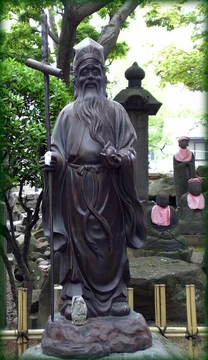
Emperor Kōan
Sixth legendary emperor of Japan, lived to age 137.
Historians dispute his actual existence and regard him as a "legendary emperor"[1] According to the traditional order of succession, Emperor Kōan is regarded as the sixth legendary emperor of Japan.[2] The Kojiki contains only his name and genealogical information.[1]
Quick Facts
- Reign
- 393 BC – 291 BC (traditional)
- Predecessor
- Kōshō
- Successor
- Kōrei
- Spouse
- Oshihime
- Issue
- Ōkibinomorosusumi-no-Mikoto; Emperor Kōrei
- Royal house
- Imperial House of Japan
- Father
- Emperor Kōshō
- Mother
- Yosotarashi-hime
Facts from the source article.
Key facts and history
The Kojiki and Nihon Shoki record only his name and genealogy.[3] The Japanese have traditionally accepted his historical existence, and an Imperial misasagi or tomb is maintained for him.[3] No extant contemporary records confirm that this historical figure actually reigned.[3] Allegedly, Kōan's rule started in 393 BC, lasted over a century, and ended with his death in 291 BC when he was said to be 137 years old.[1]
Tradition holds that Kōan was the last emperor of the Jōmon period, a period that concluded around 300 BC.[1] Kōan is thought to have been the son of Emperor Kōshō, with Yosotarashi-no-hime as his mother.[3] The name "Kōan" was first attributed to the 8th-century Japanese scholar Ōmi no Mifune.[4] A memorial Shinto shrine in Tamade, Gose, is the traditional site where Kōan is venerated.[5]
What the cited sources add
Historian John S. Brownlee describes the claimed 137-year lifespan of Kōan as "too long," yet he observes that such extreme ages are typical for mythical figures.[6][7] According to Brownlee, no one in Japan found the long lives of earlier emperors troubling until modern times.[6][7] The precise location of Kōan's grave remains unknown.[6][7]
References
- Wikipedia, "Emperor Kōan" (CC BY-SA 4.0), which cites: Ponsonby-Fane, Richard, "The Imperial House of Japan", Ponsonby Memorial Society, 1959, p. 30 & 418; Perri, "Hunting dogs as environmental adaptations in Jōmon Japan", Antiquity, 2016, p. 1166–1180 (original not read by us) en.wikipedia.org
- Wikipedia, "Emperor Kōan" (CC BY-SA 4.0), which cites: "孝安天皇 (6)", Imperial Household Agency (Kunaichō); Brown, Delmer M. and Ichirō Ishida, "A Translation and Study of the Gukanshō, an Interpretative History of Japan Written in 1219", University of California Press, 1979, p. 251–252 (original not read by us) en.wikipedia.org
- Wikipedia, "Emperor Kōan" (CC BY-SA 4.0), which cites: Varley, H. Paul., "Jinnō Shōtōki: A Chronicle of Gods and Sovereigns", Columbia University Press, 1980, p. 90; Brown, Delmer M. and Ichirō Ishida, "A Translation and Study of the Gukanshō, an Interpretative History of Japan Written in 1219", University of California Press, 1979, p. 251–252; Varley, H. Paul., "Jinnō Shōtōki: A Chronicle of Gods and Sovereigns", Columbia University Press, 1980, p. 90; John S. Brownlee, "Political Thought in Japanese Historical Writing: From Kojiki (712) to Tokushi Yoron (1712)", Wilfrid Laurier Univ. Press, en.wikipedia.org
- Wikipedia, "Emperor Kōan" (CC BY-SA 4.0), which cites: Brinkley, Frank, "A History of the Japanese People from the Earliest Times to the end of the Meiji Era", Encyclopaedia Britannica Company, 1915, p. 21; Aston, William George., "Nihongi: Chronicles of Japan from the Earliest Times to A.D. 697, Volume 2", The Japan Society London, 1896, p. 109, 145–146; Britannica Kokusai Dai-Hyakkajiten article "Ōmi no Mifune". Britannica. (original not read by us) en.wikipedia.org
- Wikipedia, "Emperor Kōan" (CC BY-SA 4.0), which cites: "孝安天皇 (6)", Imperial Household Agency (Kunaichō); Ponsonby-Fane, Richard, "The Imperial House of Japan", Ponsonby Memorial Society, 1959, p. 30 & 418 (original not read by us) en.wikipedia.org
- Wikipedia, "Emperor Kōan" (CC BY-SA 4.0), which cites: John S. Brownlee, "Political Thought in Japanese Historical Writing: From Kojiki (712) to Tokushi Yoron (1712)", Wilfrid Laurier Univ. Press, August 14, 1991, p. 30 (we also read that source) en.wikipedia.org
- Open Library record, ISBN 9780889209978 ("Political thought in Japanese historical writing"). CC0 (metadata); book content not read. openlibrary.org
Each numbered sentence above was checked against the source it cites before publication. Sentences citing Wikipedia adapt text from the English Wikipedia article Emperor Kōan (contributors), used under CC BY-SA 4.0; this entry is available under the same licence. Other sources were used for facts only; no text or images are copied from them.
More in Longevity Myths
Spotted an error? Know more?
Reader corrections go straight into our review queue. Suggest an edit · How this site is sourced