Frequently Asked Questions
The most-asked questions about loitering munitions and target drones.
What is a loitering munition?
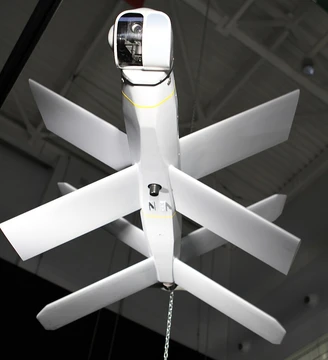
A loitering munition is a one-way attack drone that hovers or circles in a target area until an operator confirms a target, then dives onto it to detonate its warhead. It blends the persistent, loitering behavior of an unmanned aerial vehicle with the terminal strike of a missile.
What is a target drone?
A target drone is an unmanned airframe built to be shot down or intercepted so that air-defense weapons, sensors, and engagement procedures can be evaluated. It carries no offensive warhead and is expendable by design.
How does a loitering munition differ from a cruise missile?
A cruise missile flies a pre-programmed route to a fixed coordinate and cannot be recalled or retargeted mid-flight, whereas a loitering munition can hover, change its loitering pattern, and be redirected to a different target in real time before committing to its terminal dive.
Who are the key developers and manufacturers in this space?
Notable players include General Atomics (Switchblade), IAI (Python), UMS (Lancet), and various Chinese firms producing Shahed-like designs, alongside target-drone makers such as Boeing (BQM-167 MALD) and AeroVironment.
What was a notable early real-world use?
The U.S. Army fielded the AGM-114 Switchblade 200 in Afghanistan around 2017 for short-range infantry strikes, and the concept gained widespread public attention during the Russia-Ukraine conflict from 2022 onward, where Lancet and Shahed-136 systems were employed extensively by both sides.
How does a loitering munition actually operate?
The operator launches the airframe, which climbs to a loitering altitude and circles while streaming live video to a ground- or vehicle-mounted control station; once a target is confirmed, the operator triggers a terminal descent in which the warhead detonates on impact.
What range and payload can I expect?
Small infantry-portable models like the Switchblade 300 reach roughly 20 km with a 1.2 kg warhead, while larger systems such as the Shahed-136 or Lancet-3 can operate at 1,000 km or more with warheads in the 40–50 kg range.
Where should a newcomer start learning about this topic?
A good entry point is reading open-source defense analyses from organizations like IISS, Jane's, or CSIS on loitering-munition doctrine, then watching public demonstration footage from manufacturers and reviewing after-action reports from conflicts where these systems have been employed.
What is the practical difference between a target drone and a loitering munition?
A target drone is built to be destroyed so the shooter's system can be evaluated, while a loitering munition is built to destroy a target; the two roles are opposite even though both use small, expendable airframes.
Where is the field heading?
Current development trends emphasize greater autonomy, swarming coordination, longer loiter times, and AI-assisted target recognition, while target drones are evolving toward more realistic kinematic and radar signatures to better stress-test next-generation air-defense systems.