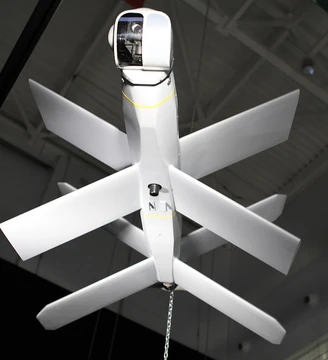
NAI CK-1
China's first indigenously developed drone, derived from the Soviet La-17.
Last updated
The NAI CK-1 is a target drone, and the first unmanned aerial vehicle built by China. It is based on the Soviet Lavochkin La-17. Work on the drone started in the early 1960s under the People's Liberation Army Air Force, but the Nanjing Aviation Institute took over the project in 1968. The drone entered service around the late 1970s.
Development
Development began after China decided to reverse engineer the Soviet-supplied La-17, which had been used for training since the late 1950s. The Sino-Soviet split cut off further supplies, prompting this effort. The PLAAF’s Weapon Test and Training Base, led by General Zhao Xu, started the work in the early 1960s.
The Cultural Revolution halted progress, but it resumed in April 1967 at NAI. The first test launch took place in late 1969, possibly in October or on 6 December. Trials finished in 1976, and the drone entered PLAAF inventory in March 1977, though design certification may not have come until 1979.
The CK-1A radiation reconnaissance variant was created to replace manned aircraft for air sampling during nuclear tests. A March 1977 requirement drove its development. China’s 22nd nuclear test, on 17 September 1977, was the first live use of the drone; it passed through the mushroom cloud twice and landed safely.
The CK-1B low-altitude target drone, meant for surface-to-air missile training, began development in February 1980. It first flew on 18 May 1982 and formally entered PLAAF inventory in February 1983.
The CK-1C enhanced manoeuvrability target drone started development in May 1983. It first flew in September 1984 and underwent certification testing from February to March 1985.
CK-1 target drone
The CK-1 has several changes from the La-17. It uses a domestic autopilot and data link, a reinforced airframe, and revised fuel and electrical systems. The La-17’s RD-900 ramjet could not be reverse engineered, so it was replaced by a non-afterburning version of the WP-6 turbojet, a Chinese copy of the Soviet Tumansky RD-9B.
This mirrors the La-17M’s development. Fighter engines near the end of their service lives were converted for drone use. The CK-1 takes off using a trolley for a rolling start.
Later variants use a solid-propellant rocket booster to shorten the take-off distance. The La-17, by contrast, launches from a ramp. The CK-1 lands with a parachute recovery system.
CK-1A radiation reconnaissance drone
The CK-1A carries an air sampling pod under each wing.
More in Loitering Munitions and Target Drones
Sources
Compiled from Wikipedia and the sources listed below. Text from Wikipedia is available under CC BY-SA 4.0; this entry is adapted from it.
- Wikipedia: NAI CK-1 (CC BY-SA 4.0).
Spotted an error? Know more?
Reader corrections go straight into our review queue. Suggest an edit · How this site is sourced