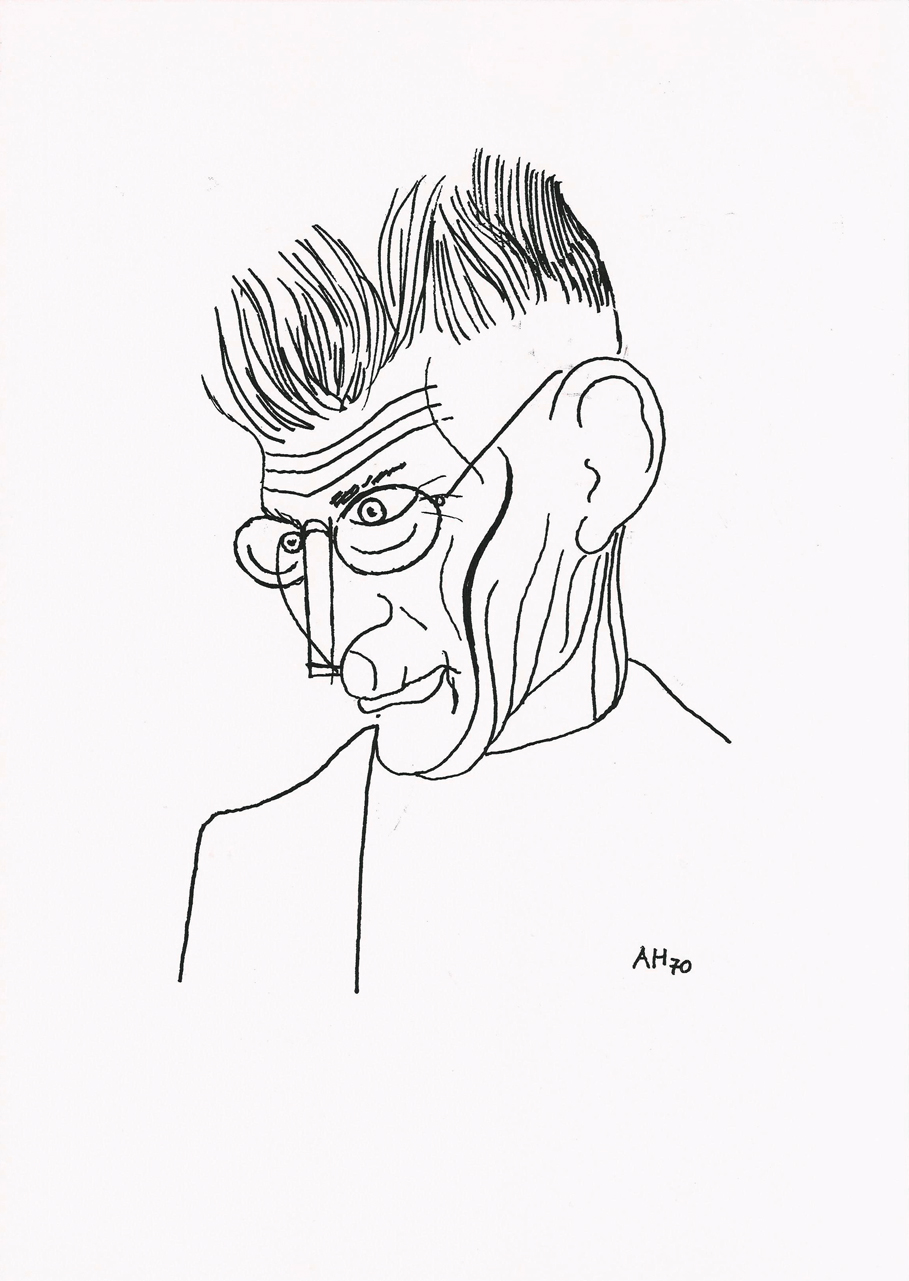
Samuel Beckett
Irish playwright, novelist, and poet; key figure in the Theatre of the Absurd.

via Wikipedia: Samuel Beckett · see source
Samuel Barclay Beckett was an Irish playwright, novelist, and poet, widely regarded as one of the most influential and important writers of the 20th century. He is best known for his tragicomedy play *Waiting for Godot* (1953), which has become a centrepiece of modernist literature and was voted 'the most significant English-language play of the 20th century' in a 1998 public poll by London's Royal National Theatre. Beckett's works, written in both English and French, feature bleak, impersonal, and tragicomic episodes of life, coupled with black comedy and literary nonsense, and he is credited with transforming modern theatre. For his foundational contribution to both literature and theatre, Beckett received the 1969 Nobel Prize in Literature, 'for his writing, which—in new forms for the novel and drama—in the destitution of modern man acquires its elevation.'
Born in Foxrock, a Dublin suburb, to a quantity surveyor father and a nurse mother, Beckett was raised Anglican but later became agnostic, a perspective that shaped his writing. He attended Portora Royal School and Trinity College Dublin, where he studied modern literature and Romance languages, graduating in 1927. A natural athlete, he played first-class cricket for Dublin University, making him the only Nobel literature laureate to appear in Wisden. After brief teaching, he moved to Paris in 1928 as a lecturer at the École Normale Supérieure, where he met James Joyce and assisted with research for *Finnegans Wake*. His first published work was a critical essay defending Joyce’s style. Beckett’s early career included literary criticism and a short-lived lecturing post in Dublin. His first novel, *Dream of Fair to Middling Women* (1932), influenced later works but was published posthumously. During the Second World War, he joined the French Resistance group Gloria SMH and received the Croix de Guerre. His later plays became increasingly austere and minimalistic, employing stream of consciousness, repetition, and self-reference. Beckett is considered a key figure in the Theatre of the Absurd, and his existential themes made his work central to 20th-century drama. He died in 1989 and was buried at the Cimetière du Montparnasse.
- born
- 13 April 1906
- died
- 22 December 1989
- field
- Playwright, novelist, poet
- nationality
- Irish
- known_for
- Waiting for Godot (1953)
Verified Timeline
Lore & Background
Samuel Beckett was born in the Dublin suburb of Foxrock on 13 April 1906, the son of William Frank Beckett, a quantity surveyor of Huguenot descent, and Maria Jones Roe, a nurse. He attended Portora Royal School in Enniskillen, which Oscar Wilde had also attended, and later entered Trinity College Dublin, where he studied modern literature and Romance languages, receiving his bachelor's degree in 1927. A natural athlete, he excelled at cricket as a left-handed batsman and left-arm medium-pace bowler, playing two first-class games for Dublin University against Northamptonshire, making him the only Nobel literature laureate to have played first-class cricket. After teaching briefly at Campbell College in Belfast, he took up the post of *lecteur d'anglais* at the École Normale Supérieure in Paris from November 1928 to 1930, where he was introduced to Irish author James Joyce by Thomas MacGreevy. Beckett assisted Joyce with research for *Finnegans Wake* and published his first work, a critical essay titled 'Dante... Bruno. Vico.. Joyce', in 1929. He returned to Trinity as a lecturer in 1930 but resigned at the end of 1931, ending his academic career. During the Second World War, Beckett became a member of the French Resistance group Gloria SMH (Réseau Gloria) and was awarded the Croix de Guerre in 1945.
Reader's Guide
Samuel Beckett's significance lies in his foundational contribution to both literature and theatre, for which he received the 1969 Nobel Prize in Literature. His works, increasingly austere and minimalistic as his career progressed, involved aesthetic and linguistic experimentation with stream of consciousness, repetition, and self-reference. Beckett is considered one of the last modernist writers and a key figure in what Martin Esslin called the 'Theatre of the Absurd.' His existential themes made his plays an important part of 20th-century drama. In 1961, he shared the inaugural Prix International with Jorge Luis Borges, and in 1984 he was elected the first Saoi of the Aosdána. His best-known play, *Waiting for Godot*, has become a centrepiece of modernist literature. Beckett's works were well received by critics and theatre audiences during his lifetime, and his career spanned Ireland and France, with short stints in Germany and Italy, where he collaborated with many leading actors, actresses, and theatre directors for his plays.
Did You Know?
- Beckett is the only Nobel literature laureate to have played first-class cricket, appearing in Wisden.
- During the Second World War, Beckett was a member of the French Resistance group Gloria SMH and was awarded the Croix de Guerre in 1945.
- Beckett's first novel, *Dream of Fair to Middling Women*, written in 1932, was not published until after his death in 1992.
- In 1961, Beckett shared the inaugural Prix International with Jorge Luis Borges.
- Beckett was elected the first Saoi of the Aosdána in 1984.
Gallery





Frequently Asked Questions
Who is Samuel Beckett?
Samuel Beckett was an Irish playwright, novelist, and poet (1906–1989) widely regarded as one of the most influential writers of the twentieth century. He is a central figure in the Theatre of the Absurd movement and helped reshape modern drama and fiction.
What is Samuel Beckett's most famous work?
His 1953 play Waiting for Godot, a tragicomedy in which two characters wait endlessly for someone who never arrives, is his best-known piece. In a 1998 public poll conducted by London's Royal National Theatre, it was voted the most significant English-language play of the 20th century.
What is Samuel Beckett's writing style like?
His work pairs bleak, impersonal scenarios with dark humor and deliberate literary nonsense, often circling around the futility and repetition of human existence. The overall tone is tragicomic, finding absurdity and comedy within despair.
Why is Samuel Beckett important to literature?
He stripped conventional plot, character arcs, and narrative comfort out of drama and fiction, replacing them with existential questioning and linguistic play. His impact on postmodern writing and the Theatre of the Absurd continues to shape global literature to this day.
In what languages did Samuel Beckett write?
He composed his works in both English and French, frequently translating and reworking pieces between the two languages. This bilingual practice let him experiment with form, rhythm, and meaning across linguistic boundaries.
More in Literary Giants 1-24
Spotted an error? Know more?
This is a living reference — every entry is fact-audited, and reader corrections feed straight into our audit queue. Suggest an edit · See this site's audit record