Libyan tea
A strong Maghrebi tea variant served in three courses with foam.
Last updated

Mhmd.abdrzg · CC BY-SA 4.0
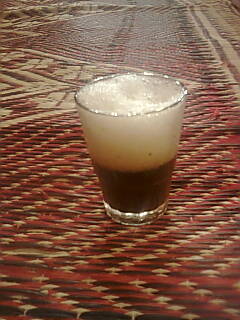
Libyan tea is a strong, syrup-like black tea served in small glass cups as part of a daily social ritual.[1] It is a variant of Maghrebi tea, differing in presentation and traditionally served in three courses.[2] The third serving of Libyan tea is accompanied by either almonds or peanuts that have been boiled and skinned.[2]
Quick Facts
- Type
- Beverage
- Origin
- Libya
- Variant of
- Maghrebi tea
- Serving style
- Three courses
- Key utensils
- Stainless steel teapot
- kettle
- trays
- glass cups
- sugar containers
- Distinctive feature
- Yellowish foam layer on top
Facts from the source article.
Key facts and history
Libyans have known tea since the nineteenth century, but it was initially limited to the Pasha, his family, and his guests.[3] Over time, Libyans developed their own presentation style called "Shahi al-Alla," which became essential for family gatherings.[3] The tea is prepared by boiling loose tea leaves, and initially the beverage is sugarless to allow foam formation.[2] The foam, called reghwa, is produced by pouring tea between two mugs twenty or thirty times.[1]
After meals, Libyans traditionally use green tea to aid digestion.[1] The Shahi al-Alla ceremony employs a stainless steel set comprising a teapot, a kettle, trays for serving, glass cups, plus receptacles for sugar and incense.[4][3] An incense burner was traditionally part of the set, underscoring the ceremony's function as a formal gesture of welcome.[4] A yellowish foam layer sits atop the tea in each glass when it is served.[2]
What the cited sources add
The same source explains that the foam is produced by continuously emptying tea between two mugs at least twenty or thirty times.[1] The Libya Observer notes that the "Alla" tea set was once a standard fixture in Libyan homes, regardless of family size.[3] That article also states that the large container in the set holds sugar, the middle holds tea, and the smallest holds incense.[3] The "Tea Drinking Culture in Libya" source suggests the foam may have originated as a practical adaptation to desert conditions, trapping sand or dust particles.[5]
Over time, this functional feature became an established and valued element of traditional preparation.[5] A food guide describes Libyan tea as "rather very strong, thick, syrup-like black tea".[1]
References
- "Libyan Food and the main dishes & meals in Libya". facts only, no text reused. temehu.com
- Wikipedia, "Libyan tea" (CC BY-SA 4.0), which cites: "Libyan Food and the main dishes & meals in Libya" (we also read that source) en.wikipedia.org
- "This is Libya’s traditional tea with foam The Libya Observer", libyaobserver.ly, 2017-07-02. facts only, no text reused. libyaobserver.ly
- Wikipedia, "Libyan tea" (CC BY-SA 4.0), which cites: "This is Libya’s traditional tea with foam The Libya Observer", libyaobserver.ly, 2017-07-02 (we also read that source) en.wikipedia.org
- Wikipedia, "Libyan tea" (CC BY-SA 4.0), which cites: "Tea Drinking Culture in Libya Black Tea Exports" (we also read that source) en.wikipedia.org
Each numbered sentence above was checked against the source it cites before publication. Sentences citing Wikipedia adapt text from the English Wikipedia article Libyan tea (contributors), used under CC BY-SA 4.0; this entry is available under the same licence. Other sources were used for facts only; no text or images are copied from them.
More in Libyan cuisine
Sources
Compiled from Wikipedia and the sources listed below. Text from Wikipedia is available under CC BY-SA 4.0; this entry is adapted from it.
- Wikipedia: Libyan tea (CC BY-SA 4.0).
Spotted an error? Know more?
Reader corrections go straight into our review queue. Suggest an edit · How this site is sourced