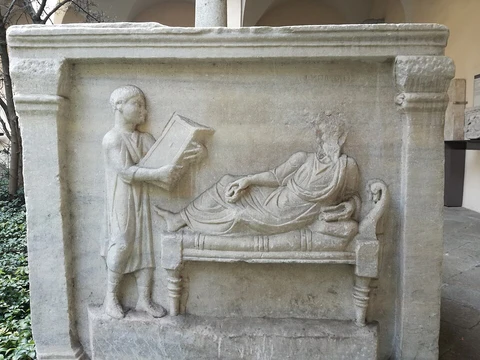
Papinian
Roman jurist whose views prevailed over four other great jurists.

Aemilius Papinianus, known in English as Papinian, lived from 142 to 212 CE and was a highly respected Roman jurist. He held several important positions: attorney general, master of petitions, and, after 205 CE, praetorian prefect. In ancient Rome, third-year law students were called "Papinianistae," meaning they were worthy of studying his work. He was also known as "the Asylum of Right and Treasurer of the Laws."
Little is known about his early life. He was Syrian, born in Emesa, and was likely a relative of Julia Domna, the wife of Emperor Septimius Severus. Some sources say he studied under the jurist Quintus Cervidius Scaevola, and one account claims he studied law alongside Severus himself. Papinian was a close friend of Severus and accompanied him to Britain in 207 CE, serving in York during a Scottish uprising. He later became attorney general and master of petitions under Severus, also serving as treasurer and captain of the guard. Before his death, Severus entrusted his two sons, Caracalla and Geta, to Papinian’s care.
After Severus died, Caracalla and Geta shared rule of the empire, but Caracalla soon decided to usurp his brother. Papinian tried to keep peace between them, which only angered Caracalla. Following the murder of Geta in 212 CE, Caracalla ordered Papinian beheaded, his body dragged through the streets of Rome. This was part of a larger purge that reportedly killed 20,000 of Geta’s associates. The details of Papinian’s death vary and have been embellished over time; it later became the subject of a 1659 play by Andreas Gryphius.
Most of Papinian’s writings have been lost, and what survives is far less than the works of jurists like Ulpian or Paul. His major works include *Quaestiones* in 37 books, written before 198 CE; nineteen books of *Responsa*, written between 204 CE and his death; two books titled *Definitiones* and *De adulteriis*; and a short manual on city administration for street and bridge commissioners. Along with Gaius, Paulus, Modestinus, and Ulpian, he was one of the five jurists whose opinions were made decisive by the Law of Citations in 426 CE. Their views became the only ones suitable for the *Codex Theodosianus* and the *Corpus Juris Civilis*, with Papinian’s opinion prevailing when the other four disagreed. The 16th-century French jurist Jacques Cujas wrote that there was never such a great lawyer before Papinian, nor would there ever be after him.
- field
- Roman law
- nationality
- Roman (Syrian origin, native of Emesa)
- known_for
- One of the five jurists whose views were decisive under the Law of Citations; hi
Lore & Background
Little is known about Papinian. He was of Syrian origin and birth and a native of Emesa, for he is said to have been a kinsman of Septimius Severus's second wife, Julia Domna, who was a member of the Emesene dynasty. One source shows him as a follower of the casuistry of Quintus Cervidius Scaevola, another shows him to have been his pupil. A concurring (but dubious) passage in the Augustan History claims that he studied law with Severus under Scaevola. Papinian was an intimate friend of Emperor Severus and accompanied him to Britain during 207 CE, where he served in 'the forum of York' in response to an uprising by Scottish Highlanders. He was at some time made an attorney general (advocatus fisci), master of petitions (requests), magister libellorum, by Severus. He also served as Treasurer and Captain of the Guard for the Emperor. Before the emperor's death, he commended his two sons Caracalla and Geta into the lawyer's charge. Sharing in the governorship of the Roman Empire with Geta proved unsatisfactory for Caracalla, who decided at some time to usurp his brother. Papinian, trying to keep peace between the brothers, only proved to encourage the hatred of Caracalla, who ordered Papinian to be beheaded (Spartianus, Caracalla), and his body dragged through the streets of Rome. His death followed the 212 CE fratricide of Geta, amongst the general slaughter of his friends and those perceived associated with him, according to one source estimated as 20,000 persons. The author of the 1911 Encyclopædia Britannica article states that the details of Papinian's death 'are variously related, and have undergone legendary embellishment.' Papinian's death was the subject of a play by Andreas Gryphius (1659).
Reader's Guide
Along with Gaius, Paulus, Modestinus and Ulpian, Papinian was made one of the five jurists whose recorded views were considered decisive by the Law of Citations of 426 CE; their views would later be considered the only suitable ones to be cited as primary sources for the Codex Theodosianus and the Corpus Juris Civilis, provided that Papinian's views prevailed whenever those of the four other jurists were not congruent. The 16th century French jurist Jacques Cujas wrote that 'there was never such a great lawyer before, nor ever will be after him.' His principal works include Quaestiones in 37 books (written before 198 CE); nineteen books of Responsa (written sometime between 204 CE and his death); two books, the Definitiones and De adulteriis, and other works, the shortest of these being Αστυνόμικος (City-Administration) which was a manual on the duties for commissioners of streets and bridges. Much of his output has been lost, as what we have is small compared to other jurists such as Ulpian or Paul.
Did You Know?
- Third year law students were given the title 'Papinianistae', meaning 'they that are worthy to study Papinian'.
- Papinian was an intimate friend of Emperor Severus and accompanied him to Britain during 207 CE, serving in 'the forum of York'.
- Before his death, Emperor Severus commended his two sons Caracalla and Geta into Papinian's charge.
- Caracalla ordered Papinian to be beheaded and his body dragged through the streets of Rome after Papinian tried to keep peace between the brothers.
- The 16th century French jurist Jacques Cujas wrote that 'there was never such a great lawyer before, nor ever will be after him.'
Frequently Asked Questions
What does the title 'Papinianistae' mean in Roman law schools?
Third-year law students were granted the honorific 'Papinianistae,' a label signifying they were finally deemed worthy of studying Papinian's writings. The fact that reaching his material in the curriculum was itself a milestone shows just how highly his legal reasoning was regarded.
More in Legal Scholars And Jurists 1-23
Spotted an error? Know more?
This is a living reference — every entry is fact-audited, and reader corrections feed straight into our audit queue. Suggest an edit · See this site's audit record