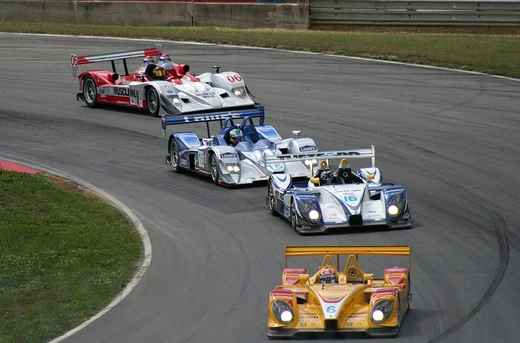
Dallara GC21
Dallara's F3-derived prototype raced in Japan from 2002 to 2007.
The Dallara GC21 was a Le Mans Prototype created by Dallara for the Fuji Grand Champion Series, using one of its own Formula Three cars as a starting point. It saw action from 2002 through 2007, and during its final two years it ran in the LMP2 class of the Japan Le Mans Challenge. In 2006, a GC21 fielded by MYZ claimed the LMP2 category win in that series. When the Fuji Grand Champion Series was revived in 2002 under the GC21 name, Dallara was asked to build a suitable car. The company took one of its F3 machines and turned it into the GC21, keeping the distinctive air intake of a Formula Three car but swapping the usual naturally aspirated engine for a 2-litre turbocharged Toyota 3S-GTE straight-four. The car made its debut in July 2002 at Fuji Speedway, one of four races that year all held at that circuit. Jerome Dalla Lana, driving for Inging, became the first winner, with all five entries finishing the twelve-lap event. By the November finale, the field had grown to eight cars, and Ronnie Quintarelli, also with Inging, took the win. Only one GC21 retired in 2002: Naozumi Itou dropped out after three laps in the third race. In 2003, the series expanded to five rounds, all still at Fuji Speedway. Shinsuke Yamazaki, driving for Aim Sports, won the March opener with six cars entered. Each subsequent race had seven entries. The season’s final event saw the first mechanical retirement: privateer Kazuhiko Yatsu suffered a gearbox failure after five laps, while Yamazaki won again. Yamazaki claimed three victories and two second places that year, securing the championship. Fuji Speedway closed in 2004 for a Hermann Tilke redesign, forcing the series to relocate. Four races were held at Twin Ring Motegi’s road course and one at Sportsland Sugo. Hiroki Saga, driving for MYG, won four races on his way to the title; the other race was won by Nova Engineering’s Katsuaki Kubota. Entry numbers dropped, with no more than five drivers competing in any event. Fuji Speedway reopened in 2005, and the GC21 series returned there for all five rounds. Team I Line’s Hiroaki Ishiura dominated, winning every race. The Japan Le Mans Challenge launched in 2006, and the GC21 competed there in LMP2 while the GC21 series ran its final season. In the GC21 series, Yasuo Miyagawa won two races for RS Serizawa, and Atsushi Katsumata won three for MYG.
Quick Facts
- Constructor
- Dallara
- Engine name
- Toyota 3S-GTE
- Capacity
- 1,998 cc / 2.0 L
- Configuration
- I4
- Turbo/na
- turbocharged
- Engine position
- mid-mounted
- Gears
- 6-speed
- Debut
- 2002 Fuji Grand Champion Series, Race 1
Facts from the source article.
Lore & Background
In 2002, the Fuji Grand Champion Series was revived under the GC21 name. Dallara converted one of their Formula Three cars into the Le Mans Prototype-style GC21, retaining the distinctive air intake of an F3 car but fitting a 2-litre, turbocharged Toyota 3S-GTE straight-four engine. The car's first race came in July 2002 at Fuji Speedway, with Jerome Dalla Lana winning the inaugural event. By the final race of the season, the grid had expanded to eight cars. For 2004, the closure of Fuji Speedway for a Hermann Tilke redesign forced the series to move to Twin Ring Motegi and Sportsland Sugo. Fuji reopened in 2005, and the GC21 series returned there for all five races. In 2006, the Japan Le Mans Challenge began, and the GC21 competed in the LMP2 category alongside the final GC21 series season. MYZ entered two GC21s in the JLMC, while Aim Sports entered one; the Aim Sports car won the LMP2 class at the Sugo 1000 km, and the #4 MYZ car won the class at Motegi and Okayama, securing the LMP2 Team's and Driver's Championships.
2007 saw the JLMC expand to four races while the GC21 series was discontinued. Aim Sports entered a GC21 in all four rounds, winning the LMP2 class at Sugo and Fuji, and taking an overall victory at the Okayama 1000 km—the car's and the series' last race, as the JLMC was cancelled shortly after.
Reader's Guide
The Dallara GC21 represents a unique crossover between Formula Three and endurance prototype racing, adapted from an open-wheel single-seater into a closed-cockpit Le Mans Prototype. Its use of a turbocharged Toyota 3S-GTE engine, rather than the naturally-aspirated units typical of F3, allowed it to compete effectively in the LMP2 class of the Japan Le Mans Challenge. The car's most significant achievement came in 2006, when the MYZ-entered #4 GC21 won the LMP2 category at both the Motegi and Okayama 1000 km races, securing the LMP2 Team's Championship for MYZ and the Driver's Championship for Yuuya Sakamoto, Yoshihisa Namekata and Tomonobu Fujii. In 2007, Aim Sports' GC21 became the only car to beat an LMP1 entry overall in the JLMC, winning the Okayama 1000 km outright. The GC21's legacy is tied to the brief existence of the Japan Le Mans Challenge, which ended after the 2007 season, making the car a notable footnote in Japanese endurance racing history.
From Formula Three to Le Mans Prototype
In 2002, the long-dormant Fuji Grand Champion Series was resurrected under the new GC21 banner, and Dallara was commissioned to supply the purpose-built machinery. Rather than designing a prototype from scratch, the manufacturer took one of its existing Formula Three chassis and reworked it into a Le Mans Prototype–style machine. The result retained the distinctive air intake characteristic of F3 cars, but the powertrain was swapped for a 2-litre turbocharged Toyota 3S-GTE straight-four, a far more exotic unit than the naturally aspirated engines typical of F3. The car made its debut in July 2002 at Fuji Speedway, where all five entries completed the twelve-lap distance and Jerome Dalla Lana, racing for Inging, claimed the first GC21 victory. By the November finale, the grid had grown to eight cars, and Ronnie Quintarelli, also an Inging driver, took the chequered flag. Reliability was remarkable: across the entire four-race inaugural season, only one GC21 retired, when Naozumi Itou dropped out after just three laps of race three.
A Challenging Middle Period
The GC21's competitive life was shaped as much by circumstance as by engineering. In 2003 the series grew to five rounds, all staged at Fuji, and Shinsuke Yamazaki, driving for Aim Sports, emerged as the standout, collecting three wins and two second-place finishes to claim the championship. The season also produced the car's first mechanically attributed retirement, when privateer Kazuhiko Yatsu suffered a gearbox failure after five laps. The following year brought an unexpected disruption: Fuji Speedway closed for a Hermann Tilke redesign, forcing the series to relocate to the road course at Twin Ring Motegi for four races and to Sportsland Sugo for one. Entry numbers shrank to no more than five drivers per event, but Hiroki Saga, racing for MYG, still dominated with four victories, while Katsuaki Kubota of Nova Engineering took the remaining race. When Fuji reopened in 2005, the GC21 returned home for all five races, and Team I Line's Hiroaki Ishiura delivered a perfect season, winning every single event without a single loss.
The 2006 JLMC Breakthrough
2006 marked a pivotal shift as the Japan Le Mans Challenge launched for the first time, and the GC21 stepped into its LMP2 category alongside its final season in the GC21 series. In the domestic championship, Yasuo Miyagawa of RS Serizawa and Atsushi Katsumata of MYG split the victories. The real drama unfolded in the JLMC, where MYZ fielded two GC21s and Aim Sports one. At the Sugo 1000 km opener, both MYZ cars failed to finish while Aim Sports' trio of Shinsuke Yamazaki, Yuuji Asou, and Masaru Tomizawa took the class win and second overall. At Motegi the script flipped: Aim Sports suffered an engine failure, and MYZ's #4 car, driven by Yuuya Sakamoto, Yoshihisa Namekata, and Tomonobu Fujii, claimed the class victory and second overall. At the Okayama finale, that same #4 car won LMP2 again while the other two GC21s retired. MYZ swept the LMP2 Team's Championship, and Sakamoto, Namekata, and Fujii were crowned LMP2 Drivers' Champions.
Farewell at Okayama
The GC21's final chapter came in 2007, as the JLMC expanded to four races and the car was officially retired from the GC21 series. Aim Sports carried the banner through most of the season, winning the LMP2 class at both Sugo and Fuji while finishing second overall at each. At Motegi, three GC21s appeared on the grid, but for the first time the class was taken by a different machine, the Max Racing RS KK-LM, with Aim Sports settling for fifth overall and second in class. The season finale at Okayama belonged entirely to Aim Sports, who were the sole GC21 entry. In a fitting swansong, the team claimed a full overall victory, edging the Team Mugen Courage LC70 LMP1 by just over twenty-eight seconds. It was a triumphant last lap for a car that had spent five years racing exclusively in Japan. The JLMC itself was cancelled shortly after that race, bringing an abrupt end to both the series and the GC21 era.
More in Le Mans Prototypes
Spotted an error? Know more?
Reader corrections go straight into our review queue. Suggest an edit · How this site is sourced