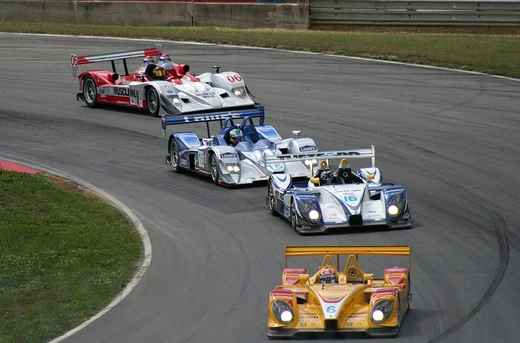
Audi R8R
Open-cockpit prototype that laid groundwork for the dominant Audi R8.
The Audi R8R was an open-cockpit Le Mans Prototype developed by Audi for the 1999 24 Hours of Le Mans, serving as a direct forerunner to the highly successful Audi R8 that arrived in 2000. It competed alongside the British-built, closed-cockpit Audi R8C. A total of five R8Rs were constructed.
Development began in 1997 when Audi started exploring an entry into the 24 Hours of Le Mans. The first prototype, shown in 1998, featured an open cockpit with clear Audi styling cues but lacked some practical elements needed for sports car racing. Designed by Michael Pfadenhauer and Wolfgang Appel and built by Dallara, the car used a 3.6-liter twin-turbo V8 engine. Its styling included a large cluster of aerodynamic vents in the nose, high sidepods with NACA ducts on top to feed the turbochargers, and a large side vent to release air from the front wheel well.
By its debut at the 1999 12 Hours of Sebring, the aerodynamics had evolved. The tail was longer, the wheel arches blended more smoothly into the sidepods instead of having a sharp edge, and the front end sat lower with more refined aerodynamic styling. After Sebring, further testing aimed to improve overall speed for Le Mans. The front bodywork was revised again, with wider, more curved sidepods. The NACA ducts were replaced by a vertical air intake emerging from the side fender. The tail was shortened, and aerodynamic elements were added to the sidepod design.
Only five R8Rs were ever built. Chassis #204 and #205 ran only at Sebring in 1999, while #307 and #308 competed at Le Mans. Chassis #306 was added in 2000 for the American Le Mans Series. Lessons from the R8R were later incorporated into the R8 for 2000.
The R8R made its racing debut at the 12 Hours of Sebring in 1999, run by Joest Racing. Qualifying was difficult, with the cars setting only the 11th and 12th fastest times. During the race, however, they proved durable, outlasting many faster competitors. Despite issues for the new BMW V12 LMR, one BMW entry was clearly superior in pace and reliability. After twelve hours, the R8Rs took a podium with a third-place finish, while the other car finished fifth.
After Sebring, the R8Rs returned to testing alongside the new R8Cs. At Le Mans testing in May, the R8Rs faced the major manufacturers for the first time, recording the 8th and 11th fastest laps and outpacing entries from Mercedes-Benz and Nissan.
Quick Facts
- Category
- Le Mans Prototype
- Constructor
- Audi (Dallara)
- Designer
- Michael Pfadenhauer; Wolfgang Appel
- Successor
- Audi R8
- Team
- GER Joest Racing
- Debut
- 1999 12 Hours of Sebring
- Races
- 4
- Capacity
- 3.6 L / 3,600 cc
Facts from the source article.
Lore & Background
The R8R project began in 1997, when Audi began research into entering the 24 Hours of Le Mans. The first prototype was displayed in 1998, showing an open cockpit car which featured many Audi styling cues, yet lacked some of the practical necessities for sports car racing. The car, designed by Michael Pfadenhauer and Wolfgang Appel and built by Dallara, featured an Audi 3.6-litre twin-turbo V8 engine. Styling features included a large group of aerodynamic vents in the nose, as well as high sidepods which featured NACA ducts on their tops to feed the turbochargers. A large vent on the side also allowed air out from the front wheel well.
By the car's debut at the 1999 12 Hours of Sebring, the aerodynamics were evolved. A longer tail was prominent, with the wheel arches more subtly curved into the side pods, instead of an abrupt hard-edge design. The front end was also lower and featured more aerodynamic styling over the original stylized prototype. Following Sebring, further testing was done on the R8R to improve its overall speed in preparation for Le Mans. The front bodywork was further evolved, with a wider and more curved sidepod being used. The NACA ducts were also replaced with a vertical air inlet coming out of the side fender. The tail was also shortened, and aerodynamic elements were added to the styling of the sidepods.
Only five R8Rs would be built in total. #204 and #205 would run Sebring only in 1999, while #307 and #308 would run Le Mans. #306 would be added in 2000 to compete in the American Le Mans Series. Lessons learned from the R8R would be later evolved into the R8 for 2000.
Reader's Guide
The Audi R8R's significance lies in its role as the direct predecessor to the dominant Audi R8, which debuted in 2000. Although the R8R shared nothing mechanical or stylistic with the R8 except for the engine, the lessons learned from the R8R were evolved into the later car. The R8R demonstrated remarkable reliability in its debut season, taking podium finishes at both the 12 Hours of Sebring (3rd) and the 24 Hours of Le Mans (3rd and 4th). At Le Mans, the R8Rs outlasted competitors from Mercedes-Benz, Toyota, Panoz, Nissan, and BMW, beaten only by a single BMW and one of the Toyota GT-Ones. Following the 1999 Le Mans, Audi chose to continue development of the R8R over the closed-cockpit R8C, which failed to finish at Le Mans and showed a lack of pace. The R8R continued into 2000 in the American Le Mans Series, taking further podiums at Silverstone before being retired permanently as the new R8s took over. Its estimated 610 hp and top speed of 335 km/h at Le Mans (with original claims of 350 km/h) marked it as a competitive prototype that helped establish Audi's endurance racing pedigree.
Did You Know?
- At the 1999 24 Hours of Le Mans, the R8Rs finished 3rd and 4th, beaten by a single BMW and one Toyota GT-One.
- The R8R's engine was a 3.6-litre twin-turbo V8 estimated to produce 610 hp.
Frequently Asked Questions
What is the Audi R8R?
The Audi R8R was an open-cockpit Le Mans Prototype that Audi entered at the 1999 24 Hours of Le Mans. It served as a direct development stepping stone toward the more refined Audi R8 that debuted the following year.
Who designed and built the R8R chassis?
The car's design was led by Michael Pfadenhauer and Wolfgang Appel, while Dallara handled chassis construction. Audi produced a total of five R8R units across its 1999–2000 development window.
More in Le Mans Prototypes
Spotted an error? Know more?
Reader corrections go straight into our review queue. Suggest an edit · How this site is sourced