Majungasaurinae
Last updated
Majungasaurinae is a subfamily of abelisaurid theropod dinosaurs proposed in 2014 by paleontologist Thierry Tortosa and colleagues.[1] Any abelisaurid that shares a more recent common ancestor with Majungasaurus than with Carnotaurus belongs to this clade.[1]
Scientific classification
- KingdomAnimalia
- PhylumChordata
- ClassReptilia
- CladeDinosauria
- CladeSaurischia
- CladeTheropoda
- Family†Abelisauridae
Named by Tortosa et al., 2014
Sources: Wikipedia taxobox: Majungasaurinae (CC BY-SA 4.0)
Quick Facts
- Type species
- Majungasaurus crenatissimus
Facts from the source article.
Biology and range
Teeth marks of Majungasaurus have been found on the ribs of other Majungasaurus, indicating cannibalism.[2] Their broad jaws generated great force when biting, enough to break a prey animal's trachea or vertebrae.[2] Evidence shows Majungasaurus fed on medium-sized sauropods including Rapetosaurus.[2] No other majungasaurine has been documented engaging in cannibalism.[3]
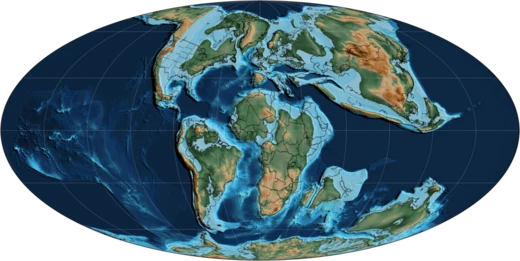
Abelisaur fossils found in southern France suggest the group may also have reached Europe.[4]
What the specialist sources record
Carnotaurus possesses eleven dorsal vertebrae whereas Majungasaurus has thirteen; Carnotaurus also has short dentary bones with a nearly vertical ramus, while Majungasaurus has a backward-curving dentary with prominent caudal projections.[5] Low, wide antorbital fenestrae, a broad triangular plate behind the parietal, two cerebral vein openings near the sagittal crest, and a wide groove on the occipital condyle are features of majungasaurines.[6]
References
- Wikipedia, "Majungasaurinae" (CC BY-SA 4.0), which cites: Tortosa, "A new abelisaurid dinosaur from the Late Cretaceous of southern France: Palaeobiogeographical implications", Annales de Paléontologie, October 2014, p. 63–86 (original not read by us) en.wikipedia.org
- Wikipedia, "Majungasaurinae" (CC BY-SA 4.0), which cites: Fastovsky, David; Weishampel, David; Sibbick, John (2009). Dinosaurs: a concise natural history. Cambridge: Cambridge University Press. p. 196. . (original not read by us) en.wikipedia.org
- Wikipedia, "Majungasaurinae" (CC BY-SA 4.0), which cites: Rogers, "Cannibalism in the Madagascan dinosaur Majungatholus atopus", Nature, 2003, p. 515–8 (original not read by us) en.wikipedia.org
- Wikipedia, "Majungasaurinae" (CC BY-SA 4.0), which cites: Sereno, "New dinosaurs link southern landmasses in the Mid-Cretaceous", Proceedings of the Royal Society B: Biological Sciences, 2004, p. 1325–30; Holtz, Thomas R. Jr. (2007). Dinosaurs: The Most Complete, Up-to-Date Encyclopedia for Dinosaur Lovers of All Ages. New York: Random House. . (original not read by us) en.wikipedia.org
- Wikipedia, "Majungasaurinae" (CC BY-SA 4.0), which cites: Novas, Fernando E., "The Age of Dinosaurs in South America", Indiana University Press, 2009, p. 259– (we also read that source) en.wikipedia.org
- Wikipedia, "Majungasaurinae" (CC BY-SA 4.0), which cites: Tortosa, "A new abelisaurid dinosaur from the Late Cretaceous of southern France: Palaeobiogeographical implications", Annales de Paléontologie, 2014, p. 63–86 (original not read by us) en.wikipedia.org
Each numbered sentence above was checked against the source it cites before publication. Sentences citing Wikipedia adapt text from the English Wikipedia article Majungasaurinae (contributors), used under CC BY-SA 4.0; this entry is available under the same licence. Other sources were used for facts only.
More in Late Cretaceous dinosaurs
Sources
Compiled from Wikipedia and the sources listed below. Text from Wikipedia is available under CC BY-SA 4.0; this entry is adapted from it.
- Wikipedia: Majungasaurinae (CC BY-SA 4.0).
- Word definitions: the Codexery glossary, each quoted from its Wikipedia article.
Spotted an error? Know more?
Reader corrections go straight into our review queue. Suggest an edit · How this site is sourced