Dies irae
Medieval Latin sequence on the Last Judgment, used in the Requiem Mass.
Last updated
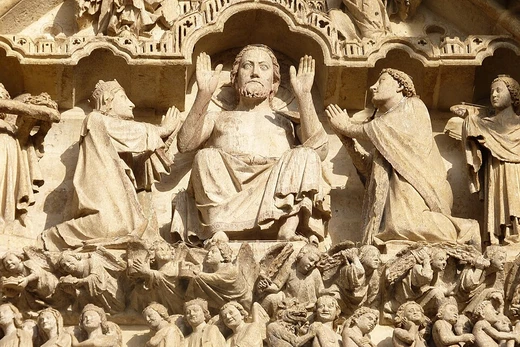
"Dies irae" ("the Day of Wrath") is a medieval Latin poem describing the Last Judgment, known for its accentual stress, rhymed lines, and trochaic metre. It is attributed to Thomas of Celano or Latino Malabranca Orsini, though some sources ascribe it to St. Gregory the Great, Bernard of Clairvaux, or Bonaventure. The sequence is best known from its use in the Roman Rite Catholic Requiem Mass and for its Gregorian chant melody, one of the most quoted in musical literature.
Quick Facts
- Attribution
- Thomas of Celano (1200–1265) or Latino Malabranca Orsini (d. 1294)
- Earliest manuscript date
- 13th century (between 1253–1255)
- Metre
- Trochaic
- Original melody mode
- Dorian
Facts from the source article.
Use in the Roman liturgy
For centuries the "Dies irae" served as the sequence for the Requiem Mass in the Roman Rite, as reflected in musical settings by Mozart and Verdi. It appears in the 1962 Roman Missal, the last edition before the Second Vatican Council revisions, and is still heard in Tridentine Latin liturgy celebrations. It also formed part of the pre-conciliar liturgy of All Souls' Day. The Second Vatican Council's Consilium for the Implementation of the Constitution on the Liturgy eliminated the sequence from funerals and other Masses for the Dead in 1969–70.
Archbishop Annibale Bugnini explained that the Consilium removed it because the sequence was not part of the ancient Roman tradition. Slightly edited, it remains ad libitum as a hymn in the Liturgy of the Hours on All Souls' Day and during the last week before Advent, divided into three parts with a doxology after each. A former indulgence of three years per recitation and a plenary indulgence for daily recitation for a month was not renewed in the Manual of Indulgences.
Text
The Latin text from the 1962 Roman Missal has been translated into English by William Josiah Irons in 1849, replicating the rhyme and metre; this version, edited for conformance to the official Latin, is approved for use in the Catholic ordinariates for former Anglicans. A more formal equivalence translation also exists. The last two stanzas differ markedly in structure: the penultimate stanza, "Lacrimosa", uses rhyming couplets instead of triplets, and the final stanza, "Pie Iesu", abandons rhyme for assonance and has catalectic lines.
In the 1969–1971 reforms, stanza 19 was deleted and the poem divided into three sections (stanzas 1–6, 7–12, 13–18) for the Office of Readings, Lauds, and Vespers, with a doxology after each. In stanza 13, "Qui Mariam absolvisti" was replaced by "Peccatricem qui solvisti" because modern scholarship denies the medieval identification of the woman taken in adultery with Mary Magdalene. The text appears in a 13th-century Franciscan calendar missal at the Biblioteca Nazionale Vittorio Emanuele III in Naples, dating between 1253–1255.
Major inspiration came from the Vulgate translation of Sophonias (Zephaniah) 1:15–16 and images from the Book of Revelation, and the Jewish prayer Unetanneh Tokef appears related.
Music
The words of "Dies irae" have been set to music as part of the Requiem service; in some settings it is broken into several movements, with "Dies irae" referring only to the first. The earliest surviving polyphonic Requiem, by Johannes Ockeghem, does not include it; the first polyphonic settings to include it are by Engarandus Juvenis (1490) and Antoine Brumel (1516). Many later composers produced notable choral and orchestral settings, including Charpentier, Delalande, Mozart, Berlioz, Verdi, Britten, and Stravinsky.
Giovanni Battista Martini ended his set of 303 canons with 20 on extracts of the poem. The original Gregorian setting, dating to the 13th century, is a sombre plainchant in the Dorian mode. Its melody gained widespread recognition through Berlioz's Symphonie fantastique and became associated with death and terror, especially in the 19th century. It has been used as a theme or quotation in many classical compositions, including works by Alkan, Brahms, Chopin, Crumb, Daugherty, Ginastera, and Glazunov, among others.
More in Last Judgment
Sources
Compiled from Wikipedia and the sources listed below. Text from Wikipedia is available under CC BY-SA 4.0; this entry is adapted from it.
- Wikipedia: Dies irae (CC BY-SA 4.0).
Spotted an error? Know more?
Reader corrections go straight into our review queue. Suggest an edit · How this site is sourced