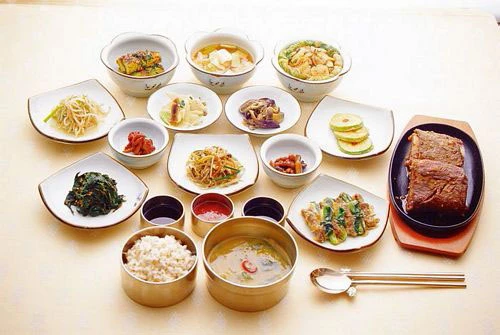
Haejang-guk
Korean soup traditionally eaten to relieve hangovers.
Haejang-guk, also called hangover soup or sulguk, is a category of Korean soup consumed as a remedy for hangovers. It typically features dried napa cabbage, vegetables, and meat in a hearty beef broth, with variations such as seonjiguk (using sliced congealed ox blood) and sundaeguk (with blood sausage).
Quick Facts
- Country
- Korea
- Course
- Hangover food
- Main ingredients
- Napa cabbage
- beef broth
- offal
- Serving size
- 100 g
Facts from the source article.
History
The term seongjutang, meaning 'soup to get sober,' appears in the Nogeoldae, a manual for learning spoken Chinese published in the late Goryeo dynasty. This soup, made with thinly sliced meat, noodles, scallions, and cheoncho powder in broth, is assumed to be the origin of haejangguk and matches the basic recipe of the present-day dish. Although haejangguk is not mentioned in Joseon-era cookbooks, genre paintings and documents from the late Joseon period depict it.
Shin Yun-bok's painting Jumakdo shows a group of unemployed children of the rich eating haejangguk while a jumo ladles boiling soup from a cauldron. According to the poetry collection Haedong jukji by Choe Yeong-nyeon, haejangguk was also called hyojonggaeng, or 'dawn bell soup.' The area within Namhansanseong was known for making this soup, which used inner parts of napa cabbage, kongnamul, mushrooms, galbi, sea cucumber, and abalone, mixed with tojang and simmered for a day.
The cooked soup was put into a hangari, covered with a cotton pad, and sent to Seoul at night, arriving warm when the dawn bell rang. This suggests hyojonggaeng was either a delivery food for hangover relief after a jaesang's banquet or used as a bribe. The restaurant Cheongjinok, one of Seoul's oldest active restaurants, specializes in haejangguk.
Types
Regional varieties of haejangguk differ in ingredients and recipe. In the Seoul region, it is a tojangguk made with kongnamul, radish, napa cabbage, scallions, coagulated ox blood, and tojang in a broth prepared by simmering ox bones. The neighborhood of Cheongjin-dong is famous for this style. In Jeonju, people eat kongnamul gukbap as haejangguk: lean kongnamul is poached in salted water, then steamed rice, sliced ripe kimchi, scallions, garlic, beef broth, and a small amount of shank are placed in a ttukbaegi, and the kongnamul broth is poured over.
When boiled, a raw egg is cracked on top. Diners add sesame seeds and salt, scallions, minced garlic, chili pepper, chili pepper powder, and saeujeot to taste. Drinking a cup of moju made from boiled makgeolli, sugar, and wheat flour is said to alleviate a hangover. On the east coast, in Yangyang and Sokcho, locals developed seopguk, a mussel soup (seop meaning 'mussels' in the Gangwon dialect).
It is in season from late winter to early spring and is prepared by boiling mussels with chives, mushrooms, eggs, and seasoned with doenjang and gochujang. In Uljin County on the Sea of Japan coast, a cold soup called ojingeo mulhoe guksu is eaten as haejangguk, made with finely sliced squid-like noodles mixed with sauce and cold water with ice cubes. Other types include ugeojiguk (with ugeoji), seonjiguk (with seonji), jaecheopguk (with jaecheop and buchu), and gulgukbap (with oyster and buchu).
More in Korean Soups and Stews
Spotted an error? Know more?
Reader corrections go straight into our review queue. Suggest an edit · How this site is sourced