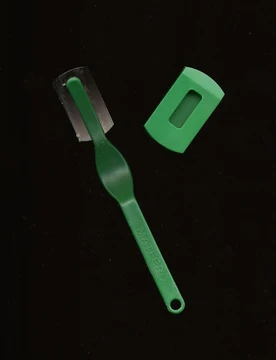
Sieve
Last updated
A sieve uses a screen such as woven mesh or perforated sheet material to separate wanted from unwanted material or control particle size distribution.[1] Particles of differing sizes can be separated using the straightforward method of sieving.[2] Through friction against both the screen openings and each other, larger particles are either separated or broken down.[2]
How it changed
Vibrating sifter machines are used to separate a desired product from contaminants like wood, metal, or plastics.[3] Vibration helps the good product go through the sieve and directs contaminants toward rejection.[3] Vibrating sieves are equipped with a motor to vibrate the sieve, allowing higher throughput at smaller mesh size than static grids.[3] The design of vibrating sieves is not trivial, and poorly designed ones can actually release foreign bodies into the product.[3]
Rectangular vibrating sieves have similar capabilities to round ones and can sometimes be used as a feeder.[3] Sieve plates must be regularly inspected to check for damage.[3] The supporting structure must be stiff enough to not vibrate, or energy is lost moving the structure instead of the sieve plate.[3] A dosing equipment must be installed prior to the sieve to avoid overflow of the sieve deck.[3]
Sizing a vibrating sieve is based on effective screening area, aperture open area ratio, and empirical trial data.[3] When very small mesh sizes cause clogging, adding an ultrasonic system helps clear blockages and extends the sieve's operational duration.[3]
What the maker and period sources say
Welding should be avoided for hygienic applications, and perforated plates offer a hygienic and robust alternative.[3] The Folger Shakespeare Library states that George Gower’s 1579 portrait of Elizabeth I is the earliest of several paintings showing the queen holding a sieve.[4] According to the Folger account, Roman legend held that a virgin could carry water in a sieve, making it a symbol for the Virgin Queen.[4] The Folger account adds that the portrait was painted when Elizabeth was 46 and had been queen for 21 years.[4]
The PowderProcess.net account explains that vibrating sieves are used to prevent product contamination by foreign bodies.[3][2]
References
- Wikipedia, "Sieve" (CC BY-SA 4.0), which cites: Ruhlman, "The Elements of Cooking: Translating the Chef's Craft for Every Kitchen", Simon and Schuster, 2007, p. 216 (we also read that source) en.wikipedia.org
- Wikipedia, "Sieve" (CC BY-SA 4.0), which cites: "Powder Checking - Vibrating sieve - Vibrating sifters - PowderProcess.net", www.powderprocess.net (we also read that source) en.wikipedia.org
- "Powder Checking - Vibrating sieve - Vibrating sifters - PowderProcess.net", www.powderprocess.net. powderprocess.net
- Elizabeth I Sieve Portrait , Folger Shakespeare Library, Washington DC, USA. This is also known as the Plimpton portrait after its donor.. folger.edu
Each numbered sentence above was checked against the source it cites before publication. Sentences citing Wikipedia adapt text from the English Wikipedia article Sieve (contributors), used under CC BY-SA 4.0; this entry is available under the same licence. Other sources were used for facts only.
More in Kitchen Tools
Sources
Compiled from Wikipedia and the sources listed below. Text from Wikipedia is available under CC BY-SA 4.0; this entry is adapted from it.
- Wikipedia: Sieve (CC BY-SA 4.0).
Spotted an error? Know more?
Reader corrections go straight into our review queue. Suggest an edit · How this site is sourced