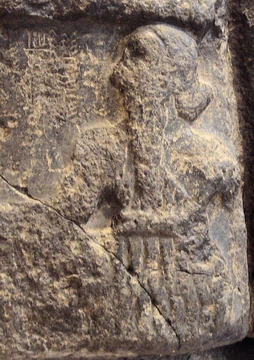
Antiochus I Soter
Last updated
Antiochus I Soter was a Greco-Sogdian Seleucid king who reigned from 281 to 261 BC.[1][2] He is the last known ruler to be attributed the ancient Mesopotamian title King of the Universe.[1]
Life and work
Antiochus was the son of Seleucus I Nicator and Apama, daughter of Spitamenes.[3][4] The Seleucids fictitiously claimed that Apama was the daughter of Darius III to legitimise their rule.[3][4] Stratonice bore five children to Antiochus, including his successor Antiochus II Theos.[5] The Ruin of Esagila Chronicle describes how Antiochus, as crown prince, fell on the rubble of the Esagila temple during a sacrifice.[6][7]
After his father's assassination in 281 BC, Antiochus faced a revolt in Syria and was compelled to make peace with Ptolemy Ceraunus.[8] Antiochus died around 262 BC after suffering defeat near Sardis against Pergamum.[9] Antiochus wed Stratonice, his father's wife and daughter of Demetrius Poliorcetes, in 294 BC.[5][10] According to Plutarch, Seleucus arranged the union after learning that Antiochus was wasting away from lovesickness.[5][10]
The Ezida Temple in Borsippa had its foundation laid by Antiochus I in 268 BC.[11][7]
What the cited sources add
The Livius account of the Ruin of Esagila Chronicle notes that the tablet likely dates to after 293 BCE, when Antiochus was appointed co-ruler with special authority east of the Euphrates.[7] The same chronicle records that Antiochus's repairs of Esagila and Ezida started on 27 March 268 BCE.[7] Plutarch's account details how the physician Erasistratus diagnosed Antiochus's lovesickness by observing his physical reactions when Stratonice entered the room.[10] The translation of Johannes Malalas states that Antiochus Soter reigned for 20 years and had two sons by Stratonice, Seleucus and Antiochus Theoeides.[12]
The Encyclopaedia Iranica entry notes that Apama bore Antiochus in 323 BC.[4]
References
- Wikipedia, "Antiochus I Soter" (CC BY-SA 4.0), which cites: Jones, "Ancient Babylonia", Cambridge University Press, 2012, p. 135; "Antiochus I Soter", Livius; Stevens, "The Antiochus Cylinder, Babylonian Scholarship and Seleucid Imperial Ideology", The Journal of Hellenic Studies, 2014, p. 73 (we also read that source) en.wikipedia.org
- "Antiochus I Soter", Livius. livius.org
- Wikipedia, "Antiochus I Soter" (CC BY-SA 4.0), which cites: "Antiochus I Soter Seleucid king", Encyclopedia Britannica; "Antiochus I Soter - Livius", www.livius.org; Magill, Frank N. et al. (1998), The Ancient World: Dictionary of World Biography, Volume 1, Pasadena, Chicago, London,: Fitzroy Dearborn Publishers, Salem Press; Holt, Frank L. (1989), Alexander the Great and Bactria: the Formation of a Greek Frontier in Central Asia, Leiden, New York, Copenhagen, Cologne: E. J. Brill, p; Arrian, Anabasis 7.4.6; ; Shahbazi, "Apama", Encyclopaedia Iranica (we also read that source) en.wikipedia.org
- Shahbazi, "Apama", Encyclopaedia Iranica. iranicaonline.org
- Wikipedia, "Antiochus I Soter" (CC BY-SA 4.0), which cites: Plutarch, Demetrius, 38 gives the most famous account of this tale. See also Appian, Syr. IX.59 (we also read that source) en.wikipedia.org
- Wikipedia, "Antiochus I Soter" (CC BY-SA 4.0), which cites: "BCHP 6 (Ruin of Esagila Chronicle)", Livius (we also read that source) en.wikipedia.org
- "BCHP 6 (Ruin of Esagila Chronicle)", Livius. livius.org
- Wikipedia, "Antiochus I Soter" (CC BY-SA 4.0) en.wikipedia.org
- Wikipedia, "Antiochus I Soter" (CC BY-SA 4.0), which cites: ; Smith, "Johannes Malalas - translation", www.attalus.org (we also read that source) en.wikipedia.org
- Plutarch, Demetrius, 38 gives the most famous account of this tale. See also Appian, Syr. IX.59. penelope.uchicago.edu
- Wikipedia, "Antiochus I Soter" (CC BY-SA 4.0), which cites: Oelsner, "Hellenization of the Babylonian Culture?", The Melammu Project, 2000 (original not read by us) en.wikipedia.org
- Smith, "Johannes Malalas - translation", www.attalus.org. attalus.org
Each numbered sentence above was checked against the source it cites before publication. Sentences citing Wikipedia adapt text from the English Wikipedia article Antiochus I Soter (contributors), used under CC BY-SA 4.0; this entry is available under the same licence. Other sources were used for facts only.
More in Kings of the Universe
Sources
Compiled from Wikipedia and the sources listed below. Text from Wikipedia is available under CC BY-SA 4.0; this entry is adapted from it.
- Wikipedia: Antiochus I Soter (CC BY-SA 4.0).
Spotted an error? Know more?
Reader corrections go straight into our review queue. Suggest an edit · How this site is sourced