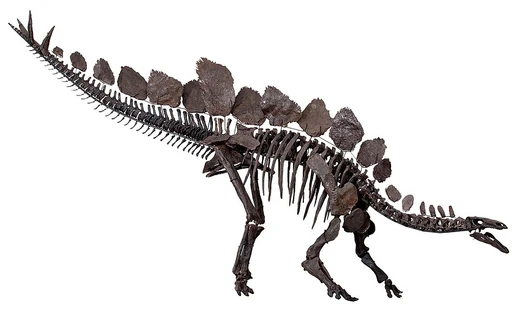
Haplocanthosaurus
A small sauropod from the Late Jurassic of North America.
Last updated
Haplocanthosaurus is a genus of diplodocoid sauropod dinosaur that lived during the Late Jurassic (Kimmeridgian stage) in North America. Two species, H. delfsi and H. priscus, are known from incomplete fossil skeletons. The type species is H. priscus, named in 1903 by John Bell Hatcher.
Scientific classification
- KingdomAnimalia
- PhylumChordata
- ClassReptilia
- CladeDinosauria
- CladeSaurischia
- Clade†Sauropodomorpha
- Clade
- Superfamily†Diplodocoidea
- Family†Haplocanthosauridae
- Genus†Haplocanthosaurus
Named by Hatcher, 1903 (conserved name)
Sources: Wikipedia taxobox: Haplocanthosaurus (CC BY-SA 4.0)
Quick Facts
- Type species
- Haplocanthosaurus priscus
- Subdivision
- H. delfsi, McIntosh & Williams, 1988
Facts from the source article.
Discovery
Four known specimens of Haplocanthosaurus exist: one of H. delfsi and three of H. priscus. The type of H. delfsi is the only one complete enough to mount; it stands in the Cleveland Museum of Natural History with a speculative replica skull, as the actual skull was not recovered. Specimens occur in stratigraphic zones 1, 2, and 4. In 2014, specimens from a different region of the Morrison Formation were assigned to Haplocanthosaurus.
The study noted four certain specimens: CM 572 (H. priscus), CM 879 (H. utterbacki, now considered H. priscus), CMNH 10380 (H. delfsi), and MWC 8028 (H. sp.). Up to seven additional specimens may belong to Haplocanthosaurus or Haplocanthosauridae indet. One potential specimen, nicknamed "Big Monty" from Montana, is claimed to measure 110 ft long, but controversy surrounds it.
Description
Haplocanthosaurus was one of the smallest sauropods of the Morrison Formation, reaching a total length of 14.8 meters (49 feet) and an estimated weight of 12.8 MT. It is known mostly from vertebral elements. In the middle and cervical caudals, the intraprezygapophyseal lamina is separate from the root of the neural canal by a vertical midline lamina. In the last few caudals and most cranial dorsals, the lateral edge of the prezygapophyseal lamina becomes widened and roughened, interpreted as attachment for muscles suspending the scapular blade.
Dorsoventrally elongate oval outlines are characteristic, shared only with Camarasaurus. Parapophyses remain as oval facets on the craniolateral margin, and sacral spines 1-3 are fused, also seen in Camarasaurus. A low horizontal ridge on lateral surfaces creating a slightly subhexagonal cross-section occurs in Haplocanthosaurus, Cetiosauriscus, and Omeisaurus. Haplocanthosaurus is distinguished by dorsal vertebrae lacking cranial centrodiapophyseal laminae, elongate intrapostzygapophyseal laminae, dorsoventrally directed dorsal transverse processes approaching the height of neural spines, and the distal end of the scapular blade being dorsally and ventrally expanded.
Classification
Haplocanthosaurus priscus was originally named Haplocanthus priscus by John Bell Hatcher in 1903. Hatcher later believed the name Haplocanthus was preoccupied by the acanthodian fish Haplacanthus (named by Louis Agassiz in 1845) and reclassified the sauropod as Haplocanthosaurus later in 1903. The spelling difference meant Haplocanthus was technically valid, but Hatcher's mistake went unnoticed until after Haplocanthosaurus became established. In 1989 a petition to conserve Haplocanthosaurus was submitted to the ICZN, approved in 1991.
Originally described as a cetiosaurid, José Bonaparte in 1999 placed it in its own family, Haplocanthosauridae. Phylogenetic studies have not clarified its exact relationships; it has been found as a non-neosauropod eusauropod, a primitive macronarian, or a primitive diplodocoid.
In 2005, Darren Naish and Mike Taylor reviewed these positions. In 2011, an analysis by Whitlock recovered it as the basalmost diplodocoid. A 2015 specimen-level analysis confirmed it as a diplodocoid, either very basal or more derived than rebbachisaurids.
More in Kimmeridgian Dinosaurs
Sources
Compiled from Wikipedia and the sources listed below. Text from Wikipedia is available under CC BY-SA 4.0; this entry is adapted from it.
- Wikipedia: Haplocanthosaurus (CC BY-SA 4.0).
- Word definitions: the , each quoted from its Wikipedia article.
Spotted an error? Know more?
Reader corrections go straight into our review queue. Suggest an edit · How this site is sourced