Wadō-ryū
A major karate style blending jujitsu with Okinawan striking.
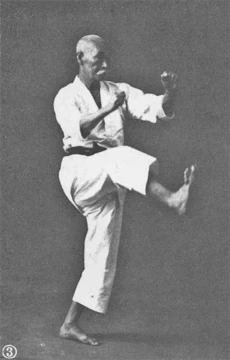
Wadō-ryū is one of the four major karate styles, founded by Hironori Ōtsuka (1892–1982). It blends Okinawan karate with Shindō Yōshin-ryū jujitsu, emphasizing tai sabaki, joint locks, and throws alongside striking. The style originated from Ōtsuka's training under Gichin Funakoshi, Kenwa Mabuni, and Motobu Chōki, as well as his background in Shindō Yōshin-ryū.
Quick Facts
- Also known as
- Shinshu Wadoryu Karate-Jujutsu
- Date founded
- 1929 or 1938
- Country
- Japan Japan
- Founder
- Hironori Ōtsuka
- Arts
- Karate
- Ancestor arts
- Karate (Shotokan, Shitō-ryū and Motobu-ryū), Jujutsu (Shindō Yōshin-ryū, other)
- Descendant arts
- Shaolin Nam Pai Chuan, Sanjuro
- Hybrid
- striking/grappling
Facts from the source article.
Characteristics
At first glance, Wadō-ryū can be mistaken for other karate styles, especially its parent art, Shotokan. But its core principles actually come from Shindō Yōshin-ryū, a jujutsu style that emphasizes striking vital points. In fact, some argue Wadō-ryū is more jujutsu than karate. Its founder, Hironori Ōtsuka, was deeply involved in jujitsu and once served as its chief instructor. When he officially registered his school with the Dai Nippon Butoku Kai in 1938, he called it "Shinshu Wadō-ryū Karate-Jūjutsu," a name that clearly shows its mixed heritage.
The katas in Wadō-ryū look different from those in Shotokan. They appear lighter and less forceful, with economical movements. Instead of blocking an attack head-on, defensive techniques redirect it. Like Shotokan, Wadō-ryū uses linear strikes, but it avoids Shotokan's aggressive style. The key principle here is tai sabaki, often mistakenly called "evasion." The term actually means "body-management," referring to how a practitioner moves both themselves and their attacker out of danger. The idea is to "move along" with an attack rather than "move against" it, relying on harmony instead of brute strength. This allows the defender to divert and evade the attack's energy, then counter with joint locks, throws, or strikes, often all at once.
The technique follows several rules. Sanmi Ittai means every technique includes a simultaneous change in position and a shift in body weight. Movements must avoid any incorrect or unnecessary technique, any extra motion, and any wasted force. The practitioner must control their own center of gravity. Tai sabaki involves leaving the line of attack by dodging. Defense and counter happen together, without hesitation. Kyusho means techniques target the attacker's vital points. Transitions between techniques should be smooth. Wadō-ryū also uses higher body positions and stances than many other karate styles.
Modern competition tends to pull Wadō-ryū away from its original roots, pushing it toward a generic karate that appeals more to spectators and competitors. A block in Wadō-ryū might look similar to one in Goju or Uechi ryu, but the underlying perspective and execution are different.
Ranks
In Wadō-ryū, rank is shown with the usual karate belt system. Beginners typically start at 9th or 10th kyū, depending on the specific school or organization, and work their way up to 1st kyū. After that come the dan grades, with 1st through 5th dan considered technical ranks. The 6th through 10th dan are honorary. Unlike some other karate styles, Wadō-ryū practitioners generally do not add stripes to their belts for dan ranks. The ability to teach usually begins at 3rd dan, though this can vary by organization; some groups also require a special course alongside reaching a certain dan level. In schools where the same belt color is used for multiple kyū ranks, stripes are often, but not always, used to show progress within that color.
History
Hironori Ōtsuka, who founded Wadō-ryū, came into the world on June 1, 1892, in Shimodate, Ibaraki Prefecture, Japan. At age six, in 1898, he started learning koryū jujutsu from Chojiro Ebashi. From 1905 until 1921, he trained in Shindō Yōshin-ryū jujutsu under Tatsusaburo Nakayama. A meeting with Gichin Funakoshi in 1922 led Ōtsuka to study under him, and by 1924 he was among the first students Funakoshi promoted to black belt in karate. To deepen his understanding, Ōtsuka also learned from other notable figures like Kenwa Mabuni of Shitō-ryū and Motobu Chōki. By 1927, he was serving as an assistant instructor at Funakoshi’s Shotokan school. Two years later, in 1929, he established the first school karate club at Tokyo University. The name “Wadō-ryū” was first used by Eiichi Eriguchi in 1934.
In 1938, Ōtsuka officially registered his karate style with the Dai Nippon Butoku Kai, calling it “Shinshu Wadoryu Karate-Jujutsu,” though it was soon shortened to “Wadō-ryū.” That same year, the Butoku Kai granted him the rank of Renshi-Go, and in 1942 he received Kyoshi-Go. Around this period, Tatsuo Suzuki, who later founded the WIKF, began his training in Wadō-ryū. In 1944, Ōtsuka was named Japan’s Chief Karate Instructor. Two years later, in 1946, he awarded Suzuki a 2nd dan. Around 1950, his second son, Jiro Ōtsuka, started training in the style as a teenager. In 1951, Suzuki received a 5th dan from Ōtsuka, which was the highest rank then given in Wadō-ryū. The style’s headquarters, or honbu, was set up at the Meiji University dojo in Tokyo in 1952, and in 1954 it was renamed the Zen Nippon Karate Renmei (All Japan Karate Federation). Ōtsuka published his book “Karatejutsu no Kenkyu” in 1955, laying out his approach. Finally, in 1963, he sent Suzuki, Toru Arakawa, and Hajimu Takashima abroad to spread Wadō-ryū worldwide.
Organisation
Wadō-ryū is spread between three independently-led organisations: Wadōkai, Wadō Kokusai and Wadō-ryū Karate-dō Renmei. Wadō-ryū has been spread to many countries in the world, by both Japanese and non-Japanese students of Hironori Otsuka. Japanese Wadō-ryū stylists Tatsuo Suzuki, Teruo Kono, Masafumi Shiomitsu, H. Takashima, Naoki Ishikawa, Yoshihiko Iwasaki, Kuniaki Sakagami and many others spread the art in Europe. Yoshiaki Ajari, Masaru Shintani and Isaac Henry Jr. spread the art in the United States and Canada, Joaquim Gonçalves (from Portugal) and many others have helped to spread the style in their respective countries. In 1968, Otsuka promoted Cecil T. Patterson of the United States to 5th dan, and charged him with the creation of the United States Eastern Wado-Kai Federation (USEWF). Following the split between Otsuka and the Wado-Kai in 1980, Patterson and the USEWF (renamed: United States Eastern Wadō-ryū Karate Federation) remained with Otsuka. Following Patterson's death in 2002, his son John T. Patterson assumed the presidency of the USEWF. Patterson's organisation continues as an active member of the Wadō Ryū Karatedō Renmei. In the UK, Wadō-ryū has been cited as a key influence in the development of the hybrid martial art Sanjuro.
More in Karate
Spotted an error? Know more?
Reader corrections go straight into our review queue. Suggest an edit · How this site is sourced